


Michigan’s 2026 spring practices are officially in the books after the playing of the annual spring game at the Big House on Saturday. Over the course of the last few weeks, we’ve gotten a better sense of who might be making the biggest contributions for the Wolverines this fall.
Here’s how we believe the offensive depth chart for Michigan might stack up based on what we’ve heard and were able to observe on Saturday.
* Asterisk denotes players that will be joining the team in the summer
Quarterback
Starter: Bryce
Underwood
Depth: Tommy Carr, Brayden Fowler-Nicolosi*, Chase Herbstreit, Brady Smigiel (injured)
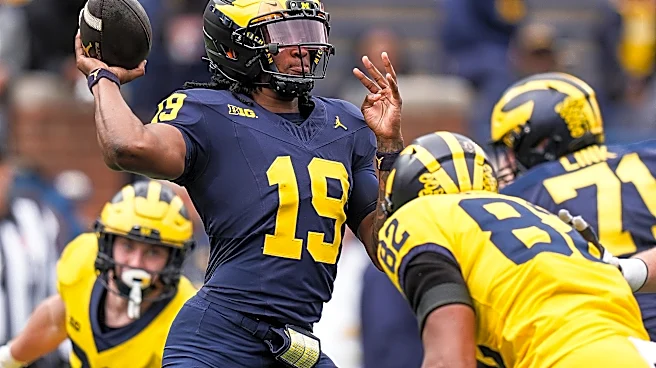
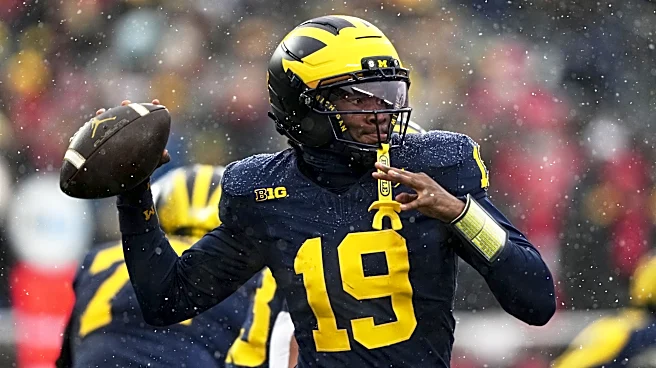
There’s no surprise here at the top. Kyle Whittingham even said as much after the spring game that Bryce Underwood is the starting quarterback.
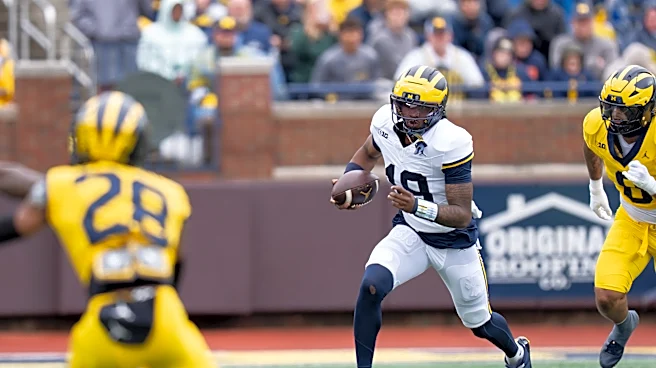
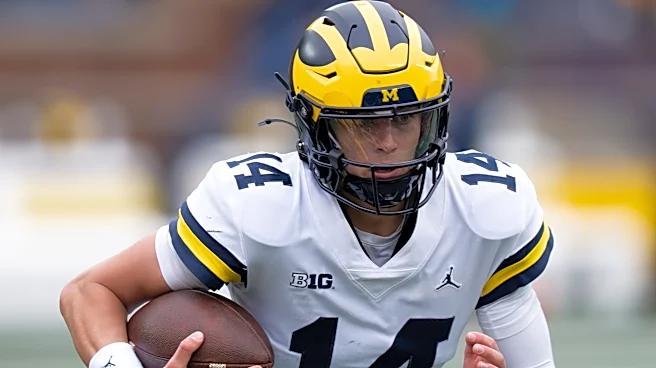
Behind him, though, is where things have gotten much more interesting. True freshman Tommy Carr was the story of the spring game and has been among the biggest performers across the roster this spring. He showed some mature awareness in the pocket on Saturday and even had some good speed and agility to pick up key yards. We shouldn’t jump to any conclusions about Carr’s future prospects yet, but his development will be something to monitor.
As for the rest of the depth chart, Brayden Fowler-Nicolosi will have some ground to make up after not being a part of the program this spring, but it wouldn’t be a surprise if his experience automatically puts him in the No. 2 spot. Redshirt freshman Chase Herbstreit and true freshman Brady Smigiel will round out the group.
Running back
Starter: Jordan Marshall
Depth: Savion Hiter, Bryson Kuzdzal, Jonathan Brown, Tomas O’Meara, Donovan Johnson, Micah Ka’apana (injured)
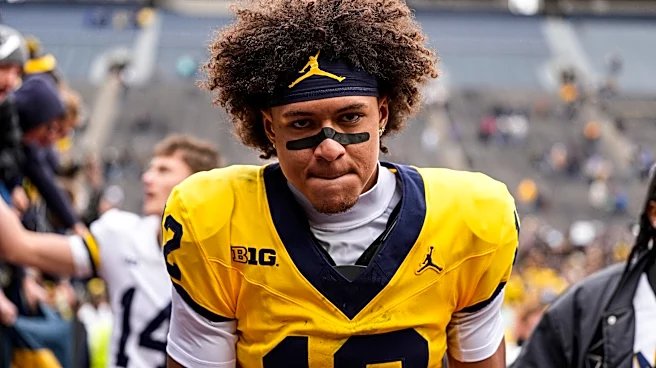
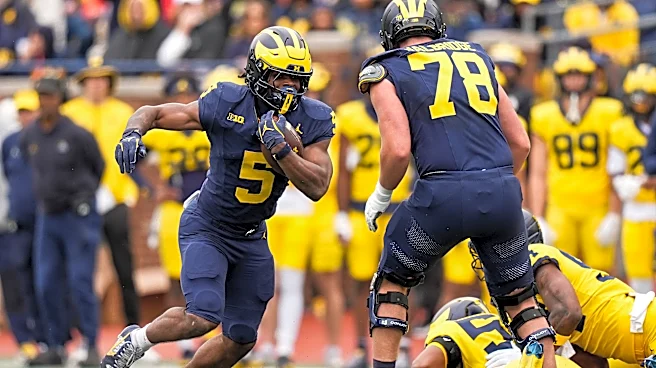
No surprises here either, as Jordan Marshall was Michigan’s leading rusher last season and will lead the room this year. Savion Hiter has been a hot topic and looked the part in the spring game. At 6-foot, 210 pounds, Hiter has a college-ready frame and shouldn’t have a problem adapting to the physicality at this level. He’s got some good burst and vision at the line, which should only raise his ceiling as a freshman.
Further down the depth chart, things get a bit more hectic. Bryson Kuzdzal will enter the year as RB3 after filling in for Marshall and Justice Haynes at the end of 2025. Micah Ka’apana likely would have been the fourth man on the depth chart, but an injury this spring will have him on the shelf for the year. True freshman Jonathan Brown, Tomas O’Meara and Donovan Johnson will be duking it out for spot carries throughout the year.
Wide Receiver
Starters: Andrew Marsh, J.J. Buchanan, Jaime Ffrench
Depth: Salesi Moa, Channing Goodwin, Jamar Browder, Kendrick Bell, Travis Johnson, Jacob Washington, Jaylen Pile
Following the spring game, Whittingham proclaimed Andrew Marsh and J.J. Buchanan are the top two receivers for right now, with the team needing to figure out the rest of the depth from there. Jaime Ffrench and Salesi Moa seem like good bets to be a part of that group, with neither one having a clear leg up over the other.
Beyond the top four, Channing Goodwin will look to bounce back after a rough finish to 2025. Jamar Browder will also look to take the next step forward in his development after seeing the field minimally as a freshman last year.
If there’s a wild card in the group, it might be freshman Travis Johnson. He might be a bit more of a project, but he was a highly-sought after recruit that could develop into a good deep threat in due time. He could stand to put just a little more weight on his 6-foot-2, 185-pound frame as well, but don’t be surprised if his name is one you start hearing more as the year goes on.
Tight End
Starter: Zack Marshall
Depth: Hogan Hansen, Deakon Tonielli, Jalen Hoffman, Eli Owens, Crandall Quinn
Zack Marshall unexpectedly got plenty of playing time last season, showing some receiving ability (16 receptions for 199 yards) to go along with his already-strong blocking. That was in large part thanks to Hogan Hansen missing time with injuries. As of right now, we’ll give Marshall the slight nod to be the starter, but him and Hansen could probably be interchangeable in the top spot, with Deakon Tonielli lagging behind as No. 3.
In Jason Beck’s offense, the H-back is likely to be a thing of the past with the team looking to spread out its formations more and not rely as much on the run game. We’ll probably see guys like Jalen Hoffman and Eli Owens on the field less than previous years, although both (Hoffman especially) can provide value as receiving threats and will be in the mix for opportunities.
Offensive Line
Starters: (LT) Blake Frazier, (LG) Evan Link, (C) Jake Guarnera, (RG) Nathan Efobi, (RT) Andrew Sprague
Interior depth: Brady Norton, Houston Ka’aha’aina-Torres, Lawrence Hattar, Luke Hamilton, Adrian Hamilton
Tackle depth: Andrew Babalola, Malakai Lee*, Marky Walbridge, Manuel Beigel, Avery Gach
At this point in the offseason, there’s not much of a reason to expect a change in the offensive line’s pecking order. The Wolverines have the benefit of bringing back six guys that started games at various points last year, as well as Andrew Babalola, whose ceiling is likely higher than any offensive lineman on the roster.
Babalola was still a bit limited this spring after injuring his knee last fall camp, so he is still working his way back to full strength in the hopes he can once again fight for a starting job. He’s the wild card that could shake up the starting lineup, possibly bumping either Andrew Sprague or Blake Frazier to the bench or a guard spot. The same could be said for freshman Malakai Lee, a highly-touted four-star recruit that will be enrolling in the summer.
If there’s another spot that could get interesting this offseason, it’s probably the right guard spot, where junior Brady Norton and senior Nathan Efobi will be battling it out after both having started games with mixed results in 2025.