

It’s been 35 years since the 1991 Atlanta Braves changed the trajectory of the franchise with an improbable run to the World Series and a classic encounter with the Minnesota Twins.
Though Atlanta came up short in that seven-game showdown, that season launched a sustained run of success for the team and introduced a new generation of Braves that would star throughout the decade.
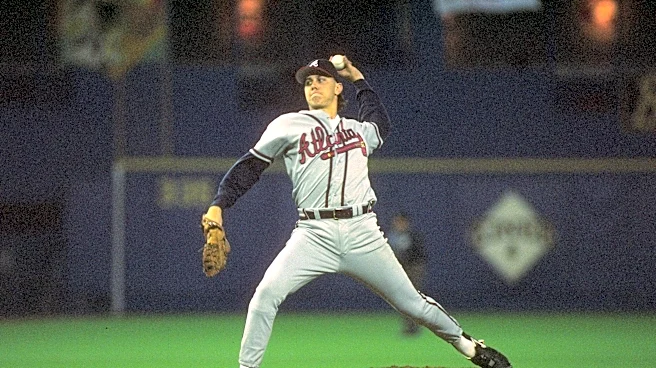
Steve Avery was anything but a household name when he entered the 1991 season but found himself throwing some of the most
important games in franchise history by year’s end.
The third overall selection in the 1988 draft out of Taylor, Michigan, Avery made it to the big leagues in roughly two years. He took his lumps as a 20-year-old rookie in 1990, finishing 3-11 with a 5.64 ERA in 20 starts for Atlanta following his June promotion.
With the first full season of his major league career ahead of him in 1991, Avery’s spring training goals mirrored the Braves as a whole – just find ways to improve.
“I was just hoping to get better,” Avery said. “I was 3-11 as a rookie, but I was always confident. I wasn’t really questioning that I would get better, but if you haven’t felt the success at that level, then it makes you wonder a little bit. I just wanted to get off to a good start in spring training and kind of took that a little more serious.”
One of the major factors working in Avery’s favor was the unwavering support of manager Bobby Cox. Even though Avery struggled mightily as a rookie, Cox believed the young lefty was primed for a breakout season and insisted Avery be included on Atlanta’s opening day roster.
That opinion was not universal, however. Newly hired general manager John Schuerholz was not convinced. One look at the 1990 numbers certainly supports Schuerholz’s assessment, but Cox went to bat for Avery to break camp with the Braves and Schuerholz reconsidered.
“I’m sure there was talk about me not even making the team, going to Triple-A, and trying to get stronger or better,” Avery said. “Bobby fought for me to stay. He actually told me that after I retired and I came back to spring training a couple of times. He said Schuerholz was in favor of sending me back down and Bobby just told him, “No.” I mean, that’s just the kind of person he was, the kind of manager he was. He had confidence in you and wasn’t afraid to take chances, too.”
The gambit by Cox paid off and it did not take Avery long to prove his worth to the Braves as the 1991 season got underway.
Atlanta won eight of Avery’s first 10 starts as he compiled a 6-2 record with a 3.19 ERA in 59 1/3 innings. The Braves raced out to a 25-19 start and trailed the first-place Los Angeles Dodgers by just a half-game in the old National League West standings after two months.
Strong starting pitching was the foundation for the Atlanta’s new-found success.

Tom Glavine was putting together what would turn into a Cy Young Award campaign, while Avery and veteran Charlie Liebrandt were supplying quality innings. The biggest issue for the rotation was the early struggles of John Smoltz, who went 2-11 in the first half before rediscovering his form down the stretch.
While the Braves enjoyed their best start in nearly a decade, June tested their mettle in ways many of the younger players had yet to experience. It was with those challenges in mind that new Atlanta signed several veterans to strengthen the roster over the winter.
Longtime St. Louis Cardinals third baseman Terry Pendleton brought Gold Glove excellence to the hot corner while first baseman Sid Bream and slick-fielding shortstop Rafael Belliard were signed away from the Pittsburgh Pirates to help shore up the infield defense.
“The leadership was Sid and Terry,” Avery said. “Those guys came over and just changed the way our defense played. We weren’t nearly as strong defensively in 1990. Terry also had an MVP season at the plate. Just a bunch of perfect things came together – young guys that got better and then veterans that were hungry and came out and showed us how to take the field every day with the chance to win.”
The Braves weathered the storm during the summer months and found themselves back on sure footing as the second half began. Just as Atlanta won 9-of-11 coming out of the All-Star break, the Dodgers dropped 9-of-11 and the race was on for the division crown.
“Right after the All-Star break, we had a good stretch, they had a bad stretch, and we cut the lead,” Avery recalled. “From then on, it was close all the way to the last day. So, we felt like it was almost playoff baseball, even during the season for the last month. Then, when we got in the playoffs, it was like we were already ready and tested a little bit. We played well against Pittsburgh and played well against Minnesota. Just fell one run short.”
Over the final 38 games, Atlanta and Los Angeles traded the division lead back and forth eight times as they battled all the way down to the very last series of the regular season.
Tied with three games to go, the Braves took the first two games from the Houston Astros to complete an eight-game winning streak while the Dodgers dropped 2-of-3 to the Giants. Just like that, Atlanta celebrated its first division title since 1982.
The ride was just getting started, however.
Atlanta’s next challenge was a National League Championship Series battle against the Pirates, a team led by future Hall of Fame manager Jim Leyland and starring All-Star sluggers Barry Bonds, Bobby Bonilla, and former Cy Young winner Doug Drabek among others.
Pittsburgh was seeking redemption after losing the 1990 NLCS to the Cincinnati Reds and cruised to a 5-1 victory as Drabek bested Glavine to open the series.
The Braves had an answer, however. Avery was waiting in the wings to give the first of two electric pitching performances at a chilly Three Rivers Stadium in Game 2.
With the gametime temperature a brisk 51 degrees, Avery had no trouble heating up.
“I was really never a nervous person,” Avery said of his preparation for that Game 2 start. “I was always pretty confident. So, I treated it like another start. Obviously, I was used to the cold weather being from Michigan. I think that was a big factor for me, but I just felt good.”
Avery delivered 8 1/3 innings of shutout baseball before finally giving way to Alejandro Peña with the tying run in scoring position in a 1-0 game. The veteran righty recorded the final two outs and sent the series to Atlanta tied at a game apiece.

Unfortunately for the Braves, they went on to lose 2-of-3 at Atlanta–Fulton County Stadium. Back in Pittsburgh with their season on the brink, Avery once again took the ball for Atlanta in hopes of forcing a decisive Game 7.
Just like his postseason debut six days prior, he would not disappoint.
This time Avery tossed eight scoreless innings against Drabek as Atlanta won another 1-0 game with Peña slamming the door. The next day, Smoltz continued his redemption arc with a complete game shut-out in Game 7 to send the Braves to their first World Series since 1958.
Avery’s masterclass – 16 1/3 shutout innings and 17 strikeouts – earned him NLCS MVP honors and still stands as one of the greatest postseason pitching performances in franchise history. All of that from unproven young pitcher who almost didn’t make the opening day roster.
Cox’s insistence that Avery be a part of the rotation from Day 1 instilled a confidence that only grew as the lefty gained more and more valuable experience throughout the season. Avery finished the regular season 18-8 with a 3.39 ERA in 35 starts and 210 1/3 innings.
“I got better and better as it went on and then by the time the playoffs came, I was really confident,” Avery said.
Experience was one part of the equation, but youth also worked to Avery’s advantage against the Pirates. He was seemingly unphased by the October stage.
“I mean, I went out and I was 21 years old,” Avery said. “Sometimes, it’s good to be young enough to where you don’t really know what’s going on. I didn’t really know about being nervous yet. If it was later in my career, I probably would’ve realized it was a little more serious. But at the time, I just went out and treated it like another start.”
Braves pitching coach Leo Mazzone was one of the many who marveled at Avery’s calm demeanor in the biggest games the team had played to that point.
“We used to go over the lineup, but at no time did I ever say, ‘You can’t throw this guy this (pitch),’” Mazzone recalled of the Game 6 preparations. “After we do that, I’m walking down to the bullpen with Steve and I said, ‘Steve, you got this figured out?’ And he goes, ‘Yeah.’ So, I said, ‘Good, tell me.’ And says, ‘I’m going to warm up, find out what I’ve got, and then pitch accordingly.’ That’s the best scouting report I’ve ever heard.”
Even with Bonds, Bonilla and a host of other veteran hitters in the lineup, Avery remained cool, calm, and collected. And he stayed with his tried-and-true game plan.
“I always knew my strengths, so even if the hitter’s report is that he’s got the same strengths that I do, I’m going to take my chances,” Avery said. “If I felt good with a certain pitch, I was going to use it whether he was good against it or not. I just tried to put it in a spot that I couldn’t get hurt with it. I always had pretty good control and, when I was younger, I had good stuff. That combination is pretty good when it’s going right.”
After taking the Pirates to seven games and prevailing in the NLCS, the Braves headed to the World Series against Minnesota, another worst-to-first team. The Twins won the American League pennant in five games over the Toronto Blue Jays, a future World Series foe for Atlanta.
The Braves and Twins delivered an instant classic in which each team won all its home games. Minnesota went up 2-0 in the Fall Classic before Atlanta brought the series home and won three straight.
Avery started the first World Series home game ever played in Atlanta, delivering seven innings and allowing just two earned runs. The Braves won in dramatic fashion in extra innings as Mark Lemke singled home David Justice for a 5-4 victory in the bottom of the 12th inning.

Up three games to two, Atlanta had two chances to win the series back in Minnesota, but Kirby Puckett’s walk-off home run in Game 6 was followed by the epic Game 7 duel between future Hall of Famers Jack Morris and John Smoltz.
Smoltz pitched scoreless ball into the eighth, but Morris fired a 10-inning shutout and Gene Larkin’s pinch-hit single with the bases loaded gave Minnesota the series with a 1-0 victory.
Atlanta returned to the World Series in 1992 against Toronto, falling short in six games. The Braves’ next opportunity to win it all would not come for three more years, but the 1995 team finally broke through. Justice hit a solo home in Game 6 to back Glavine’s 8-inning masterpiece as the Braves beat the Cleveland Indians for their first world title since 1957.
Avery was among 10 remaining members of the 1991 team on Atlanta’s 1995 World Series roster. After four years of October battles, the Braves finally won it all.
“It’s the best,” Avery said of the celebration. “That’s why we play, to try and run on a field after the last out of the World Series and be able to tell everyone you’re the best team in the world. To go through the losses almost made 1995 even more sweet, you know? We came close an awful lot of times and you realized that it’s not easy no matter what. For us to be able to complete that season on top was pretty special.”
All of those Octobers and the memories those teams created still echo to this day.
Avery closed out an 11-year career in 2003, back in Michigan as a member of the Detroit Tigers. He finished 96-83 with a 4.09 ERA in 297 career appearances.