






Editor’s note: This guest post was provided by BWRAO reader and community member Simon (or Abemunch in the comments). If you would also like to potentially contribute a guest post when the schedule isn’t so busy, feel free to reach out.
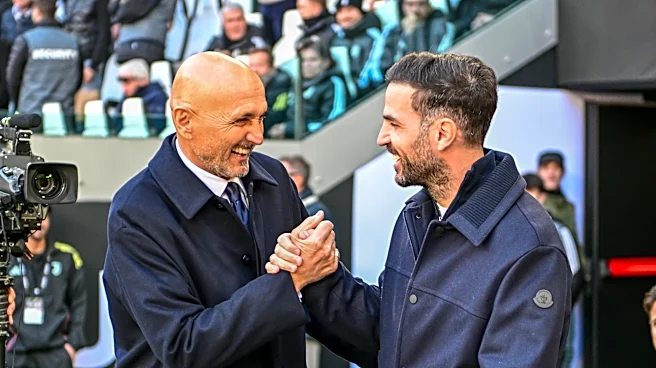
Watching the interview of Cesc Fabregas after Como defeated Manchester United last month offers a few reflections on the current struggles at Juventus. Manchester United is a similar story — a once-great team that has cycled through managers, signing player after player for
huge fees and massive wages, only to see them flop, resulting in a new manager, and a new system with ill-fitting players. It’s clear to see how Man United’s embarrassment in comparison with Como echoes that of Juventus both on and off the pitch.
Drawing on the common strand that players who have succeeded elsewhere fail to recreate their talents on the field in Turin, we can, and often have, blamed recruitment not suiting the manager’s style, or the fact that players are simply not cut from the same cloth of the great names that once trained at Continassa. Those who were able to live up to the fact that the Juventus jersey weighs heavier than others. Yet, when players like Douglas Luiz, Nico González, and Jonathan David show success for other clubs or national teams, this argument falls down. Do we really believe that the players signed by Juventus are less talented than those attracted by Como? This begs the question of what makes playing attractive football and getting results so difficult at the Allianz.
When asked how Como could compete so freely with Man United, Cesc replied “the boys played with a free head, a free mind … playing with tension, this will only block you, will only make you make mistakes.”
Of course, it’s easy to argue that the pressure is off for a Como team who are playing in their first-ever Champions League campaign, where every point reassures their deserved status as dark horses, at least in the group phase. The sort of tension we see in Bianconeri shirts comes with the expectation of excellence and thus the fear of failure. We know the stakes are higher at Juve. There’s a concept in psychology called social facilitation and social inhibition, which states that when we feel watched, we have a higher state of cognitive arousal. This makes us perform better on easy tasks and worse on complex tasks. Given that there will always be pressure on Juventus players, the solution is to make the task at hand simpler. One way of achieving this is through training and repetition, so that what once was a complex task hindered by social pressure becomes an easy task that is facilitated by it. This is where the second quote from Cesc’s interview is important:
“You need to give them confidence to express their talent in a certain way, in a certain style of play.”
Let’s borrow another concept from psychology, self-efficacy. This states that when we attempt an action and succeed, our belief in our ability to complete that action increases, but it decreases if we fail. Fabregas isn’t just giving his players confidence about their talent, but specifically in their ability to express it through a certain style of play, presumably through training drills that are clearly playing out effectively on the pitch. Watching Juventus play, it doesn’t seem they have that belief. It doesn’t take a coaching mastermind to see that players are afraid to try things — albeit we have started seeing some verticality in the last couple of games. It’s gone wrong so many times that they choose to stick with the safe, sideways passing we’ve seen for years now. This Juventus team lacks swagger, as we saw in the game against Lecce, where the fear of dropping points from a 2-0 first-half advantage led them to revert to a scared, safe state in which they didn’t even tempt putting a last second corner into the box in case of a counter-attack. Many questioned why Edon Zhegrova didn’t feature when the team was playing about as poorly as they had all season, and an answer might be that Juventus’ belief in their self-efficacy to hold onto a lead, let alone grow it, held them back. The one player who seems to ooze belief in his ability — an infectious characteristic on the pitch — right now is Zhegrova, but having lost faith in our ability to win games meant he stayed on the bench. The result was a boring, predictable Juve that retreated into its defensive shell and lost the spontaneity that led them to a first-half victory.
This brings me to the final quote from Fabregas, who spoke about the fluidity of his team, saying “it’s all about occupying the right spaces at the right time, with the right rotations and having an objective.”
I find it hard to believe that Juventus players are manifestly worse than those of Como at understanding positional spaces, so why do they seem to lose themselves in the fluidity, becoming vulnerable defensively? This is where I believe successive managements have failed to put players in a position to succeed. Juve CEO Giovani Carnevali summarized this in a statement that “our goal was to replace as many players as possible.”
Fluidity and unpredictability of structure require organization, and that organization requires, at the elite level, an almost telepathic level of communication. When the player you’re interchanging with is here one season and gone the next, how could you possibly think about building patterns of play? Yes, coaching can help, but in the moment, on the field, it boils down to routine and instinct. As above, this requires repetition to build a confidence in where and how everyone will move. It also requires players to know each other’s strengths and weaknesses to pre-empt and cover for one another. Great teams aren’t composed by talented players, but a squad that works together: Paris Saint-Germain’s rise to the top came only after losing stars like Neymar, Kylian Mbappé, and Lionel Messi.
With players constantly churning in and out of Juventus, they have no chance to build their confidence and patterns of play. Of course, at Juventus more than Como you have to prove immediately you’re worthy of the shirt, but how does one prove their worth without being afforded the opportunity to express themselves? In their rush to usher in a new successful project, the constant switching of first-team players undermines the chemistry that allows instinctual patterns and routines, which — unlike skillful and imaginative approaches — aren’t overwhelmed by the heat of the moment.
What this team needs is to identify a core group of players that will form the next dynasty and allow them to cultivate a sense of unity and understanding. In doing so, they can build the chemistry to support each other’s rotations, gaining a belief that they can play a certain way and get results. In their desire to plant a new forest, successive managements have failed to carve a team from the players they have available.