

Washington has played nine games so far this season which means we are almost 30% of the way through the regular season. Given that we are in the middle of a one-week break in the action thanks to finals and the end of fall quarter, it seems like a good time to stand back and take stock of what we’ve seen out of the Huskies so far this season.
In order to frame the discussion, I’m borrowing the premise behind the STATS by Will and Jim podcast from the Basket Under Review umbrella and picking out my
favorite seven stats that showcase Washington’s season so far.
Stat Number One: 1
That’s the number of 5-man lineups that Washington has played for more than 18 minutes so far this season per CBB Analytics. If it sounds like that isn’t very many for this point of the season then you would be correct. The Huskies have played 9 games already and 18 divided by 9 is…2. If the Huskies simply played the same lineup for 7% of every game they would have played more than that.
Evanmiya.com uses possessions instead of minutes played for their lineup stats and Washington has only the one lineup that has played more than 35 possessions and none over 50. Big Ten and national title contender Purdue has also played 9 games but has played 3 lineups over 45 possessions including a starting lineup that has played 131 possessions already.
The lack of playing time for any of Washington’s lineups really showcases the difficulty the Huskies have had putting together a consistent product. Desmond Claude missed 4 games. Bryson Tucker has missed 5.5 games. Hannes Steinbach missed 3 games. Jacob Ognacevic has missed all 9 of them.
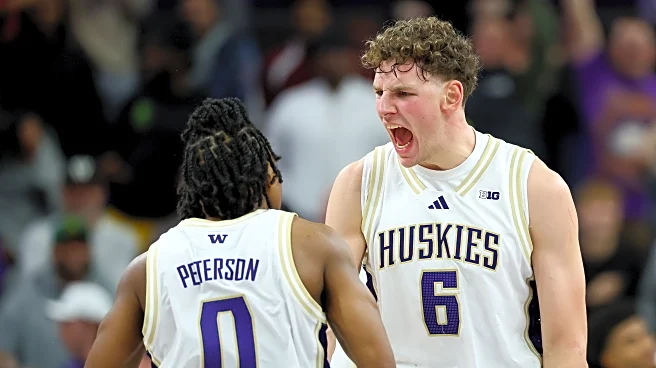
Curious about that one lineup that has played more than 18 minutes? That grouping is Quimari Peterson, Zoom Diallo, Wesley Yates III, Hannes Steinbach, and Franck Kepnang. The Huskies have a net rating in the 70th percentile with that group on the floor. Perhaps unsurprisingly that lineup has shot 67% on 2-point attempts while opponents have shot just 43% on those shots.
Stat Number Two: 11
That’s the dividing point for Washington’s Effective Field Goal % percentile when Hannes Steinbach is off the court versus when he’s on the court. That means Washington has ranked in the 10th percentile or worse in eFG% in every lineup combination of big men that doesn’t have Steinbach on the court. Just Sommerville? 3rd percentile. Just Kepnang? 3rd percentile. Both Kepnang and Sommerville? 1st percentile. None of them? 2nd percentile. The raw numbers rank from 37.5% to 44.5% in those groupings. Any way you slice it, Washington just has not been able to score efficiently at all when Steinbach is off the court.
Contrast that with Steinbach playing and Washington ranks in the 90th percentile or better when Steinbach is out there with four guards/wings or if Steinbach is paired with Franck Kepnang. That latter total may be a little bit surprising but the Huskies rebound 43% of their misses when both are on the court while shooting 42% on three-pointers. That might be partly because the big man duo take up so much space in the middle that it leaves the perimeter open or you could say that’s mostly good shooting luck that will come down to earth eventually. Maybe it’s a little of both.
Stat Number Three: 0:57
That’s the number of seconds it took in the Denver game for Bryson Tucker to equal his number of three-pointers made from last season. The Huskies led Denver by 10 points in the early 2nd half when Bryson Tucker hit a three to put them up 42-29 with 18:12 remaining. Then he hit another one with 17:39 left. Then he hit another one with 17:15 left.
Tucker went just 3/20 (15%) from deep last year as a five-star freshman playing under Mike Woodson’s archaic system at Indiana. He attempted just six shots from beyond the arc in Indiana’s first 10 games last year and missed all of them. Washington needed Tucker as a wing defender and floor spacer early on this season starting at the small forward spot alongside Hannes Steinbach and Franck Kepnang and he looked up to the task shooting 50% on two-pointers and 41.7% on three-pointers.
Of course, Tucker then rolled his ankle with 11:52 remaining and the Huskies trailing by 7 against Baylor and has yet to return. The Dawgs hope to have Tucker back relatively soon since they only have two games in the two weeks following the USC win. If Tucker continues to be at least an average shooter when he returns it would give Coach Sprinkle a lot more flexibility with his lineups particularly when playing Hannes Steinbach as the only true big at center.
Stat Number Four: +59
That is Washington’s scoring margin in the 4th quarter/OT of games so far this season. Now college basketball isn’t on the quarter system (even though UW is for academics) but KenPom still shows breakdowns by 10 minute increments. The Huskies are outscoring opponents by about 6.5 points per game during the 4th quarter/OT which is their best stretch. They’ve been a +39 in the 1st quarter, -6 in the 2nd quarter, +11 in the 3rd quarter and then +59 in the 4th quarter.
Those numbers get even more pronounced if you look at closer to even competition. If you only count the 5 games that the Huskies either lost or it came down to the final minutes then it’s +16 1st quarter, -35 2nd quarter, -10 3rd quarter, and +45 in 4th quarter/OT.
It’s no surprise then that Washington has required furious comebacks to come back and defeat Southern and USC while a big rally against UCLA ended up falling just short. Time and again the Huskies have generally played even over the first 10 minutes, fallen apart in the 2nd quarter, made some small dents once the half begins, then hit their groove when it really mattered at the end of the game.
That’s not a sustainable method of winning games. If you had to pick one quarter to play your best then it’s good that it comes at the end. But falling behind by an average of 7 points per game during that 2nd quarter stretch leading into halftime is not a trend that Washington can continue if they want to find a way back to the NCAA tournament.
Stat Number Five: 39.0%
That number is Washington’s offensive rebounding rate so far this season which ranks 19th in the country. It’s still early so that total will come down over an entire season but Florida was at 38.5% last year as they finished 5th on the way to a national title. The Huskies last year finished just 252nd in offensive rebounding rate at 27.5%. So safe to say this is a major leap up.
And the reason for that leap is both very clear and singular: Hannes Steinbach. The German freshman is one of the best rebounders in the sport just as he was one of the best rebounders in the BBL last year and just like he’ll be one of the best rebounders in the NBA next season. Steinbach is now up to 10th nationally in individual offensive rebounding rate at 18.2%. The national leader last season was at 18% and no Husky did better last season than Great Osobor’s 9.4%.
Steinbach’s rebounding on the offensive glass completely transforms Washington’s offense. The Huskies have gotten 44.4% of their misses when Steinbach is in the game this season which is a 99th percentile total per CBB Analytics compared to 33.9% when he’s off the court. That off court total is in the 69th percentile and still quite good but it isn’t revelatory the way it is when Steinbach plays.
Those numbers suggest that perhaps the biggest point of emphasis when Steinbach plays should be turnover avoidance. Sometimes it might not be that much worse to turn it over out of bounds and set your defense rather than throw up an off-balance three-point shot which only has a 10% chance of going in and might create a long rebound and run out on the other end. But if Steinbach is under the basket then you’ve got nearly a 50/50 chance of getting the ball back and either getting a put back or a chance to reset the offense. Washington’s turnover rate has been identical with/without Steinbach so far but UW can’t afford dumb mistakes rather than getting up even a bad shot.
Stat Number Six: 26.5%
That’s the percentage of Washington’s shots that have come in the paint but not at the rim this season which ranks in the 95th percentile nationally. That’s not necessarily a good thing. Those are generally not very efficient shots because it usually suggests there’s a rim protector between you and the basket, otherwise you would’ve gotten a true layup/dunk. Those shots are usually either floaters/runners or jump hooks.
There are some players that have amazing touch in that range but Washington doesn’t have many of those. The Huskies are shooting 39.1% on those shots which ranks in the 32nd percentile nationally and is only slightly better than they shoot on true midrange jumpers (37.7%) or on above-the-break three-pointers (37.0%). Taking that many shots in that range suggests that Washington really wants to try to drive the ball all the way to the basket but they haven’t been able to clear the way well enough to get there.
There are several good reasons for this. Washington prefers to run a double big lineup. Hannes Steinbach is shooting 67% from 3-point range so far but on only one attempt per game while neither Franck Kepnang nor Lathan Sommerville shoot from further than about 10 feet out. Even if one of them sets a screen on the perimeter, the other is probably near the basket clogging the lane. Then you have Zoom Diallo, Desmond Claude, and Wesley Yates III who all love to take the ball to the hoop.
Washington’s struggles in the paint have been even more pronounced since Claude in particular returned to the lineup. Washington’s non-rim paint percentage went up to 31% in the 5 games since Claude came back (up to 98th percentile) while their percentage of made shots there decreased to 34.3% (19th percentile). Sure enough, Claude has taken 38.1% of his shots in that range and is shooting just 7/24 (29.2%) so far. If Washington is going to turn things around in Big Ten play then they need Claude to either find a way to get all the way to the basket more often or they need him to start making those shots at a much higher clip. Hopefully the 2nd half against USC is a sign that Claude is starting to get back into playing shape and will have a bit more burst moving forwards.
Stat Number Seven: 34.7%
That’s the combined three-point shooting percentage of Washington’s trio of hoped-for snipers added in the transfer portal with Wesley Yates III, Quimari Peterson, and Jacob Ognacevic. Last year they shot a combined 42.3% from deep by going 188 of 444. They played an average of 32 games across the three of them last year which translates to 5.9 makes on 13.9 attempts per game. This year in reality through 9 games we’ve seen them make 4.6 out of 13.1 attempts per game.
All of that of course has the massive caveat that Jacob Ognacevic has yet to play a minute for the Huskies and is out for at least another month with a foot injury suffered in the preseason. The hope is that he’ll be back by the end of January and so will get to play 10-15 games but his shooting from the PF spot was a critical piece for this roster that has been completely absence since Bryson Tucker also got hurt after his pleasantly surprising shooting start (as noted in stat number three).
The fact that Washington has still almost attempted the same number of threes per game even with Ognacevic hurt shows you that both Peterson and Yates have shifted their shot profiles to shoot more from the outside as the only real threats from deep on the team right now. Yates in particular is driving the ball less than he did last season as he’s averaging 2 more attempted threes per game this year than he did during conference play for USC last season. His efficiency on those shots though is way down in part because he’s making just 30% of his corner three-pointers which is in just the 44th percentile nationally. If those totals get back up to 40% or higher the rest of the way then it would be worth another point or two more per game and create even more space inside.