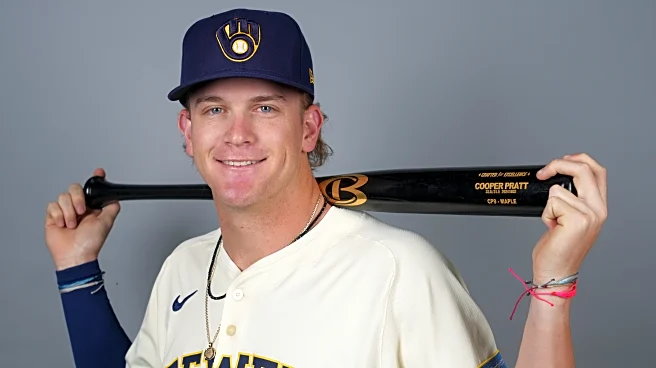

When Cooper Pratt reportedly agreed to an eight-year extension (with two additional option years) with the Brewers earlier this week, it came as quite a shock. These types of deals aren’t completely unheard of, even within the organization; when Jackson Chourio signed his big extension before the 2024 season, he’d played a grand total of six games above Double-A, which is three more than the number of games Pratt had played at Triple-A when news of the extension broke. Colt Emerson of the Mariners
signed a Chourio-like extension this week: he has not debuted yet, and may not for some time.
But there’s a difference. When Chourio signed his extension, he was baseball’s No. 2 prospect. Emerson, via Baseball America, is No. 7. Pratt, on the other hand, is ranked No. 50 by Baseball America, No. 64 via MLB Pipeline, and he is not in the top 100 on Baseball Prospectus. Pratt is a good prospect, but he’s not exactly a great one, and as BA’s JJ Cooper points out, the expected outcomes for a player in Pratt’s range do not exactly suggest “this guy will definitely be a star.”
Based on Cooper’s chart, the most likely outcome for Pratt is that he’ll have a career WAR value between 3 and 10 WAR. The Brewers, a team without a ton of financial resources, just promised him a minimum of $50 million; I do not think that’s the outcome they’re looking for.
But not all prospects are the same. Pratt is an outstanding defensive player, so even if he never really learns to hit major league pitching, it’s not the same as if a corner outfielder never learns how to hit. Joey Ortiz earned 1.4 fWAR in 2025 while having an atrocious offensive season; that’s more WAR than Luis Arraez earned (via FanGraphs or Baseball Reference) in 2024 when he won a batting title.
Offensive Outlook
This deal probably signals that the Brewers think Pratt will figure it out at the plate. His track record is a little mixed; he looked great in Low-A and High-A in his first full pro season in 2024, but hit just .238/.343/.348 in 2025 at Double-A. There are a couple of caveats to that line, though: first, that wasn’t that bad for the pitcher-friendly Southern League, and translated to an above-average 107 wRC+. The other thing is that Pratt was very young; as a 20-year-old at Double-A, Pratt was nearly four years younger than the average player in that league, so the fact that he was above average offensively (while playing defense that won him a Minor League Gold Glove in 2024) is actually quite encouraging.
Pratt’s power hasn’t shown up yet, and it may never be a major strength. He’s hit only 16 homers across nearly 1,000 plate appearances as a minor leaguer. But he’s not a small guy (listed on FanGraphs at 6’4” and 210 pounds) and the Brewers may be banking that he’ll grow into it a bit. He’s also shown good patience (a 12.7% walk rate in 2025), and he cut his strikeout rate drastically in 2025 (from 20% to 15.2%), another encouraging sign for a young player who moved up a level.
It won’t take a ton of offense for Pratt to live up to the value of this contract over its lifetime. The average annual value is only a little more than $6 million, which, by popular estimates, means he needs only about 0.75 WAR per season to justify that value (even if this isn’t a perfect one-to-one comparison). Based purely on defense, Pratt should outperform that, and if he hits even a little, he could outperform it by a lot.
Logjammin’
But the arguably bigger question that this deal raises has to do with fit. Ever since it was clear that the Brewers had several high-level middle-infield prospects, we knew this question would need to be addressed eventually, but this commitment to Pratt — the third- or fourth-best infield prospect in the system, with Andrew Fischer charging up from behind and two controlled, relatively young established players in the big leagues — makes that question a little more urgent.
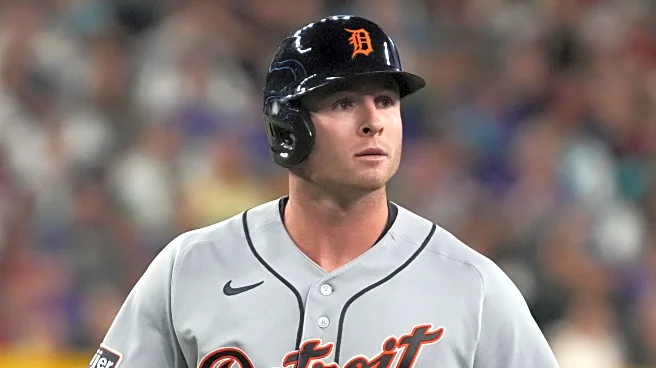
Jesús Made is the obvious pearl of the organization, and is a more-or-less consensus top-three prospect. He has a good chance at being the No. 1 overall prospect league-wide heading into next season, as the two players ahead of him — shortstops Konnor Griffin and Kevin McGonigle — will likely both have graduated by mid-summer (McGonigle is already playing for the Tigers, while Griffin is expected in the big leagues as soon as the Pirates secure the extra year of service time they’ll gain by keeping him in the minors to start the season, or they agree to an extension not totally unlike Pratt’s, if more lucrative). Jett Williams has played a lot of middle infield and is a little further along than Pratt. Luis Peña sometimes almost feels like a forgotten man, but he actually outperformed Made in the Dominican Summer League when they were both 17 and had a 139 wRC+ at Single-A Carolina as an 18-year-old. Fischer, who looks like he’ll keep playing third base for now, looked ready for primetime this spring, when he posted a 1.429 OPS in five Cactus League games and hit .357/.438/.714 in four games with Team Italy in the World Baseball Classic.
Add Brice Turang and Joey Ortiz to the mix — both still have three years of team control remaining after this one — and you can see the problem, even if that problem is a good one: there are too many guys.
The first thought is that this is a big year for Ortiz. His offensive approach has been better early this season, but there are no questions about his defense. If he hits even a little, he’s a useful player; if he can get close to the league-average offensive player he was in 2024, he could produce at a borderline All-Star level. Maybe the ship has sailed on Ortiz as a good offensive player, but he was a consistently above-average minor league hitter, and as we’ve seen with Turang, we shouldn’t necessarily write these guys off after one or two tough years in the big leagues.
However, Ortiz’s spot is also probably the most precarious. That doesn’t necessarily mean he’s on his way out with the Brewers, and he could become quite a luxury as a utility player. But he’ll also get a bit more expensive when he gets to arbitration next season, and his defense should hold value throughout the league. Whether he bounces back offensively or not, the Brewers are likely to check on Ortiz’s market after the season. If no deal that the front office likes comes to the fore and the Brewers are ready to move on from Ortiz as the everyday shortstop, I’m sure they’ll consider using him as a right-handed backup to all three infield positions.
It might be a little early to make this proclamation, but Turang is a star. He’s also likely to be very expensive in a few years; as a Super Two player, he’s already making over $4 million and has three more arbitration years after this one, and he’ll hit the market when the 2029 season ends as a soon-to-be-30-year-old free agent. While we don’t necessarily want to start thinking about the end of Turang’s tenure in Milwaukee, for the purposes of this exercise, we should at least acknowledge the possibility that Turang might play three more seasons in Milwaukee and then gets traded a year before he hits free agency.
Even still, that clogs up one of the Brewers’ three infield spots for the next three years, limiting opportunities for others. Third base is another question: it’s likely spoken for this season, with Luis Rengifo and David Hamilton (though a later-season opportunity for a younger player there, particularly if there are any injuries, does seem possible), but there’s a likely opening there beyond 2026.
So what are some options?
The first step is to build a defensive hierarchy. Turang is at the top of the heap at second base and should stay there as long as he’s on the team. Ortiz, Pratt, Made, Williams, and Peña all play shortstop, though the writing has been on the wall for Peña for a while, and basically as soon as Williams was traded to Milwaukee, people started speculating about where he’d move. Made’s defensive reputation is pretty good, but his added weight this season might precipitate a move to third base. Ortiz, as a proven defensive stud, is ahead of Pratt, but it doesn’t seem like the Brewers think there will be much of a step down defensively if and when Pratt takes over at the position. Fischer seems like a capable third baseman, but probably not as good as any of these other options, and first base may be in his future.
So even if we shift Made to third base and Fischer to first, we have to consider alternatives. Williams has played way more shortstop than anything else as a minor leaguer, but he also doesn’t have quite the same defensive reputation that these others do, and he did play a decent amount of center field last season. Peña has never played the outfield, but he’s a 70-grade runner, and probably could play the outfield. The Brewers don’t have the same organizational depth in the outfield as they do in the infield, and switches for Williams and Peña might benefit all parties. That’s something to keep an eye on moving forward.
Looking down the road, then, it requires a lot of projection (and here’s where I’ll remind you that it’s unlikely that all of these players work out as useful big leaguers, no matter how promising they are now), but you could see some sort of alignment in a couple years like this:
1B: Fischer
2B: Turang
3B: Made
SS: Pratt/Ortiz
OF: Jackson Chourio
OF: Sal Frelick
OF: Williams/Peña
That would get all of these prized prospects into the lineup — and who knows, the Brewers may not have to worry about squeezing all of these guys in at once, as Peña, for instance, will still only be 21 in two years, and he’d still be a young debutant if Milwaukee just waited three years, traded Turang, and then installed Peña as the starting second baseman heading into 2029.
These questions don’t all need to get answered today, but the guarantee of money to Pratt makes his arrival in the big leagues feel closer than ever. We know that Williams is already on the doorstep. We probably won’t see Made, Peña, or Fischer this season, but if Made really is on the Chourio track, that would line him up for the beginning of 2027.
To reiterate, this is not a bad problem. But at some point, decisions will need to be made, both by those closer to the field and those further away from it. Will positional changes provide the necessary relief, and will those changes go smoothly? Could a blockbuster trade be in the cards? (A related question: Does the eight-to-ten-year extension the Brewers just gave Pratt increase his trade value?) There are a lot of different ways that things could still be addressed, but the Pratt extension makes the future of this team feel just a little bit closer.