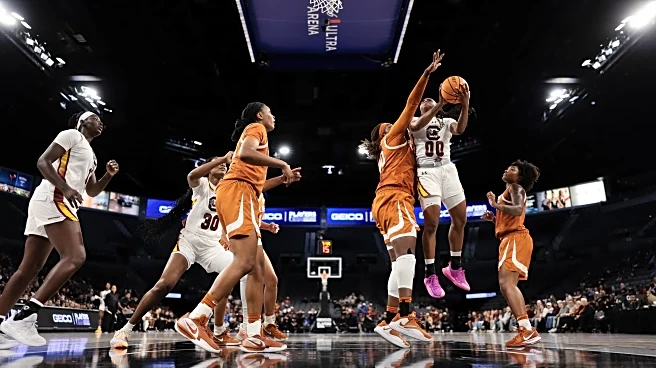




Pressure is a privilege.
And in women’s college basketball, the pressure of a top-five ranking and championship contender status is a privilege, one that is earned not through starry recruiting classes, transfer portal coups or preseason award nominations, but through successfully navigating a challenging schedule against top-tier opponents.
That reality explains why SEC teams occupy five spots in the top 10 of the latest AP Top 25 poll. The SEC is a gauntlet of great teams, giving programs the privilege
of responding to the pressure and proving themselves with victories that confirm their championship credibility.
Head coach Vic Schaefer and No. 4 Texas, certainly, did that back in November, capturing the inaugural Players Era Championship by defeating No. 3 UCLA and No. 2 South Carolina on back-to-back days in Las Vegas. As Schaefer proclaimed after the Longhorns’ consecutive victories, “Down south in Texas, we call that Texas Fight, and this group has got it.”
Schaefer, however, recently seemed less enthused about taking on a similarly difficult test.
After the Longhorns suffered their first loss of the season at LSU on Sunday, the longtime head coach asserted that his squad had been dealt an intentionally unfair schedule by the conference higher ups, as Texas has to follow up their trip to Baton Rouge with one to Columbia for a rematch with the Gamecocks (7 p.m. ET, ESPN).
Schaefer since has walked back the accusatory statements that he made on Sunday afternoon. Still, hearing complaints (and a Julia Roberts quotation) from the head coach when the going has gotten tough is not exactly the attitude that inspires confidence in Texas ahead of another showdown against South Carolina.
A game against the Gamecocks should not be seen as an obstacle to the Longhorns’ greatness, but an opportunity reaffirm it after a disappointing loss.
That’s surely how South Carolina will approach the matchup, as the Gamecocks will be eager to avenge their lone loss of the season. Head coach Dawn Staley welcomed the challenge of an “unforgiving” SEC schedule, saying, “We expect nothing because the road is hard. If someone sets it up for you to eat off this golden platter…it’s not gonna be the right season.”
Schaefer did muster his more characteristic spunk when closing his media availability on Tuesday, declaring, “We’re gonna play our ass off on Thursday night. Praise the Lord and Hook’em Horns.”
So, will Texas or South Carolina be singing hoops-inspired hallelujahs after this high-stakes SEC matchup?
The outcome of the sixth showdown between the Longhorns and Gamecocks since the start of 2025 will, once again, be determined by the four factors: effective field percentage, turnover percentage, offensive rebounding percentage and free throw percentage.
Effective field goal percentage

Texas has taken two of five games off South Carolina, but the Longhorns shot better than the Gamecocks in just one their wins—their victory last February in Austin.
That fact captures how the Longhorns enter their matchups with the Gamecocks (and most games) at a disadvantage, as effective field goal percentage accounts for a team’s performance on 2-pointers and 3-pointers—and the Longhorns don’t care for 3s. Against lesser opponents, a torrent of 2-pointers is more than enough for Texas to earn a victory, but against a high-level opponent like South Carolina, every edge matters. Shooting better than 47 percent on 2s against a Staley defense, as they did last February, is not a replicable strategy, especially since junior Madison Booker has not seen her shot fall at her regular clip in games against the Gamecocks.
South Carolina, however, also is not a particularly potent 3-point shooting team, but they at least take more than the second-fewest 3s per game, which is where Texas ranks.
Both teams primarily rely on a single 3-point sharpshooter. For Texas, it’s sophomore Jordan Lee, who is shooting 37.4 percent on 6.1 3s per game. For South Carolina, junior Tessa Johnson takes 5.2 3s per game, hitting 43.8 percent of them. The Gamecocks also have other players capable of increasing their volume, with both super senior Raven Johnson and senior Ta’Niya Latson shooting career bests from deep on more than 2.5 attempts per game; Johnson is at 37.5 percent and Latson at 41 percent.
Turnover percentage

Both Texas and South Carolina establish their dominance over inferior opponents through the possession battle. They don’t turn the ball over, all while causing their opponents to consistently cough it up.
So far this season, Texas commits the second-fewest turnovers per game, while pressuring opponents into nearly 25 giveaways per game. South Carolina ranks 15th in turnovers committed, and troubles opponents into more than 18 miscues per contest.
Those stats suggest the Longhorns have the advantage. However, LSU just induced a season-high 17 Texas turnovers. South Carolina, like LSU, has athletic defenders who can play the kind of defense the results in Texas exceeding their usual number of turnovers, whether by disrupting the dribble of Texas’ ball handlers, closing off passing lanes and preventing Longhorn players from getting loose via screens.
The Longhorns will need a return-to-form game from super senior Rori Harmon, who experienced at rare benching in the fourth quarter against LSU. But expect Raven Johnson to be roaring and ready to make her life even harder on Thursday evening, as Johnson’s size, strength and length, into addition to her defensive smarts, suggests she can win this matchup between seasoned SEC point guards. Considering Harmon hit the game winner in the Players Era Championship final, while Johnson had a quieter game, Raven should be even more motivated to make sure she puts South Carolina in position to win.
Offensive rebounding percentage

The boards, of course, will matter in this SEC battle.
Last January, even as South Carolina routed Texas, the Longhorns lapped the Gamecocks on the offensive glass, as now-senior Kyla Oldacre corralled offensive board after offensive board, finishing the afternoon with 12 offensive rebounds.
South Carolina will be ready to wrestle with Oldacre, who, despite often coming off the bench, averages 3.4 offensive rebounds per game, grabbing 18 percent of available offensive rebounds in her 20 minutes. Much of the responsibility of neutralizing Oldacre will fall on senior Madina Okot, who is South Carolina’s best defensive rebounder. During the Players Era Championship final, Okot did her job, collecting 10 defensive, and 11 total, rebounds. The Gamecocks need a strong game on the glass from sophomore Joyce Edwards, whose rebounding numbers have waxed and waned game to game. According to Staley, freshman Alicia Tournebize, South Carolina’s 6-foot-7 midseason addition, will be available to play. Grabbing a few key offensive boards against an SEC rival would be quite the debut!
Both teams also can benefit from boards grabbed by guards and wings, with Booker and R. Johnson, in particular, being strong rebounders for their positions.
Free throw rate

The aforementioned Oldacre gets hacked often as she fights on the glass, giving her the highest free throw rate on the Longhorn roster. But as a 66.3 percent free throw shooter, she struggles to consistently translate all those hacks into extra points.
Similarly, South Carolina’s bigs also collect the most fouls against them. However, in contrast to Texas’ primary offensive players, the Gamecocks have an offensive star who knows how to earn her way to the stripe in Latson.
Although Latson has shifted her offensive game as a member of the Gamecocks, she earned almost eight free throws per game last season at Florida State. That’s also the number of freebies she shot in the Players Era Championship final. Even though that did not result in a win for South Carolina, Latson’s ability to use her scoring craft to compile trips to the line—where she shoots a team-best 83.3 percent—could prove pivotal in the rematch.