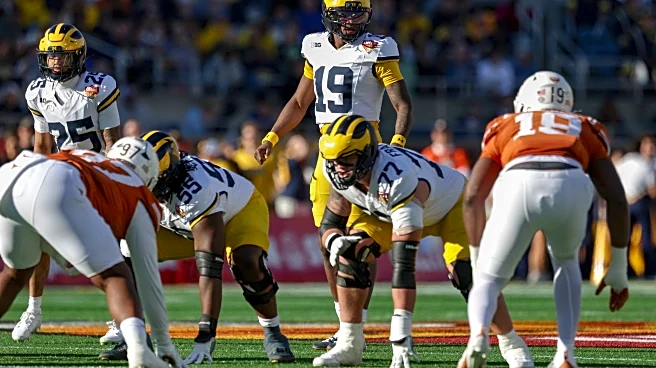

The Michigan Wolverines are entering a new era under head coach Kyle Whittingham, but in order to understand the situation he’s inheriting, we have to look back at how the 2025 season played out.
Here are the final grades for each position group.
Quarterback: C
Bryce Underwood’s freshman campaign was filled with flashes of impressive potential, but also plagued by inconsistency — finishing with 2,428 passing yards, 392 rushing yards, a 60.3 percent completion rate, 17 total touchdowns and nine interceptions.
There’s no doubt he desperately needs to improve his accuracy, footwork and decision-making to take the next step, but fans should be very excited he officially decided to return for his sophomore year.
Running backs: A
The running back room was by far the most productive unit on offense this season, as Jordan Marshall (team-high 932 yards, 10 touchdowns) and Justice Haynes (857 yards, 10 touchdowns) formed one of the nation’s top rushing duos despite both dealing with injuries. Bryson Kuzdzal also showed the unit had depth, providing a spark when Haynes and Marshall were sidelined. It’s great that Whittingham retained Tony Alford, which should keep the run game playing at an elite level in 2026.
Wide receivers: C+
Andrew Marsh solidified himself as the top target midway through the season, becoming the first Michigan freshman wide receiver to record multiple 100-yard games since 2009. In a win over Northwestern, Marsh broke a school-record for a freshman with 12 catches and 189 yards. Donaven McCulley also had a solid year (39 catches, 558 yards), but there wasn’t much depth in the room beyond those two, which really hampered the overall impact of the wide receiver unit.
Tight ends: C+
The tight ends were solid but not stellar in 2025. Marlin Klein was expected to be the go-to guy — and he did lead the room with 24 receptions and 248 yards — but he didn’t live up to expectations. Meanwhile, Zack Marshall (16 catches for 199 yards) showed glimpses of being a more reliable player, and he could have a major role in 2026. Max Bredeson also led the Wolverines with an 84.3 run blocking grade and 78.0 pass blocking grade per PFF.
Offensive line: C+
The offensive line was up-and-down to say the least, struggling to play with consistency and being completely dominated against top competition. Blake Frazier (65.6 overall PFF grade), Jake Guarnera (68.7) and Andrew Sprague (69.4) all played well for the most part, so it’s nice that all three are returning next season. The lack of consistent and quality pass protection was certainly the biggest area of concern, so we’ll see if that’s corrected under the new regime.
Defensive line: B+
The defensive line played very well overall, as Derrick Moore (team-high 89.7 overall PFF grade) and Rayshaun Benny (80.2) were the two highest-graded defenders on the team. Moore had a historic season, becoming just the seventh player in program history to record 10 sacks in a single year. Damon Payne Jr. and Tre Williams were fine, not good, on the interior, and the same can be said about TJ Guy and Dominic Nichols.
Linebackers: B+
The linebackers were the best unit on the defense for most of the season, highlighted by All-Big Ten honoree Jimmy Rolder (team-best 73 total tackles), Cole Sullivan and Ernest Hausmann. Sullivan led the Wolverines’ entire defense with three interceptions, while Hausmann was second on the team in tackles with 68. Unfortunately, Hausmann’s unusual exit at the end of the season left a sour taste to what was an otherwise impressive campaign for the linebackers unit.
Defensive backs: B
There were several standout players in the secondary, including Jyaire Hill (third on team with 78.6 overall grade), Zeke Berry (team-high 10 pass deflections), Mason Curtis, Brandyn Hillman and TJ Metcalf. However, the secondary didn’t hold up in losses to Ohio State, Oklahoma and USC. It was impressive to see so many true freshmen like Shamari Earls, Jayden Saunders and Jordan Young play well in the secondary, but the unit had a tendency to falter in the biggest games.
Special teams: D+
The special teams were frustratingly abysmal in 2025. From poor punting to inconsistent field goal kicking to a mind-boggling return game, it became abundantly clear Michigan had to move on from special teams coordinator JB Brown. Dominic Zvada finished the season 17-for-25 on field goals and 43-for-43 on extra points, while Hudson Hollenbeck averaged just 43.2 yards on 40 punts. Now with Kerry Coombs taking over, we’ll see if the special teams unit can improve next year.