



The Colorado Rockies are a team in the midst of a rebuild. With this in mind, the staff at Purple Row thought it would be useful to revisit the “State of the Position” series that we ran in March to see where things stand. We’ve asked authors of the spring articles to re-evaluate their earlier remarks with an eye toward the August 3 trade deadline.
What I said in March
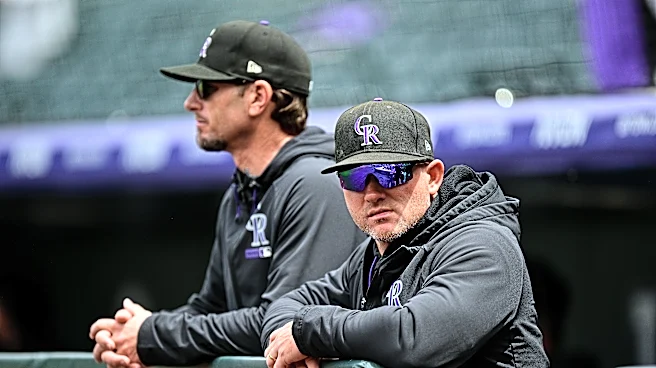
For my initial article about the new coaching staff, I described them as a “data-driven team of problem solvers and relationship builders.” I also introduced
you to them, and asked manager Warren Schaeffer (who I described as a “communicator” and “relationship builder”) to describe each member of his staff in one word:
- Bench Coach, Jeff Pickler: “Prepared”
- Assistant Bench Coach, Ron Gideon: “Wise”
- Hitting Coach, Brett Pill: “Relentless”
- Assistant Hitting Coach, Jordan Pacheco: “Smooth”
- Pitching Coach, Alon Leichman: “Unique”
- Assistant Pitching Coach, Gabe Ribas: “Polished”
- Bullpen Coach, Matt Buschmann: “Funny”
- First Base/Outfield Coach, Doug Bernier: “Energetic”
- Third Base Coach, Andy González: “Machine”
- Bullpen Catcher & Assistant to Baseball Operations, Kyle Cunningham: “Controversial”
- Catching Coach & Bullpen Catcher, Chris Rabago: “Sneaky”
After a whirlwind offseason, we finally were able to see the coaching staff in action. Schaeffer was running his first spring training, and his new staff put their words into action. Spring training was all about experimentation. Not only did they tinker with baseball strategies, but they also tinkered with basic things such as the daily schedule. We saw some early results in spring training, but now we’re in the midst of the regular season and can start to see progress in those areas.
Since we’re only part of the way through the season, the picture will be incomplete. But we can still get glimpses of how things have been working (or not).
All stats current as of July 11, 2026.
Where the Rockies are now
Multi-inning Relievers
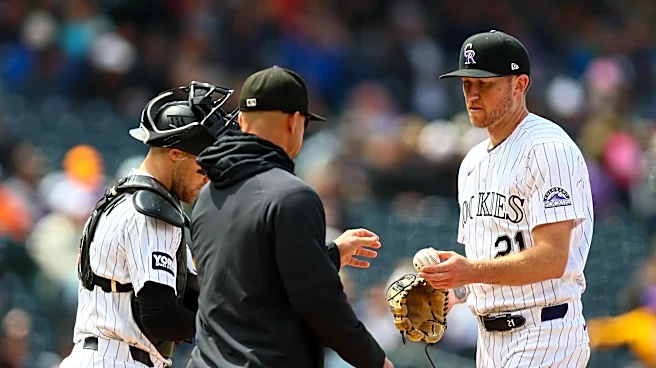
At the beginning of the season, the Rockies experimented with “bulk relievers.” Essentially, the idea was that the game would start with an opener, and then he would be relieved after an inning for someone else to pitch 4-6 innings in the middle of the game. Initially, this was reserved for Antonio Senzatela and Chase Dollander. When he was called up on April 14, Tanner Gordon was also in the mix. The thinking behind it was that the “starter” could go deeper in the games – ideally the sixth or seventh inning – while not seeing the top of the order right out of the gate. It was also promoted as a way to save the bullpen, especially with the extreme conditions the Rockies have to play in. As an additional wrinkle, they would occasionally have a starter throw his scheduled bullpen in the game.
Dollander made 10 appearances before his injury, and six of them were in relief. Five were bulk relief, where he pitched anywhere from four to six innings, and one was an in-game bullpen appearance. Senzatela was also used in a bulk relief role, but his outings were much shorter than Dollander’s. He made one appearance of three innings, and another of 3.1 innings, but the rest have been 2.2 IP or fewer. 10 of his last 11 appearances have been within the confines of one inning (one outing was 0.2 IP). Gordon was used the most like Dollander, pitching 3-6.1 innings across seven bulk relief appearances.

Dollander is on the 60-day IL after undergoing internal brace surgery; Senzatela has transitioned into more of a traditional reliever; and Gordon was moved back into the starting rotation.
In their place, Zach Agnos has become the de facto bulk reliever. Agnos has made 25 appearances (including two starts), and nine of them have been three or more innings in length (though one was his start on June 6 against the Milwaukee Brewers). Juan Mejia has also been used over multiple innings 12 times in 38 appearances, but never more than two innings.
Conclusion: The bulk reliever experiment showed some promise, but injuries to the rotation (including Dollander) forced them to abandon it for a more traditional pitching approach. We’ll see if that change was due to the injuries, or if this will be a permanent switch back.
Pitch Suggesting
Another tactic the Rockies experimented with early in the season was “pitch suggestions.” The idea was that the pitching coaches, typically Alon Leichman, would suggest every pitch to the pitcher and catcher, who would if they wanted it. Most of them embraced it, but some pitchers still called their own pitches. It was a collaborative effort between all three parties, and the pitchers had the autonomy to shake off any pitches they didn’t agree with.
As the season has gone on, it appears the Rockies have transitioned away from pitch suggesting. President of baseball operations Paul DePodesta told the media last weekend that they are refining the process, and some players are still using it.
Conclusion: It will be interesting to see if the Rockies go back to pitch suggestions after the All-Star Break, what the process will look like going forward, or if they abandon it completely. But this particular experiment shows that the coaching staff and front office aren’t locked into one way of thinking and are constantly refining their approach to the game.
Base Stealing
Schaeffer & Co. have emphasized better baserunning and generally creating more opportunities on the basepaths. That means focusing on speed and stolen bases. The Rockies made that vision clear when they traded for Jake McCarthy, who leads the team with 15 stolen bases in 19 attempts. Every single position player who has made an appearance with the Rockies has at least one stolen base except for TJ Rumfield, Chad Stevens, Brett Sullivan and Sterlin Thompson. Hunter Goodman has more stolen bases in the first half of 2026 (5) than the last three seasons combined (3). He’s been caught four times, but is still attempting more than he ever has.
The Rockies as a team have recorded 66 stolen bases in 95 attempts. The 66 stolen bases ranks them 14th in MLB, and the 29 times caught ranks them fourth. In the first half of 2025, they stole 52 bases (23rd) and were caught 24 times (T-8th). In 2024, they had 53 stolen bases (T-20th) and were caught 19 times (T-10th).
Conclusion: The Rockies are prioritizing different ways to get runs. It goes back to “he gets on base” from Moneyball, but it’s working.
In summary, this coaching staff has shown a willingness to try new things and make adjustments as needed.

Offensive Output
The biggest turnaround so far has been the offense.
Heading into Sunday’s game against San Francisco, the Rockies ranked in the top seven in average (.256) and OPS (.748), sixth in slugging (.421) and seventh in OBP (.327). Comparatively, in 2025, they ranked last in OBP (.293), 27th in OPS (.679), 24th in slugging (.386) and 23rd in average (.237).
Since June 1, the Rockies’ 215 runs scored are the second-most in MLB behind only the Milwaukee Brewers (221). They also have four players in the Top 20 in OPS since June 1: Kyle Karros (1.065, 3rd), Hunter Goodman (.995, 9th), TJ Rumfield (.946, 15th) and Jake McCarthy (.943, 18th). They have also been averaging 5.06 runs per game at home and 4.54 runs on the road. They have not averaged more than 4.0 runs on the road since 2020 (4.07) and have not averaged more than 4.5 runs on the road since 2007 (4.72).
It wasn’t always like this. May was a rough month. After a 14-18 start, they went just 8-20 in May and were outscored 190-119. But since June 1, they are 17-21 and have been outscored just 221-215. They also have not been shut out since May 19.
Conclusion: The Rockies are finding more ways to score runs and keep games closer. They are not rolling over and letting teams beat them’; instead, they are forcing them to. By the All-Star Break in 2025, they’d been outscored 589-336 (-253). In 2026, it’s 552-465 (-87).
Plate Discipline
Plate discipline has been something that has plagued the Rockies for years. But that is changing this year, as well.
In 2025, the Rockies struck out 25.9% of the time. Only the LA Angels were worse (27.1%). In 2024, they led the league with a 28.8% strikeout rate; and in 2023 they ranked third (25.5%). However, in 2026, they rank 11th so far (22.8%).
Their walk rate is still relatively low – 8.4%, which ties them with the St. Louis Cardinals for 17th in MLB. In 2025, they ranked last (6.7%). In 2024, they were tied with the San Diego Padres for 16th (7.5%). And in 2023, they were 18th (7.4%).
Some of this can be attributed to an overall tightening up of plate discipline. In March and April, the Rockies struck out 25.1% of the time – 29th in MLB. Since June 1, they’ve struck out just 21% – 10th in MLB.
As far as walk rate is concerned, they walked just 8% of the time (21st) in March and April. Since June 1, they’ve walked 9.5% of the time (6th).
And no player exemplifies that more than third baseman Kyle Karros. Prior to Sunday’s contest, Karros had reached base in 19-straight games. It was the longest active on-base streak in the league, and tied for the longest streak by a Rockie this season (Mickey Moniak, April 15-May 7). He is also slashing .342/.434/.631 with six homers since June 1. Both his 1.065 OPS and .434 OBP rank third in the league. Prior to that, Karros was slashing just .215/.273/.337 with three homers.
Conclusion: The Rockies are becoming much more patient at the plate. They are learning as they go and making adjustments. They are putting more emphasis on getting on base by any means possible, which is helping them score more runs, especially late in games.

Defensive Positional Versatility
In addition to pitching versatility, the Rockies also touted positional versatility in the field. This is nothing new for the Rockies, but this new team has cranked it up to 12.
This was first evident when they signed Willi Castro, who has been the definition of a “versatile veteran” for years. So far in 2026, Castro has played every position at least once except for pitcher and catcher and there have been occasional instances where he played multiple positions in the same game. Cory Cohen wrote an excellent profile on Castro’s positional versatility just last week.
We’ve also seen Edouard Julien play first and second base, as well as Tyler Freeman and Troy Johnston play both infield and outfield. Braxton Fulford has been primarily used as a designated hitter and backup catcher, but also dabbled in the outfield last week. This was also something we saw from Ryan Ritter in spring training.
But perhaps the biggest indicator of the new coaches’ emphasis on positional versatility is Cole Carrigg. Carrigg is famously a “super-utilityman” (and a switch hitter, to boot). Interestingly, he has only played outside of center field twice — he played three innings of shortstop over two separate appearances — but that’s likely because of Brenton Doyle’s injury.
Conclusion: This is something the Rockies have worked on for years, and it’s something many teams do across the league. It’s one thing to have a player who can play a couple of positions well, but it’s another to be “able” to play everything serviceably. And perhaps this is something the Rockies have realized, as well, because Castro in particular has stayed in the infield a lot more lately and there haven’t been as many in-game positional adjustments. This will be something to keep an eye on in the second half.
Win-Loss Record and Overall Results
The biggest and most obvious metric is the raw win-loss record of the Rockies in 2026. Heading into the All-Star Break, the Rockies are 39-59. That’s about a 64-98 pace. Considering they’ve lost 100+ games in each of the last three seasons, that’s a significant improvement. Additionally, the last time they won more than 34 games in the first half was 2022, when they were 43-50 (they finished 68-94 that year). Don’t get me wrong – if they finish 64-98, it’s still bad. But the last year they won fewer than 100 games was 2022, and 98 losses is still 21 fewer than last year.
In 2026, they are 22-25 at home and 17-34 on the road. They are also 14-14 in one-run games, and have scored an MLB-leading 133 runs in the eighth inning or later. They have come from behind to win 25 times, and five of those have been from down three runs.
Additionally, they are slashing .294/.360/.480 with 43 doubles, four triples and 28 home runs in the eighth inning or later. 50 of the Rockies’ games have been decided by two runs or fewer, which is tied for the second-most in the majors. Their 30 losses by that margin are the third-most in MLB.
Conclusion: Warren Schaeffer has repeatedly said this team believes in each other, and he and players have mentioned on countless occasions how they never believe they are out of any game. That was something we saw last year, and it has continued this year. The fact that they have not been shut out since the middle of May shows how much fight there is in this team, and that’s all you can ask for (even though coming back from a 9-0 deficit in the first inning to win the game doesn’t happen very often).

Closing Thoughts
As I said in the opening, the coaching data is incomplete because we only have just over half a season’s worth of data to look at. Additionally, the Rockies are coming off of a historically bad 2025 season, so they have a big hole to dig themselves out of.
But the early returns – especially since June 1 – have been encouraging. May was bad, but they’ve since turned a corner. That shows they’re learning and making the necessary adjustments. The Rockies remind me of students who have gotten F’s on their report cards for the last few years and are looking to get C’s. It takes the right teacher(s) to get them there, and so far, things are trending in the right direction under “The Schaeffer Way.”
Join the conversation!
Sign up for a user account and get:
- Fewer ads
- Create community posts
- Comment on articles, community posts
- Rec comments, community posts
- New, improved notifications system!
Please keep in mind our Purple Row Community Guidelines when you’re commenting. Thanks!