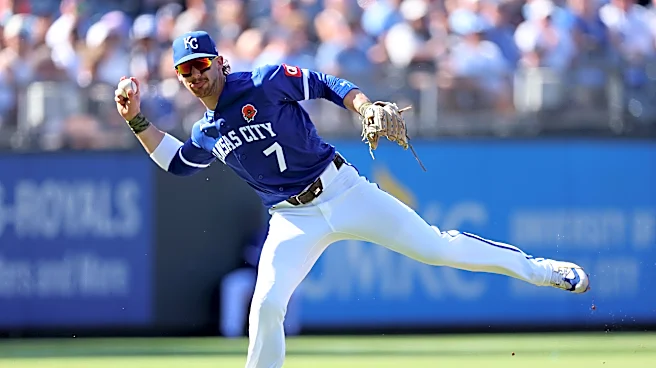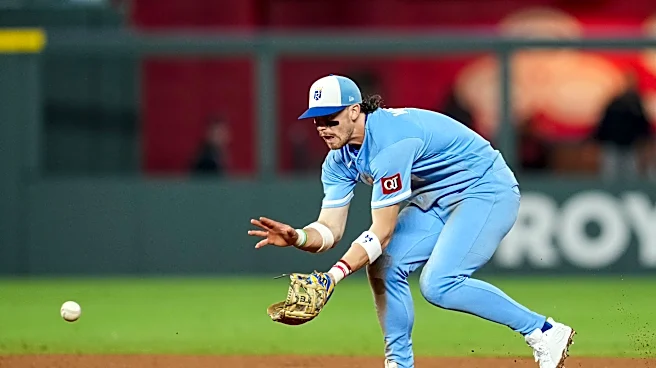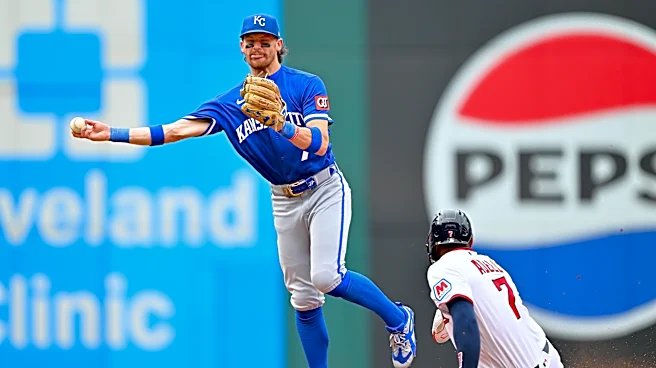



Bobby Witt Jr. is the best defensive shortstop in baseball. Last year’s Platinum Glove Award winner, Witt has the speed, arm strength, and refined technique to make the unthinkable plays and send everyone’s jaws dropping to the floor. Everyone expected Witt to pick up another Gold Glove this year, and maybe a second consecutive Platinum Glove. He’s that good.
But Witt did not win. This year, the winner of the American League Gold Glove Award at shortstop was Tampa Bay Rays defensive whiz Taylor Walls.
Now, Walls is a good defender; otherwise, he probably wouldn’t have a big league job because he doesn’t hit at all. Fortunately for Walls, you shouldn’t have to be able to hit to win a Gold Glove. It’s not the 90s anymore.
Unfortunately for Witt, Walls winning wasn’t a case of the better player winning. Witt was robbed.
Defense is famously one of the more difficult things to measure in baseball. Still, the industry has gotten better at it, and there are two widely-respected publicly available metrics that attempt to measure overall defensive contributions. One is Defensive Runs Saved, which is calculated by Sports Info Solutions. The other is Fielding Run Value, which is a Statcast-based statistic calculated by league itself. Both stats are presented as runs saved above or below average.
Sometimes, the two metrics grade players very differently because, again, measuring defense is hard. That’s true for Walls, who is a DRS darling but not seen particularly well by FRV. Which should you value, though? I think players should get credit if a stat thinks they are doing well. And so if you’ve read some of my writing about defensive stats, you know that I like to use a little house stat of mine; I call it AVGDEF. This simply averages DRS and FRV. I also like to prorate it over 1,000 innings—not unlike ERA—which I call AVGDEF/1000.
Overall, there were a dozen players with at least 600 innings. And lo and behold, Witt ranks the highest at AVGDEF and AVGDEF/1000. He was also the only player who had at least +8 DRS and FRV.
Walls had a great year. But Walls didn’t play as much as Witt did at short, and it’s at least a yellow flag that FRV thought that Walls was a below average fielder. Witt is consistently great by any metric, and by these metrics he was the best, because of course he is.
But Witt’s defensive stats only go so far. Per Rawlings themselves, defensive stats only account for a quarter of the overall vote. The other 75% of the vote comes from 210 total voters—the manager and six coaches from every team. You can’t win the Gold Glove if those voters don’t think that you’re better.
So how on earth did Walls draw so much of that vote? I think part of it is simply that the Rays were great and the Royals stunk. I know that team success isn’t supposed to be a part of votes like this, but I just can’t help that it was a contributing factor in a situation like this when you have two good candidates. Royals pitching gave up so many runs and the team itself lost so many games, and when you compare that to a Rays team that won their division (and then the pennant) while allowing fewer runs than Kansas City, well, maybe some biases creep in.
In any case, a Witt win would not have changed anything about the Royals’ 2026 fortunes or 2027 fortunes. But it would have helped Royals fans to feel a little better.