
The Atlanta Falcons have long tried to emulate other organizations. They sought to gain the personnel genius of the Patriots, the free agency and cap wizardry of the Saints (blech), and the defensive mastery
of the Seahawks and offensive excellence of the Titans. Never content to sit still, flitting rapidly from one disaster to the next, Atlanta has too often failed to understand both their moment and the way success sours quickly in the NFL, especially when you’re importing coaches and executives who want to do things the way they did them with their prior franchises.
What’s different about this hiring cycle is that the Falcons are pulling in different archetypes. There’s the near-Falcons lifer with no experience in his role but an innate understanding of where this franchise has succeeded and failed. There’s the general manager who learned from great executives and then had to put that wisdom to work rebuilding a sorry franchise into a playoff team, with all the mishaps and bumpy roads that implies. And there’s the head coach who is fresh off two seasons of abject failure with a dysfunctional organization, a very different addition than the hot coordinator hires the Falcons have favored.
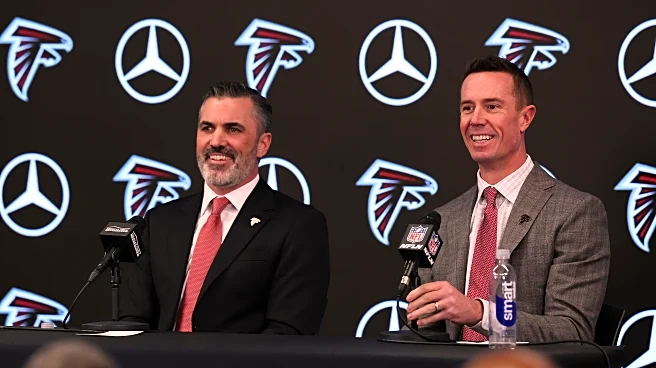
These three men come from drastically different backgrounds and have very different roles in this organization. What the Falcons are asking them to do is work together to find a better way forward, and all three will join this team in 2026 having experienced adversity and failure recently enough that it will shape how they approach their respective jobs. For the Falcons to enjoy a better future, they’ll depend on Matt Ryan, Ian Cunningham, and Kevin Stefanski learning from what didn’t work and being flexible enough to adapt and change as the league and this franchise do, rather than clinging to the ghost of past success the way this franchise so often has.
Matt Ryan
Few understand what the Falcons have done well and done poorly over the past two decades than Matt Ryan. Scooped up with the third overall pick in the 2008 NFL Draft, Ryan went on to have more success than any other quarterback in franchise history. He also fell short in big games and saw the tail end of his career wasted for reasons largely outside of his control, with his standout performance in the Super Bowl being marred by a slow motion defensive collapse, a couple of key execution errors, and a coaching mishap.
Ryan does not have experience in this role, which is the major knock on his hire, but what he does have experience with is the Atlanta Falcons. He’s familiar with their organizational dynamics, he’s familiar with how they’ve tried to prop up and ultimately failed front offices, coaching staffs, and rosters, and he’s familiar with the way a greed for short-term gains has led to them making costly decisions over and over again. He was traded to the Colts in the wake of one such disastrous decision, after all.
What that means is that while Ryan will need to learn his role as he goes, he does not need to learn all that much about the Falcons. A man who saw tremendous highs but never got to the promised land of a Super Bowl win with this franchise is now in charge of making it happen for a roster he’s no longer a part of, but you could not ask for someone in charge to better understand why the Falcons fell short. Ryan lived it, and all the ways the Falcons fell short of building a quality defense or taking advantage of their opportunities more generally have been teaching moments for him. If he’s learned from them, Ryan should have the patience, flexibility, and wisdom to resist jumping in to throw his weight around in search of big splashy moves and shortcuts and enable his new general manager and head coach to build a culture and roster that wins lots of football games.
Ian Cunningham
The last two Falcons general managers came from successful organizations. Thomas Dimitroff oversaw college scouting for several years for a juggernaut Patriots team, while Terry Fontenot handled pro personnel for a Saints team that had reeled off four double digit win seasons. Both were key cogs in those front offices and brought real expertise to Atlanta with them, Dimitroff much more successfully than Fontenot, but neither one suffered through years where the bottom dropped out and shakeups were underway.
Cunningham is different. He came from a pair of wildly successful organizations but joined the Chicago Bears in 2022, when the team was fresh off a 6-11 season and had enjoyed just three playoff berths and two winning seasons since 2010. This was not a model franchise, but an inept one, and one famous for never getting the quarterback position fully right. Cunningham and general manager Ryan Poles were among those tasked with pulling the Bears out of mediocrity, and it was a bumpy ride to do so.
Chicago went 3-14 in their first season, 7-10 in their second, and 5-12 in their third. Matt Eberflus was a bad coaching hire and the roster needed significant, significant retooling to be viable, the kind of multi-year rebuild the Falcons shied away from signing up for under Fontenot and (late in his tenure, anyways) Dimitroff. But it all came together in 2025, when all the big name signings, draft picks, and the right coach came together to propel the Bears to 11-6 and the NFC Divisional Round.
How much of that was Cunningham responsible for? That’s tricky to know, but we do know his strong college scouting background and consistent praise from Poles suggests he was a major piece of the puzzle. Critically, we also know that he’s viewed as a patient, even-keeled executive with a good eye for talent, joining and organization that has grown weary of incoherent plans and shortcuts. The fact that he and Poles were willing and able to assume control of a franchise with major problems and painstakingly fix it, including cleaning up their own personnel and coach mistakes, is a good sign for Cunningham in Atlanta.
Adversity is a different kind of teacher than success. If you emulate the best practices of great organizations, you can enjoy success, but changing times, philosophies, and attrition can leave you falling back on what used to work instead of exploring what might work now. Cunningham had to work with Poles and others in Chicago to rebuild the football culture and roster on the fly, figuring out a new way forward for a franchise that had become a punching bag, and the lessons he learned while he did so should serve him exceptionally well in Atlanta.
Kevin Stefanski
Every Falcons head coaching hire under Arthur Blank has fallen into one of two buckets.
- The up-and-coming coordinator who oversaw a promising offense or defense, or;
- The former head coach with a hot resume at the college or pro level.
Raheem Morris sort of fits in both—nobody would say his head coaching resume in Tampa Bay got him the job in Atlanta, but he had the experience and was the coordinator for a talented Rams team. Every other coach was in #1 or #2, from Jim L. Mora (49ers defensive coordinator) to Bobby Petrino (Louisville head coach) to Mike Smith (Jaguars defensive coordinator) to Dan Quinn (Seahawks defensive coordinator) to Arthur Smith (Titans offensive coordinator).
Kevin Stefanski is different. He’s a former NFL head coach, like Morris, but unlike Morris he’s fresh off his last stint instead of more than a decade removed from it. Unlike everyone else on this list, he was not imported from a franchise enjoying real success to bring in a tried-and-true philosophy and players from his old team. Instead, Stefanski was fired by the hapless Cleveland Browns and is coming off of two putrid losing seasons. There’s not going to be many successful practices from the Browns franchise to import here.
But the Falcons—and plenty of other franchises, given that Stefanski was a hot name on the coaching circuit this January—were more than willing to look past that. They’re not after Stefanski’s ability to bring the Cleveland way to Atlanta, but they are after Stefanski, the man and the coach who remained a steadying force in the turd tornado that is (appropriately) the Browns. They’re hoping that they have the measure of Stefanski as an offensive mind, a leader of men, and a head coach, but the Falcons are also counting on all that adversity giving their new coach perspective he might not otherwise have gotten.
What did we criticize Quinn, Smith, and Morris in particular for? The adherence to things that were not working, the stubbornness about making in-game adjustments and philosophical changes, and the shuffling of coaches and players but not necessarily the coaches and players who were proving to be the biggest drags on the team. Stefanski has success to draw on in Cleveland—two playoff berths for a franchise that hadn’t been there since their return is nothing to sneeze at—but he’s also had years of organizational dysfunction and his own mistakes to reflect on. Coaches like Mike McCarthy and Quinn have proven that saying you learned from failure is not the same as actually doing it, but Stefanski has experienced lower lows and more organizational ratscrewing than most before arriving in Atlanta. When he talks about not taking shortcuts and when he considers what didn’t work with the Browns, it should only help him avoid pitfalls with the Falcons.
We can’t know that Ryan, Cunningham, and Stefanski have learned from where they and their past franchises have failed in the past, of course. We can’t know they’re the right men for their jobs or that they’ll lift the Falcons into winning. The unknowns are the unknowns.
What I do like about this Falcons offseason, ultimately, is that the Falcons have brought on people who are familiar with lean years and failure. There’s a joke in there that it makes them well-suited for their roles with the Falcons, who have had nothing but lean years and failure for close to a decade. There’s also the potential for them to avoid the temptation to fit a template from a past organization on to a franchise that’s not a good fit for that template and to forget a path that’s truly new, one informed but not defined by a past that has featured hard knocks for all three men and this team alike. I hope they can seize this moment, as do we all.