






A bit over a week ago, I wrote about goals for every New Jersey Devils forward for the upcoming season. Now, it is time for the the blueline to get its look. Many people seem to be under the impression that defense and goaltending is a weak point for the Devils, but I am of the opinion that this is forgetting one key detail about Sunny Mehta’s offseason: that he traded former starting goaltender Jacob Markstrom to the Florida Panthers for Evan Rodrigues and Jesper Boqvist.
I am still not sure how
Mehta pulled this off, because Markstrom was a huge part of the Devils’ struggles last season. According to Natural Stat Trick, the Devils had the 24th-best defense by raw goals against per 60 minutes of five-on-five play while having the 15th-best expected defense at five-on-five. When you consider that Jake Allen saved over six goals above expected at five-on-five, that leaves some poor, poor numbers for Markstrom, who allowed about 10 goals above expected. But Markstrom is gone now, and the Devils’ defense can be put to a better test. How do they perform with Jake Allen leading the way in net? How do they perform with Nico Daws, who has been solid or better in each of his call-ups over the last few years?
Today, let’s look at the six established blueliners who will be returning to the team this year. Looking ahead, next weekend will close this series out and feature goals for the three goaltenders expected to play NHL games this season along with four defensive hopefuls.
The Defenders
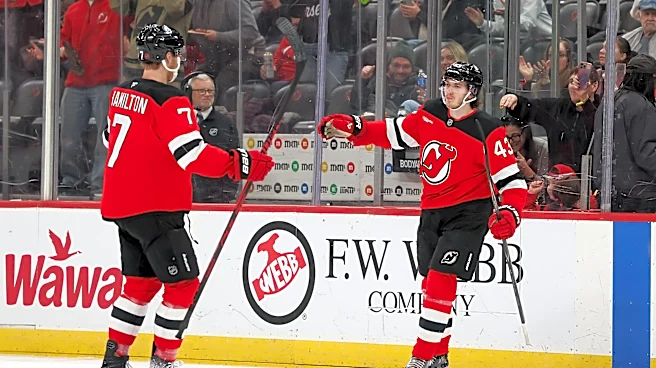
Dougie Hamilton
Goal: Put Up 60 Points
Ever since his knee injury in in the 20th game of the 2023-24 season, Dougie Hamilton has had a difficult time regaining his excellent form that he showed in the latter days of Lindy Ruff’s Devils tenure. Over the last season, injuries and some baffling usage decisions led to an excruciatingly slow start for the right-handed giant, as it seemed like Tom Fitzgerald was trying to force the big man out of New Jersey.
Alas, Tom, when you give out no-trade clauses…
Following the passing of the New Year, the Devils were off to one of their usual pathetic spirals that they regularly underwent last season. Tom’s big idea was to scratch Dougie Hamilton after a 4-1 loss to Pittsburgh where Dougie helped set up the Devils’ sole goal. It was notably not to bench one of the goaltenders who caused the 9-0 blowout debacle to the Islanders a couple days prior. Dougie was scratched for a very much not-ready-to-play Johnny Kovacevic and Simon Nemec, who was coming off a short injury in what turned out to be a terrible loss to Winnipeg where Nemec actually had some serious gaffes.
From the next game on to the end of the season, Dougie Hamilton had 29 points in 37 games. So, counting that Pittsburgh game and saying he finished the season on a 30-in-38 stretch, Hamilton played to a 65-point-per-82 (or now 66 per 84) pace. As Keefe got to play a more robust system to finish the year, and players like Nico, Jack, and Dougie got to play the way they’re best at playing, the offense from the top of the team was unlocked. Before the end of the year, Tom was shown the door.
Dougie’s goal for the season is simple: show everyone that this is who he is. He’s not a shutdown guy, but he is someone who drives offense from the blueline and manages by the grace of his long reach to not negatively impact the actual defensive part of his game. If he does this, he will be reminding onlookers that he is still a legitimate number one defenseman.
Luke Hughes
Goal: Make it so Dougie Hamilton doesn’t need to have a resurgence
So what if Dougie Hamilton has an okay year, but doesn’t get back to that top level that he showed a long glimpse of in the second half of last season? Well, it is time for Luke Hughes to hit that next level. Per HockeyViz’s Synthetic Goals model, Luke Hughes actually tracks in a similar pattern to his oldest brother, Quinn. They both started decent, had a strong age-20 year, dipped a bit in the third, and then were in a borderline 2D/3D territory at 22. But age 23 is where Quinn took a massive leap in quality of play, beyond the point production he had prior.


If Luke is to meet his potential, he needs to make that jump into solid 1D territory happen this year. If that happens in conjunction with Dougie resurging, great. But the Devils should be hoping for Luke to be the best defenseman on the team while playing like a true 1D. He has the tools and the speed to be a two-way monster, and this is going to be the first time since 2023 that he is healthy and signed for training camp. He missed the end of the 2025-26 season getting surgery to repair a shoulder injury that made him miss a month in January and seems to be ready for camp already. And with a long-term contract on the books, we don’t have to wait around to see him with the rest of the team.
Aside from be healthy and ready for the start of the season, what can Luke do to achieve that level?
- Luke needs to vastly reduce the number of blocked shots off his stick in the offensive zone. If he has space, he is dangerous, but he either needs to do one of two things: he can either make better decisions and more passes from farther out, or he can make it more painful to block his shots. Luke had a top shot speed of 97.2 miles per hour, per NHL EDGE, which was in the 89th percentile last season. If he can bust out more of those, and fewer 75 MPH wrist shots from the blueline (but maybe more of those from the wings or slot), he might run into less trouble in that area.
- Luke needs to be more physical. I get that he’s been nursing a nagging shoulder for awhile, but he has considerable size to go with his elite foot speed. He doesn’t need to line people up like Brendan Dillon, but he needs to be more of a bully with his backside when protecting the puck and get a little chippier around the net, even if referees overpenalize him for it at first. Once he starts playing like that consistently, the calls will fade a bit as he ages.
- Push for penalty killing time. Believe it or not, Luke Hughes was the Devils’ best left-handed defenseman by both expected and real goals percentages on the penalty kill last season by a wide margin in over 85 minutes.
Defensemen with Luke’s physical tools are near unicorns. If he cleans up those areas of the game while maybe converting more of his chances (keeping in mind that his oldest brother didn’t become the goalscoring threat he is now until he was 24) and getting more involved in defensive special teams, he’s going to have a good year.
Brett Pesce
Goals: Don’t Get Hurt, Consider Not Blocking Everything
Brett Pesce is a great player and I am happy he is a New Jersey Devil. That said, I want to see him able to finish his entire contract out. When he was in Carolina, Brett was a bit of a two-way threat, chipping in some secondary blueline production while playing a strong positional defensive game that was not very physical but still very disruptive in the neutral and defensive zones. In Carolina, he averaged about 106 blocks per season or 125 per 82 games, and that was dropping a bit by the end of his tenure. By comparison, he has blocked at a rate of 164 per 82 games in New Jersey, and he has only played 109 of a possible 164 games due in large part to that.
Sheldon Keefe and Brad Shaw need to see this by now, too. We shouldn’t be seeing stuff like this in the offseason:
In total, we only saw Brett Pesce fully healthy and in a groove for the first eight and a quarter games of the season…the Devils were 8-1-0 in those games, and Pesce had three points. In the remaining 28 games he played before his season-ending knee sprain, Pesce put up four points as the Devils went 12-15-1. Taking into account that his hand still didn’t feel right after that surgery, it would rather behoove the Devils coaching staff to conjure up a defensive system that doesn’t rely so much on his personal heroics. The team needs him healthy for the whole 84 games and hopefully more after that.
Jonas Siegenthaler
Goals: Be More Assertive and Keep the Puck Away From the Defensive Zone
While Jonas Siegenthaler has flashed some fantastic play throughout his Devils tenure, he has been a bit inconsistent over the years. As a shutdown defenseman, Siegenthaler can be a victim to the ebbs and flows of the team, but he is particularly gifted at one thing: denying zone entries at the blueline. Using some microstats from All Three Zones, we can see a few trends between Siegenthaler in his best season (2022-23) and the last two years.
- In 2022-23 and 2024-25, Siegenthaler had some positive offensive impacts. In 2022-23, Siegenthaler created a lot of point shots for Dougie Hamilton, and was a good facilitator in transition and on the cycle. In 2024-25, Siegenthaler was less effective offensively but still took quite a few one-timers that led to deflection chances. But last season, he wasn’t generally as involved in any specific manner.
- In 2022-23 and 2025-26, Siegenthaler was incredible at denying entries at the blueline. However, he was better at forcing dump-ins in 2022-23.
- In 2024-25, Siegenthaler was more assertive in the defensive zone, retrieving and getting touches on the puck often, leading to him being one of the best in the league at creating exits out of the defensive zone. He was a bit more conservative over the last season, and the Devils often had trouble as a team getting the puck out.
To reduce chances against against league average, you have to win the balance of battles in at least two of the three zones. You can possess the puck in the offensive zone so often that it’s difficult to score against you, and the Siegenthaler-Hamilton pairing was outstanding at that in 2022-23. But part of that equation was Siegenthaler also being a great stopper in the neutral zone. In 2024-25, with Johnny Kovacevic, neither Kovacevic nor Siegenthaler were outstanding in the offensive zone, but Kovacevic was outstanding stopping puck carriers at the blueline and they were both very good at getting the puck out of the defensive zone. Both of these sorts of pairings have been able to generate rather positive results. Last season, Siegenthaler’s pairings were mostly just good in the neutral zone. Not enough happened offensively, and things didn’t go well if the other team did eventually get the puck into the defensive zone.
Johnny Kovacevic
Goal: Play Similar or Better Defense While Reducing Penalties
Coming back from a major knee surgery, Johnny Kovacevic didn’t look too good to me in January. But once the Devils had the Olympic break behind them, Kovacevic performed much like he did in 2024-25. Over the team’s last 25 games, of which Kovacevic played 23, Kovacevic was fourth on the team in goals for percentage and one of seven to break even or better. His 2.44 on-ice goals against per 60 five-on-five minutes ranked fifth on the team and second on the defense to Luke Hughes’s 1.66/60. Kovacevic also had six points. Still, Kovacevic was not the best at reducing chances against with 2.85 expected goals against per 60, and his 50.07 xGF% was 11th on the team and well behind Luke Hughes’s defense-leading 54.84.
Still, his numbers were acceptable, and the team did well with him on the ice. So it would be great if he didn’t take 29 PIMs in those 23 games, bringing his season total to 38 PIMs in 34 games. Of those 38 PIMs, 18 were minor penalties and 16 contributed to putting the Devils a man down. Since Kovacevic is not very offensively gifted and contributes most on defense (and on the PK), his minor penalties can be difficult to deal with. His 0.89 minor penalties per 60 were second-worst to Brenden Dillon’s 1.06, far above Jonas Siegenthaler’s 0.53/60 and Brett Pesce’s 0.24/60.
Brenden Dillon
Goal: Play A Lot Better than the New LHDs on the Roster
Sunny Mehta has stacked the Devils with left-handed defensemen: Declan Chisholm was acquired on June 25 from the Detroit Red Wings, and Vladislav Kolyachonok was signed to a one-year deal on July 1. They, along with the giant left-handed prospect Anton Silayev, will be vying for NHL ice time this season. They, along with Seamus Casey, will comprise the defensive hopeful section of next week’s roster goals article. But in Brenden Dillon we have a guy who is probably the most vulnerable to getting moved out of the entire defensive group.
Business-wise, Dillon is in the last year of his contract. Each of the five other returning defensemen in this article have at least another year on their deals. Dillon also only has a 10-team no-trade clause, and his $4 million cap hit can fit teams that are looking for left-handed defensive help. Also consider that this is an analytical regime, and Brendan Dillon has legitimate weak-points. He takes a lot of penalties, as mentioned a bit above. And on the penalty kill, he sees a ton of chances against. Per Natural Stat Trick, Dillon had the worst chance rate against among defenders with 10.38 expected goals against, and his total of 26 power play goals against was the most on the team. Consider this: Brenden Dillon was a net -23 on the PK in 188 minutes, subtracting shorthanded goals from the total against. Dougie Hamilton was a net -9 in 111 minutes.
Dillon was much stronger at reducing even strength chances against this season. Maybe it was the goaltending, maybe it was something Simon Nemec did in their shared minutes, but Dillon managed to have the second-best expected goals against rate on the team (tied with Dougie Hamilton) while having the fourth-worst actual goals against rate (Nemec was worst on the team) at five-on-five.
And there are things that would be tougher to replace if Dillon were no longer a Devil. He can be wicked in the neutral zone and at the blueline, serving as a reminder for opponents to keep their heads up and be careful where and when they pass the puck to their teammates in the middle of the ice. But he does need to be a bit faster to pucks in the defensive zone and remember that he is most effective when he nails down the netfront area. When you see Dillon roving and chasing, things usually go poorly.
It’s also pretty easy to get the impression that Brenden Dillon is a well-liked teammate, though, especially among older veterans. If Dillon can play in a way that accentuates his strengths to the point that Sunny Mehta doesn’t feel the impulse to push one of Chisholm, Kolyachonok, or Silayev into his spot, it should be a good thing to get the best out of him before he likely moves on in the 2027 offseason. I’m still wondering how that 2025 Carolina series might have gone if he didn’t have such a serious neck injury halfway through Game 1 (amongst other untimely injuries).
Your Thoughts
What do you think of the goals I’m suggesting here for our returning blueliners? Do you agree, disagree, or have anything else you would suggest they should be shooting for? Leave your thoughts in the comments below, and thanks for reading.