
#1 – Luka Garza and the Celtics controlled the board
I never thought I would start the 10 takeaways with Luka Garza one day, but here we are – and how could we not? In 26 minutes, the former Timberwolves big man grabbed nine offensive rebounds. That’s as
many as the entire Raptors team.
Led by Garza, the Celtics brought much more energy and showed far more discipline on the glass, and that is what won them the game. Looking at the Four Factors, the Celtics and the Raptors performed similarly in eFG%, TOV% and FT rate… but the rebounding domination was outrageous.
Because of that, the Celtics finished with 101.6 true shot attempts last night, ten more than the Raptors. With ten extra opportunities to score, Boston built an important road win against another playoff team in the East.
#2 – Pritchard hunting the jump-shots
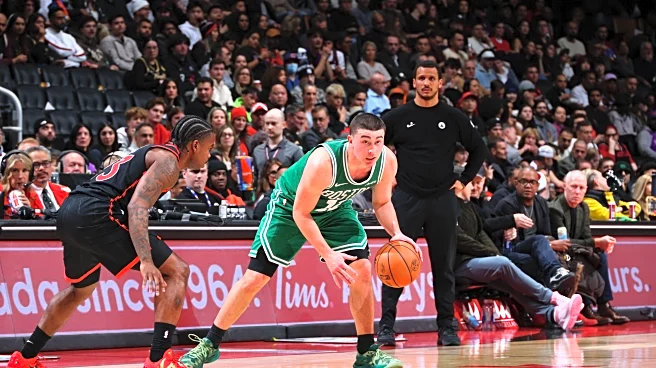
Last night in Toronto, Payton Pritchard took 18 jump-shots. From seven to 30 feet, Pritchard was able to get to his spots without losing the ball. Only one turnover, while generating 33 points and 10 assists.
Against all matchups, he was comfortable using his speed and punished the Raptors’ switch defense. When defended by Jamal Shead or Immanuel Quickley, he actively looked for a screen to either create space or force a slower defender onto him.
Once switched onto Scottie Barnes or Sandro Mamukelashvili, PP could speed things up with ease and consistently find his spots, even against an aggressive defense. Thirty-three points on 65% true shooting, alongside ten assists — safe to say Pritchard was very comfortable with the increased usage with Jaylen Brown out.
#3 – Pick-and-roll reps for PP
Alongside one of the best screeners in the league in Queta, and without Brown as a ball-handler, it was the perfect night for Pritchard to work on his pick-and-roll game. On this first example, notice how close his hips are to the screener, which pins Brandon Ingram below the play.
Because of his shooting gravity, Mamukelashvili overcommits defensively and jumps, which opens the roll for Queta. With the Celtics’ best shooters stationed in the corners — Derrick White and Sam Hauser — there is no help, and that’s two easy points generated out of the pick-and-roll.
The Celtics ran a lot of pick-and-roll to punish the Raptors’ switch defense, but once they realized Gradey Dick couldn’t keep up with PP, they shifted to a double-and-recover coverage. However, Joe Mazzulla is no fool. He asked Baylor Scheiermann to set a screen on an empty side, so when the Raptors briefly double Pritchard after the screen, there is no help coming from the corner and he can drive the ball. A clever read from both Pritchard and the coaching staff to punish the aggressive coverage.
#4 – Bench zone defense
After the rebounding and Pritchard’s scoring, the third major reason for the Celtics’ win was the zone defense with the bench unit. The goal of that zone was simple: force as many jump-shots as possible — and the numbers show it worked.
In their previous game, the Raptors took only 24% of their shots from deep, generating far more attempts and efficiency at the rim. Last night, the Celtics forced a very different profile: 51% of Toronto’s shots came from beyond the arc, while rim attempts dropped to just 23%, with poor efficiency (50% on shots within four feet).
With less rim protection in the bench unit, the Celtics bet on the Raptors’ lack of shot-making to compensate. It worked well — as long as Mamukelashvili wasn’t on the floor.
#5 – Mamukelashvili dilemma
The former Spur kept the Raptors in the game thanks to his scoring. To protect the paint at all costs, the Celtics were willing to leave him alone in order to keep Neemias Queta or Garza near the rim — but he was not the right guy to ignore from deep.
After six made three-pointers, the Celtics adjusted their coverage and put their center on players with less shooting gravity, such as Ja’Kobe Walter or Scottie Barnes. This allowed them to stay closer to the paint without taking unnecessary risks on Mamukelashvili’s shot.
As the Raptors big man rarely uses post-ups and plays more like a guard, Derrick White or Hugo Gonzalez were better defensive matchups for him.
#6 – Queta playing in space
Another highly efficient scoring night for Queta, with only one missed free throw and seven made field goals on 100% efficiency. To create space and use his speed, Joe Mazzulla and his staff deployed him frequently away from the paint.
In the first action below, he gets the ball from a handoff, then flows directly into a zoom action as a screener to create a gap for Pritchard. After all that movement, he can use the space to flash into the paint.
The timing of the next play is also excellent in helping Queta move in space. Sam Hauser’s back screen on Mamukelashvili comes just late enough to give Queta the best possible angle to roll to the rim.
And yet, the most impressive play from Queta came in the third quarter. Catching the ball beyond the arc, he fakes, drives against Sandro, and with just a few dribbles gets deep into the paint to score at the rim by himself.
#7 – Gonzalez inbound cuts
Speaking of tactics, let’s look at Hugo Gonzalez’s two buckets off inbound plays. They show that Hugo is much quicker than his size and body language might suggest. On the first play, he completely tricks Gradey Dick, forcing him into Garza’s screen. With the switch poorly executed and Scottie Barnes too close to Josh Minott, it results in an open layup.
Using a similar approach in the second quarter, Hugo again uses a screen from Garza before sprinting to the rim. Barnes stays attached to him but expects Sandro to switch — and it’s already too late, as Hugo finds himself free at the rim once again.
#8 – Reversed Spain PnR
Joe Mazzulla also pulled another card from his playbook with a reversed Spain pick-and-roll. Usually, a Spain pick-and-roll uses the big man as the initial screener on the ball, with a shooter setting the back screen. On the play below, the roles are reversed, with the ball screen from Hauser and the back screen from Garza.
It doesn’t create enough immediate separation, but once Garza sets the second screen, the Celtics flow into a handoff that generates strong offensive continuity. They also ran the traditional Spain pick-and-roll to keep the defense guessing.
#9 – Baylor Scheiermann forced 3 turnovers in 3 minutes
In just eight minutes, Baylor Scheiermann made an immediate impact at a crucial moment of the game. Starting the fourth quarter, he applied strong pressure on the ball and created transition opportunities — including a beautiful pass to Hugo.
Like last season, despite limited playing time (around ten minutes per game), Baylor keeps impacting the game defensively with his ability to generate turnovers, consistently showing his basketball IQ.
#10 – Double-big lineup
After weeks of seeing small-ball lineups off the bench, Luka Garza was back in the rotation and the Celtics played with a true center on the floor at all times — even using two centers together at points. That’s how little they respected the Raptors’ spacing.
Queta and Garza switched onto wings without much concern for their shooting, making sure no one could touch the paint.