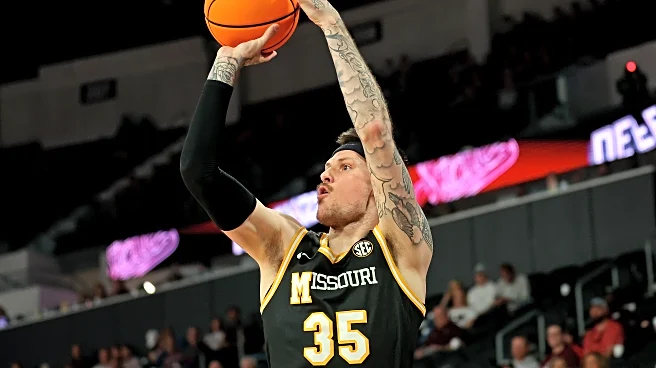


Eighteen seconds remained in the first half when Jacob Crews bolted up the lane off an elevator screen, got balanced and drilled a 3-pointer against Kentucky at the SEC Tournament.
Canning that shot also snapped a drought.
The last time the Missouri wing hit a jumper, the Tigers were in garbage time, furiously trimming a deficit in a loss at Oklahoma. But even that wasn’t his longest dry spell. Earlier in February, Crews went four games without knocking down a catch-and-shoot jumper. He’s attempted
just 18 of those shots since Missouri entered SEC play — bringing his season total to 114.
Keep in mind, coach Dennis Gates set the ambitious goal for Crews to make 100 of those shots this season. Crews’ shot volume encapsulates the inconsistency that has confronted the Tigers’ backcourt at various junctures.
Optimists might point to T.O. Barrett’s emergence. Or that Jayden Stone, whose career has been pockmarked by injuries, has exceeded modest expectations. They could also note that Trent Pierce has settled into a reliable reserve role.
Yet Missouri’s preseason ambitions hinged on something else: Anthony Robinson II becoming a consistent scoring threat, Crews replacing a portion of Caleb Grill’s long-range production, and UCLA transfer Sebastian Mack providing downhill pressure. That hasn’t materialized. Robinson’s development has stalled, Mack has been out of the rotation since a 26-point loss at Alabama, and Crews’ role has diminished.
Instead, the Tigers have settled into an equilibrium — one good enough to earn a No. 10 seed in the NCAA Tournament, a matchup with Miami, and a de facto home game Friday at Enterprise Center in St. Louis.
In Miami, Missouri will see a mirror. The Hurricanes also rely on a short rotation, score efficiently at the rim, and run their offense through a dynamic forward. Like the Tigers, they depend on physical lead guards who can swing outcomes — and face the same question about what the rest of the backcourt can provide in a toss-up affair.
Understanding Missouri’s bind starts with a wide-angle view of usage — how many touches the guards receive, and how efficiently they convert them.
Let’s start with possessions. The chart above shows average backcourt possessions expanding rapidly in early January when Stone and Pierce returned from injury. That allocation then remained steady throughout SEC play, between 46.7 and 49.0 per game.
Unsurprisingly adding Stone and Pierce led to a sustained scoring increase as conference play progressed, peaking during the upset of Vanderbilt.
Now comes the important part: efficiency. Among Missouri’s guards, it gradually declined as the schedule toughened. The slope turned downward again in January as the Tigers adjusted their rotation. While it’s subtle, points per possession improved briefly in early February, plateauing the night Missouri knocked off Tennessee.
A closer look reveals how fragile that balance is. Let’s examine possession allocation among the backcourt.
Over the last two months, Robinson and Crews saw steady declines in touches, which were reallocated to Barrett, Stone, and Pierce. By early February, Pierce’s average possessions surpassed Crews, and Robinson’s surplus over Barrett evaporated at the SEC Tournament.
The same situation has unfolded with scoring output: Barrett, Stone, and Pierce have backfilled for Robinson and Crews. Healthy versions of Stone and Pierce were supposed to be additive. Instead, they’ve mostly provided just enough production to keep MU afloat.
That stress has become clear the past couple of weeks.
How can we see it? By looking at possessions, scoring and efficiency over the last 11 games. During that period, average possessions fell by 8.7 percent, points per possession slipped by 8.6 percent, and points per game dropped by 16.6 percent.
Exploring shooting and play-type reveals what’s happening. Barrett’s possession volume has remained steady, but those touches have decreased in value since he bullied the Volunteers. In his last four outings, the sophomore is shooting just 46.1 percent at the rim, with looks now worth only 0.961 points.
Stone’s scoring chances are unchanged, but less effective. Since Jan. 31, he’s hit only 34.1 percent of catch-and-shoot jumpers and his efficiency on those fell 20.9 percent. Pierce remains reliable overall, but his output varies game to game.
Every so often, Barrett faces an opponent and a mismatch he can exploit, but the past couple of weeks have reinforced the notion that he’s bumping up against a ceiling. Occasionally, Stone or Pierce shoots it well enough to come along for the ride. When that occurs, the Tigers pack enough potency to supplement Mitchell, who is routinely playing 35 minutes and pushing 30 percent usage, to get a quality result.
MU achieved that alchemy enough down the stretch to assemble tournament-worthy credentials. Yet it also saw that buffer dissolve during a three-game losing streak ahead of Selection Sunday. What that means going forward is less clear.
To Robinson’s credit, he’s stabilized after a January tailspin. He’s quietly boosted his efficiency in recent weeks, but that progress has come on just six shots per game. It also reflects occasional makes from long range. The junior is converting only 43 percent of his point-blank chances in that span.
Then, there’s Crews’ vanishing act.
He averaged almost five catch-and-shoot attempts during MU’s first 21 games, but that cratered to 1.6 per night in the latter half of SEC action. Plugging Stone and Pierce back in was always going to cut into his role, but Crews’ usage rate in SEC play is 12.7 percent — the lowest of any Tiger seeing regular minutes. The question now isn’t necessarily whether Crews is hitting shots. It’s whether he’ll shoot it at all.
Solutions aren’t within easy reach, either.
While we can critique MU for featuring Shawn Phillips Jr. early on and its early structuring of the rotation, Gates and his staff have mostly pulled the right levers since the new year. First, they slowed the tempo. Next, they shortened the bench. And by mid-February, the staff calibrated a substitution pattern that steers clear of underperforming lineups. Trent blossomed briefly to bestow needed flexibility. Along the way, they modified some facets of their offense against Vanderbilt($) and Tennessee to help Mitchell assault opponents from his preferred locales.
What the Tigers need now is obvious but also elusive: consistency from their backcourt.
Mixing up personnel or tweaking sets can help, but the data makes an elegantly simple case. Their guards need to make the most of what the sub pattern and system offer them. When they oblige, the Tigers punch above their weight. The last three weeks vividly show us what happens when they don’t.
It’s also what might tip the balance on Friday night.
We’ll see which version of the backcourt turns up.