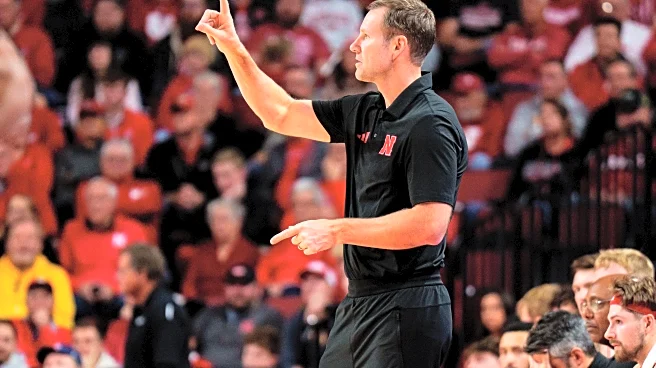

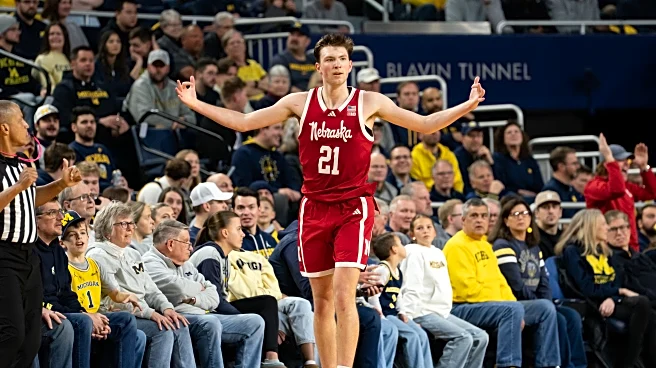


Fred Hoiberg’s Nebraska has spent the last three seasons seemingly on the edge of a breakout.
There was the 2022-23 team that won five of its last six in the regular season as sharpshooting guard Keisei Tominaga began to capture some national attention, the 2023-24 team that made the NCAA Tournament before a hot shooting night from an ordinarily 3-point deficient Texas A&M squad ended its run before it began and, last but not least. the 2024-25 group that went a respectable 21-14 without star Rienk
Mast.
Getting there wasn’t easy. Hoiberg went 7-25, 7-20, 10-22 and 16-16 in his first four seasons in Lincoln. Each showed some level of improvement and building up a program that’d spent much of its history mired in mediocrity at best was going to take time, but four years is a long, long time.
Now the Huskers sit at 10-0 in the 2025-26 season with a 14-game winning streak stretching back to its College Basketball Crown title this past Spring. It’s not like they’re playing a bunch of nobodies either, they just 30-pieced Wisconsin after blowing out in-state rival Creighton.
So, how is Hoiberg doing it?
Contrary to what’s been customary around the Big Ten for decades, Nebraska plays a modern brand of basketball that emphasizes pacing and spacing on the offensive end of the court. These Huskers get out running and let the ball fly if they’re open with strong offensive showings in the majority of their games.
They’re also excellent at making the whole greater than the sum of its parts. On top of their shooting and pace, Nebraska is pretty pass-happy and has four players averaging 2.7 or more assists. The bulk of that comes from the Husker backcourt, but Mast adds an extra dimension as a passing center.
Mast’s return to action was an undertold positive to this team on a national level. He was great in 2023-24, averaging 12.3 points, 7.5 rebounds ands 3 assists while shooting 43.3% from the field and 34.4% from distance. He’s even better now, averaging 18 points, 6.5 rebounds and 3.1 assists while shooting 54.6% from the field and 41.7% from 3-point range.
Standing at 6’10”, Mast brings a ton of skill to his position with crafty footwork in the paint and great court vision. Nebraska’s off-ball movement creates several lanes for Mast to take from the arc or on the block and he has the accuracy to deliver the ball where it needs to go for an assist or an extra pass to get a clean look. There isn’t a spot on the court that Mast can’t hurt a defense, making coverage all the more complicated especially now that he’s hitting shots from deep at over 40%.
As for other passers, Jamarques Lawrence leads the team with 3.9 assists per game, Sam Hoiberg is a close second with 3.8 and Pryce Sandfort is at 2.7.
That adds up across the team, with Nebraska’s roster sporting an assist rate of 62.8%, good for 19th nationally. A high assist rate means better basketball more often than it doesn’t for the simple reason of passing leading to better shots more often than it doesn’t. It’s a stylistic choice that’s let many a talent-deficient team stay on the court against superior-on-paper competition and many talent-strong teams win games late into March.
Nebraska isn’t loaded with talent but its certainly not deficient. Mast can, and is, performing at an all-conference level while Sandfort has emerged in his first season as a regular starter with averages of 15.6 points, 5.4 rebounds and 2.7 assists while shooting 37.2% from distance.
What Fred Hoiberg is doing is putting his players in a position to do what they’re best at. For Lawrence and Sam Hoiberg, it’s facilitating and taking the shots when they come. For Sandfort, it’s some of the same with a bit more scoring. For Mast, it’s a bit of everything. The rest of the Huskers have roles to play and have done so well up to this point.
If there’s weaknesses for Nebraska on offense, it’s their general lack of size proving less than successful against reliable rim protection and a lack of offensive rebounding. Neither have really slowed it down, the Huskers are still hitting 62.3% of their attempts on 2s.
The Huskers rate even better defensively, sitting at 25th in KenPom’s efficiency rankings. They tend to drag possessions out on that end, grinding the opposition into late clock situations where good shots are hard to come by.
There isn’t a ton of ball pressure on that end, instead the Huskers try to seal off passing lanes in the interior and create a wall to keep the ball from getting through the 3-point line. They’re doing that without fouling, allowing a defensive free throw rate of just 20.6%, good for third nationally.
In turn, Nebraska’s foes have to settle for a lot of 3s. Few teams see more attempts from distance than the Huskers, with a whopping 3-point field goal rate of 51.3%, among the highest nationally. Just 29.4% of those attempts end up going in.
Nebraska gives up a solid amount of looks from distance, but typically recovers well enough to contest and matches the volume on the other end, avoiding any sort of shooting discrepancy.
This is the formula Hoiberg used to build this program through the years, taking away the interior defensively as he put together a roster that could keep up by making enough 3s. Now that’s paid off with the talent he’s acquired and the system he’s instilled.
Nebraska looks strong heading into Big Ten play and it’ll be worth tracking how this style fares in a conference that hasn’t dealt with or deployed it too much historically.