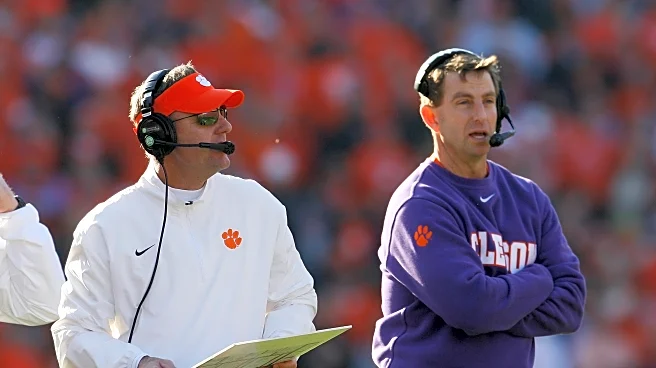

Clemson’s decision to move on from Garrett Riley and bring back Chad Morris is not a nostalgia play. It’s a structural one.
This hire suggests that Clemson wants to shift to a more run-forward, or at least
balanced, offensive structure. The pass-forward model that defined the Riley era did not generate the outcome everyone wanted — not because Clemson lacked talent, but because the structure itself narrowed the margin for error too far.
Looking at the two eras side by side reveals why.
The Two Eras, By the Numbers
Across both tenures, Clemson ran roughly the same number of plays per season. The difference lies not in volume, but in how those plays were distributed, their relative success and what they asked the quarterback to do.
Run–Pass Distribution
- Morris era (2011–2014): 53.1% run / 46.9% pass
- Riley era (2023–2025): 48.6% run / 51.4% pass
That shift shows a clear shift in philosophy. Its effect is magnified when you look at how efficiency and leverage changed alongside it.
Passing Efficiency
- Morris era YPA: 8.15
- Riley era YPA: 6.97
Third Down Conversion
- Morris era: 44.8%
- Riley era: 38.7%
Points Per Game
- Morris era: 36.4
- Riley era: 30.3
Red Zone Scoring Percent (TD or FG)
- Morris era: 82.5%
- Riley era: 79.0%
These are not only stylistic differences. They’re outcome defining differences.
What Changed — And What Didn’t
The modern assumption is that leaning into the pass automatically increases an offense’s ceiling. Clemson’s recent data challenges that idea.
Despite throwing the ball more often under Riley:
- yards per attempt dropped
- third-down efficiency declined
- total scoring and scoring consistency suffered
Importantly, this wasn’t driven by obvious culprits like protection. Sacks per game actually declined slightly during the Riley era. Cleaner pockets did not produce cleaner offense.
The issue wasn’t execution in isolation — it was structural leverage.
The Problem With a Pass-Forward Structure
A pass-forward offense narrows the margin for error by design by adding explosiveness and an increase in success rate.
When early downs skew pass-heavy without explosive efficiency or high success:
- second and third downs carry more weight
- missed throws end drives outright
- quarterbacks are asked to convert leverage downs repeatedly
That’s exactly where Clemson struggled.
Third down is where offense structure either holds or collapses. Under Riley, Clemson simply didn’t win there often enough. And when you fail at a higher rate on third down, everything compounds: shorter drives, tighter games, and fewer chances to absorb mistakes.
The offense didn’t lack for effort or complexity. It lacked insulation.
Why a Run-Forward Structure Changes the Math
This is where the Morris comparison matters — not because of nostalgia, but because of risk distribution.
1. It Lowers the Burden on the Quarterback
Morris’s offenses did not require quarterback perfection to function.
By leaning slightly run-forward:
- early downs were less volatile
- negative plays didn’t immediately kill drives
- quarterbacks were asked to exploit leverage, not create it every snap
That’s why Clemson could still average over eight yards per pass attempt while running the ball more often. The quarterback wasn’t responsible for keeping the offense alive — only for punishing defenses when they overcommitted.
2. It Allows Wins on Off Days
One of the defining traits of the 2011–2014 offenses was resilience.
Clemson could still win games where the quarterback:
- missed throws
- had uneven stretches
- didn’t dominate statistically
The run game provided an alternative path to success. That doesn’t make the passing game less important — it makes the offense less fragile and less dependent on one player.
By contrast, a pass-forward structure with middling efficiency has no fallback. When the quarterback isn’t sharp, the offense stalls and you lose games.
3. It Lets the Offense Dictate Terms Late
Perhaps the biggest difference shows up in close games:
- keeps play-action viable
- forces defenses to still defend the full playbook in the fourth quarter
- dictates substitutions and personnel groupings
This isn’t just about grinding the clock. It’s about maintaining leverage.
When the offense can run the ball without becoming predictable, it doesn’t have to shrink late. It can close.
What This Hire Suggests
Clemson didn’t just change coordinators. It signaled a reassessment of structure.
This hire suggests that Clemson wants to move toward:
- balance over dependency
- Situational leverage and risk management — creating favorable downs early so that risk does not concentrate on one player or in high-impact snaps like third downs and red zone plays.
- control over constant aggression
That doesn’t mean abandoning modern concepts. It means acknowledging that pass-forward football without pass dominance is a losing bet.
What to Watch Going Forward
Early indicators will matter more than play design:
- early-down run rate
- third-down conversion
- passing efficiency, not attempts
If Clemson regains balance, the biggest beneficiary won’t just be the quarterback. It will be the entire team — operating with margin again.
Because the lesson of the past few seasons is clear:
An offense that requires perfection rarely gets it.
Be sure to check out our sponsor, Section 103, which has added a Clemson apparel collection.
They have polos, hats, stickers, and a variety of shirts to choose from. You can grab some new Clemson gear with our promo code for 10% off: STS10