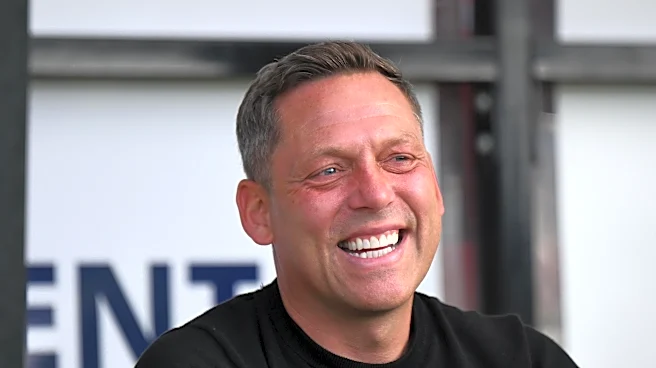



It really doesn’t feel all that long since he was appointed, but Leam Richardson’s hit two big milestones this week. The Barnsley game was his 50th in charge of the Royals (in all competitions), and October 28 is the one-year anniversary of his appointment.
Below I’ve recapped the story so far, as well as going into the stylistic changes he’s made and the performances he’s overseeing – both collective and individual. You can also find our latest approval rating poll at the very bottom of this article.
This is the third such poll we’ve run on Richardson. The first (January 2026) yielded a mark of 3.67/5, but there was a massive drop-off at the end of last season to 1.7/5.
The story so far
While the decision to relieve Noel Hunt of his duties 12 months ago wasn’t particularly unpopular (though he had his defenders), Reading’s appointment of Richardson prompted a somewhat mixed reaction. On the one had he brought obvious pedigree (having won the League One title with Wigan Athletic) and was brought in reassuring quickly, but the perception for many fans was that he was an underwhelming choice.
In league action (let’s ignore that Carlisle United game for everyone’s sake), his tenure started pretty well: six wins in 10 games before the end of the festive period. Despite some horror shows in London (3-1 at Leyton Orient, 3-2 at AFC Wimbledon) and an unconvincing style of play, another six wins (in 14) by mid-March pushed the Royals into the top six.
And that’s where everything unravelled. Reading needed to up their game in the closing weeks of the campaign but, in reality, did the opposite: more opposition sides celebrating promotion on our ground (two) than wins of our own (one), with some other ugly performances to boot: Stevenage away and Doncaster Rovers away in particular.
The result? Two dead-rubber fixtures to close off the campaign, a worryingly sour mood and increasingly vocal calls from fans online and on matchdays for Richardson to be sacked.
Personally, I ran out of patience after the depressingly unambitious 1-1 draw at Rotherham United. He simply didn’t look like the man to take us forward. I’d argued shortly after his appointment that a key task facing him would be to tackle supporters’ apathy, but on that front, things only got worse during his first six months in the dugout.
To some fans’ annoyance and/or bewilderment however, the ownership stuck by Richardson, opting for stability over yet more change in the dugout. Rob Couhig made that case on our podcast in late April in typically unapologetic Couhig style.
Tactical and stylistic changes
Repaying that faith though, from the summer onwards, Richardson’s looked like a distinctly different manager – and Reading have looked like a distinctly different team.
The key statistic, with 26% of Reading’s league fixtures played, is that Reading sit sixth. In fact, on a ‘points per game’ basis (to factor in how some clubs have played more matches so far) Reading are actually fifth – swapping places with Saturday’s opponents Plymouth Argyle.
The 2026/27 version of this side is markedly more positive and entertaining in possession. That’s been partly down to a tactical change – Reading now committing to a standard 4-2-3-1 with wingers and full-backs providing width on both sides, rather than the more rigid hybrid of 4-2-3-1 and 3-2-4-1 (or 3-box-3 if you prefer) Richardson used last season.
But tactical changes still require a manager to commit to them by instilling a more attacking mindset, and that’s certainly been evident this season. Reading have upped their shots per game tally from 10.9 last season to 15.4 this season (fifth-best in the league), and goals per game from 1.39 to 2.08 (best in the league).
In fact, going by league games this season, the Royals are as likely to score five goals in a game as they are to draw a blank (twice each). This is a team that consistently scores goals and, even on an off day, looks like a threat – markedly different from last season.
Collective and individual performances
In terms of overall performances, Reading are clearly looking a better side this season than last. There have been some standout showings: Blackpool at home is my highlight, but you could also throw in Stevenage away, games when we stuck five past Mansfield Town and MK Dons, and possibly a commendably stubborn display to give Premier League Brentford a good game in the League Cup.
At the other end of the spectrum, the Chelsea and Wigan Athletic games were probably the worst we’ve seen from Reading this season. Our lowest level in 2026/27 does seem to be less severe as the lowest level in 2025/26 though, and it comes less often.
That being said, performances do seem to have been dropping off a bit in recent weeks; Reading haven’t been at their same level from earlier on this season in the last half a dozen matches or so. While that’s correlated with injuries – Jack Marriott, George Earthy and Benn Ward – we still need others to step up to compensate.
Which brings us to individual performances – quite a mixed picture.
Reading’s best players so far this season tend to be summer signings who’ve hit the ground running, including Kyreece Lisbie, George Earthy and Udoka Godwin-Malife. That certainly shows Richardson’s done a good job in getting those players up to speed quickly and improving the first team.
He’s also developed some others who were here already. The obvious example is Paddy Lane, who looks like a new player from last season, but I’d also throw in Paudie O’Connor (although the scale of the upgrade has been less extreme) and Marriott (who somehow seems even more ruthless this season).
On the flipside, too many individuals have stagnated or gone backwards. Chief among them are Joel Pereira and Lewis Wing, both of whom were some of Reading’s best players in recent seasons but aren’t at those same levels now. While for me they’ve actually just gone from being ‘very good’ to ‘good’ (some of the criticism has been over the top), that’s still a bad trend.
Although Andy Rinomhota’s pushed him down the pecking order, Charlie Savage has still gone from a key player to someone who’s now not really strongly pushing for a spot in the first team. Similar can be said of Daniel Kyerewaa – on paper a quick, direct winger who should fit this system to a tee, but has dropped to fourth choice behind Lisbie, Lane and Randell Williams.
Anything else?
A commonly aired frustration last season was how wide of the mark Richardson’s media comments sometimes felt – particularly after the 1-1 draw at Port Vale.
However, as noted in the epilogue of Rescuing The Royals by Josh Lewin (a book covering the 2025/26 season): “A plan was hatched for Leam to get some media training from an independent party over the summer, and Leam agreed to try to be ‘less guarded’, with the warning that old habits usually die hard.”
Whoever conducted that training deserves a raise (credit to Richardson too of course, in all seriousness). Since pre-season, he’s come across far, far more relaxed, confident, frank and personable in his pre- and post-match media interviews. His interview after the Barnsley game was a good example – striking the right balance between criticism and praise, while still coming across as authentic.
Approval
What do you make of the job Richardson’s done in the dugout so far?
You can grade him in our approval rating poll below, with one being the lowest and five the highest. If the poll doesn’t display on your device, try this link right here.