


The room where a team gathers to hear the announcement of its postseason fate on selection day is often fraught with anxiety and anticipation.
For the Mizzou gymnasts, staff and supporters assembled at the Columns Club in Memorial Stadium two weeks ago, any cause for concern was already far in the past.
As one of the nation’s top 16 teams by their National Qualifying Score, the system used by the NCAA to determine placement and qualification for the postseason, the Tigers already knew their seed and their destination.
Now, MU heads to Lexington, Kentucky, as the No. 8 national seed just two steps away from another nationals appearance, which would be the program’s third in the last five years.
And as impressive as that achievement would be on its own, Mizzou is also on the cusp of something even greater: earning a status as one of the sport’s elite. While the Tigers are still relatively new to the national stage, they are already knocking on the door of a place very few MU programs before it have entered.
Returning to Fort Worth for the second straight year would leave no doubt: Mizzou is becoming one of the sport’s legitimate, national powerhouses.
How the Tigers have established themselves as a standout brand in gymnastics is arguably just as interesting as how they have gotten so close to reaching the mountaintop of the sport.
Reaching New Heights

By any objective measure, this postseason will be the culmination of the greatest five-year span in program history.
Two of the program’s four total national championships appearances have come during that stretch, including last season’s record-breaking third place finish at Four on the Floor. MU also finished fifth nationally in 2022.
The team’s prior highest finish had been No. 12 in 2010 under head coach Rob Drass, when 12 teams made the national championships. Mizzou’s first nationals appearance came all the way back in 1981 under Jake Jacobson during the program’s second season when the Tigers finished 16th at the AIAW National Championships, the last season before women’s gymnastics became an NCAA-sanctioned sport.
But neither of those coaches were able to achieve the kind of consistency MU has found under Shannon Welker. After ending his first season in Columbia at No. 41 in the national rankings, 2014, the Tigers have finished the season ranked 21st or higher every year since.
Mizzou has also finished in the top-15 of the national rankings for five consecutive seasons, a streak that is poised to extend into a sixth year barring a major upset at regionals. The team’s previous longest stretch of consecutive years in the top 15 was just two, from 2005 to 2006 and again from 2009 to 2010.
“He’s done a great job at building up this program and making it a program that gets better every single year in so many different ways,” assistant coach Jackie Terpak said of Welker, “and continues to grow.”
Perhaps no statistic better reflects the transformation of the program under Welker than the individual accolades received by MU gymnasts during his time in Columbia.
Eight Tigers were named WGCA All-Americans between the beginning of the program in 1980 and 2021. Mizzou gymnasts have received 12 All-American honors over the last five seasons, including eight just last year — matching the total set over the program’s first 42 seasons of existence.
Not only did eight MU gymnasts earn All-American status last season, but Helen Hu delivered the Tigers’ first individual national championship in gymnastics with her 9.9875 on beam in the national semifinals.
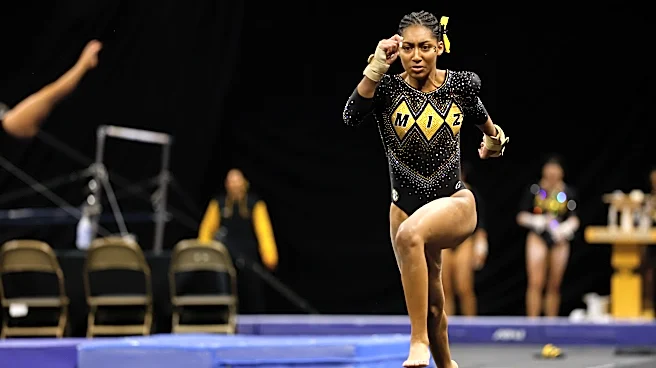
While Hu’s beam performance was arguably the hallmark of last year’s team, Mizzou’s floor squad — known as the Fab Floor — has become its calling card. The Tigers have combined high-caliber performances with show-stopping routines known for their creativity, ranking in the top-10 nationally on the event four of the last five seasons and going viral with gymnastics fans on social media.
The driving force behind the routines: Terpak, who coaches the floor squad and also serves as the team’s choreographer. She helps build each gymnast’s routine, from music to dance moves and the technical portions of the performance.
“Every athlete’s a little different, and although we have a system in place, they all need certain little things for them individually,” she said, “and so not only pulling that out of them and building a routine that’s best for then, but then that’s also going to complement this team and keep them moving forward.”
The process begins during the summer with the music for the routines.
Selecting the right songs looks slightly different for each gymnast. Terpak will match some gymnasts with music she thinks is a good fit, like Railey Jackson with her water bender music, while others will come up with the songs they want, which happened with Kaia Tanskanen’s Hamilton-themed routine.
“It all starts with the music, working with them and collaborating [with] them on what they really enjoy and what not only I see them doing a great routine to,” Terpak said, “but also what they feel a little bit comfortable with, even though I have no problem pushing them out of their comfort zone.”
From there, Terpak works with the gymnasts in August and September on the choreography and figures out how the puzzle pieces of dance and technical moves fit with the music to create a complete routine ahead of the season.
“Helping them put something together that they really enjoy and that they feel like they were a part of making is important for them as well,” Terpak said, “When they go out on the stage, on the floor in front of thousands of fans and really owning what they do, and knowing that they not only put the hard work into it but they helped create that, I think that’s huge for them.”
The results since Terpak’s arrival in 2023 speak for themselves. Mizzou has become known for both its technical proficiency on floor and the energy and creativity its gymnasts showcase, something that already helped the Tigers stand out from the crowd before this season and was only elevated by the team’s move to Mizzou Arena.
“I mean, they are absolutely phenomenal. I love watching floor. I do not do floor, but it is probably my favorite event to watch,” graduate student Grace Anne Davis said, “just simply because of the floor routines and the dance and how [Terpak] creates stories within it. It’s not just choreography; it’s a story, it’s a show.”
The Greatest Show in CoMo

From the moments immediately after fans stepped foot into Mizzou Arena for a gymnastics meet this season, the Tigers made sure to put on a show.
From the playbills handed out before each meet to the photo booth on the main concourse and the themed posters for each individual home contest, MU sought to evoke the feeling of attending a major Broadway play for their inaugural season in the arena. Public address announcer Phil Fortaleza even had a read each meet shortly before team introductions got underway telling fans to sit back and enjoy the show.
“It’s an aesthetic sport, and that’s an aesthetic arena. The lighting and the sounds and the video boards, it’s all really fun and exciting and fresh,” Terpak said, ‘So I think that’s not only great for our student-athletes and motivating to them, but it’s great for our fans as well.“
Mizzou’s gymnasts helped add to the theme of a major show, coming up with unique celebrations after each big routine and stuck landing, and working to engage the crowd at every step along the way in a manner that few other teams around the country have been able to do.
“When they step onto that stage, onto that floor, onto that event, it’s an opportunity to show off all the hard work they’ve put in and the opportunity they’ve earned,” Terpak said, “And that allows them to have a little bit more fun with it, too: entertain the crowd, play along with them, make eye contact, make them feel something. So we’re really intentional about that, and we talk about that all the time and practice it in the gym, as well.”
So much of the team’s branding, from its floor routines to its social media presence and the environment it has created at Mizzou Arena, can be traced back to Terpak.
“Her presence alone has just been phenomenal for this program, and she has embedded herself so far into this program,” Davis said, “Her roots are definitely in there: you can see it with the cohesion, the graphics; I mean, the floor routines, everybody’s engaged. I can’t say enough good things about what she’s done.”
The show culminates in the final rotation, floor, where the arena lights go out and fans turn their phone flashlights on to participate in the swag surf with the team before the event gets underway. Fans responded, often getting loudest during the final rotation as the team had an average attendance of over 4,000 for its three conference home meets at Mizzou Arena.
The Tigers’ energy and flair both on floor and throughout the meet have helped them connect with their fans and enhance their national brand, but it wouldn’t work without the team’s high-scoring routines and technical proficiency to build off of. That’s something MU’s gymnasts have provided in spades the last few seasons, elevating the team and making the time right for a move to Mizzou Arena.
“We’ve added in show aspects, but I think we’ve earned the right to add in show aspects. So I think it just is all around creating this idea and this concept that this is what Mizzou Gym is,” Davis said, “It’s fun, it’s powerful, it’s beautiful. It’s something that everyone should come and watch. It’s the greatest show.”
Sustainable Success

How Mizzou has found success this season — through mostly homegrown talent — again set the team on the road to nationals. But it also puts MU on the right path to sustain its recent accomplishments well into the future.
Of the Tigers’ 88 routines that scored a 9.900 or above this season, over 70 percent were performed by gymnasts expected to return next season. Another eight of those routines were by Addison Lawrence, who was recently named a WGCA Regular Season All-American and could potentially return for one more season due to an injury that kept her out of action back in 2024.
When added to the prior tally, that means 73 of those 88 routines were performed by gymnasts who could be back next season. Perhaps more importantly, 36 of Mizzou’s highest-scoring routines were by freshmen and sophomores.
Arguably no gymnast among that group has taken a bigger step forward than Railey Jackson, who entered college as a five-star recruit but was slowly incorporated into the lineups last season as a true freshman while recovering from an injury. One year later, she’s become one of the most versatile and valuable parts of the team, scoring a 9.900 or higher multiple times on vault, beam and floor — one of two MU gymnasts to accomplish that feat alongside junior Hannah Horton.
“One thing about Railey is she is so adaptable. She can go in any spot, any event, wherever you need her. She’s a cool cucumber,” Terpak said. “She keeps the same energy all the time, is always calm and confident, and she does a great job with performing as well.”
With all of those high scores among the players with an option to return next season coming from homegrown gymnasts, the Tigers have found the key to unlocking the door that separates the great programs from elite ones: stacking year after year of top recruiting classes and successfully developing that talent.
Mizzou’s recruiting classes the last three seasons have each been rated in the top 11 nationally by College Gym News’ rankings, bringing Welker and MU some of its top performers including All-SEC honorees in Jackson, Ayla Acevedo, Olivia Kelly, Kaia Tanskanen and freshman Kimarra Echols.
This year’s signing class is even more star-studded than its predecessors, ranking fourth nationally — the highest-rated recruiting class in program history. The group is led by a pair of five-star recruits in Kendall Morgan and Imani White, who is the highest-ranked signee the Tigers have ever brought in.
Terpak credits a process-based outlook as driving the team’s success in competition and in development.
“Our focus is our process, and our focus is maximizing the ability of every single person on the team, because that’s going to allow us to be successful when we do that,” she said. “That’s something I would say we’ve been pretty good at the past few years…is maximizing the potential of the team and maximizing each of the individual athletes’ abilities.”
Mizzou’s ability to draw and develop top talent has helped the program to put its name on the national map. Continuing that cycle of recruiting and development into the future, alongside the program’s process-based focus, gives MU the potential to break through into the highest tier of collegiate gymnastics.
“We have absolutely everything we need here at the University of Missouri and within our team to be successful,” Terpak said, “and that is going to come from them continuing to work hard, continuing to have fun and be competitive, and be intentional about our culture and doing the drills and sticking to our system and what works.”
Underdogs No More

Arguably no gymnast on the Tigers is more qualified to talk about the changes seen in the program over the last five years than Davis, who was a true freshman on the 2022 squad that reached nationals alongside being regular part of that season’s vault rotation.
She scored a 9.800 during the national semifinals, where Mizzou placed fifth with a total score of 197.200 and broke the program record for highest postseason finish.
“When we went to nationals my freshman year,” she said, “I think a lot of people were kind of like, ‘Oh, they got lucky,’ in a way.”
MU was a new kid on the block at that time, making its first nationals appearance in over a decade and its first appearance under the current postseason format established in 2019. But the Tigers made some waves with national runner-up finishes by then-sophomore Sienna Schreiber on beam and then-freshman Amari Celestine on vault.
Davis was also part of the 2023 and 2024 squads that just fell short in the regional finals of a return trip to Fort Worth, but built the foundation which the 2025 team used to reach nationals for the second time in four seasons.
That three-year span saw turnover in the coaching staff, with beam coach Lacey Rubin joining Mizzou from Arizona State and Terpak joining the Tigers after spending a year as a volunteer assistant at Arkansas. From her season in Fayetteville, Terpak saw a budding program to her north.
“Competing directly against Mizzou, I feel like they were a subtly good program,” she said, “They maybe were a little bit of an underdog at that time, but they’ve continued to get better.”
Just a few seasons later, the word is officially out about MU Gymnastics.
“I wouldn’t say it’s subtle anymore. I think this team has earned their stripes of being at the highest level and being one of the best programs in the nation,” Terpak said. “The Tigers don’t have that underdog mentality anymore, and we established that last season as well: that we’ve been competitive and we are competitive, and we’re here to stay competitive.”
When Mizzou did return to Fort Worth last season, though, Davis had to make her impact as a teammate, not in the competition. She ruptured her achilles tendon, keeping her out of the 2025 season, and questioned whether to use her final year of eligibility.
The trip to nationals helped her reach a decision, and she told Welker she planned to return shortly after the team’s third-place finish.
“It was another generation that I could kind of help influence in a way,” Davis said about the decision, “We have to go through everything together, and so I really wanted to go through that with a new set of people. Not that it’s a completely different team, but there’s so many different personalities on this team, and so I really wanted to see how they could push me to be a little bit different, a little bit more adaptable in my own ways.”
Now, she has a chance to become the first gymnast in MU history to be a part of three teams that make it to nationals. That opportunity came with an increased anticipation of success for the team this season — something it has embraced with an “It’s just what we do” mentality.
“I think just the expectations have risen, and not in a bad way or where it becomes overpowering in the sense that we lose our image as a team,” Davis said, “but I think it’s in the sense that we know that this is the standard and we are capable of doing this, so it should be the expectation that we strive for.”

Mizzou is no longer an overlooked team, and reaching nationals is no longer a lofty goal — it’s becoming the bar to reach.
“It’s the expectation that we expect — that we should work towards nationals. It’s not a question anymore, it’s not this underdog mindset of, ‘Well, we just hope this,’” Davis said. “No, it’s, ‘We’re going to work for it. If it happens and as it should, then great. And it if doesn’t, we put everything out there on the floor that we knew we could.‘”
That shift in expectations took place from both within the program and outside of it. Davis noticed a change in mentality that began last season and fully formed this year, leaving the Tigers looking nothing like the group of upstarts and underdogs from half a decade ago.
“It’s gotten a little old, in my opinion, just because of how successful Mizzou Gymnastics has been in the past couple years that I’ve been here,” Davis said of being the underdog. “I think our perception shifted, so therefore the media’s perception shifts, and a lot of other peoples’ perception shifted. Because I don’t think in a way that you can change the perspective from the outside without changing it from the inside.”
As MU heads to Lexington to begin its postseason journey, the team is no longer the hunters looking to pull off an upset or surprise the gymnastics world. Welker’s squad is now the hunted, as Arkansas, Kentucky and others will look to pull off upsets of their own and send the Tigers home early.
It’s a new dynamic Mizzou has faced all season, but one the team has handled well enough to put itself in a favorable spot entering regionals. It’s also a dynamic MU hasn’t allowed to affect its core identity, celebrating stuck landings like never before and continuing to bring the same energy and excitement despite more eyes on the program and higher expectations.
“This team is adaptable and they fight through anything and everything, but at the end of the day, with their hard work and with their intensity and all the things,” Terpak said, “they know how to have fun, and they know how to show up on a competition floor and really show out.”
Though Mizzou Gymnastics still dons the black and gold and proudly bears the Tigers name, the program has elevated itself to a spot where the role of the gazelle is a more fitting description entering this postseason: racing to stay ahead of a pack of teams trying to overtake it for a spot in nationals.
And regardless of the outcome this weekend, Mizzou has no plans to slow down anytime soon.