



Many things have not felt quite right for the Atlanta Braves over the past two years. Injuries and inconsistency have plagued the club since its 104-win season of 2023.
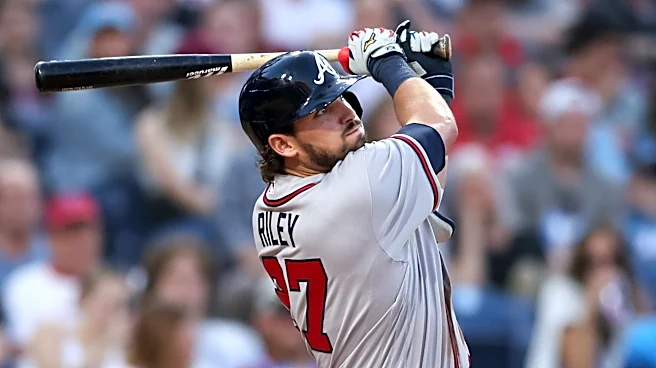
Perhaps no single player personifies those struggles more than third baseman Austin Riley.
A two-time All-Star and key member of Atlanta’s World Series championship team, Riley established himself as one of the best third basemen in Major League Baseball by averaging 36 homers and 99 RBIs to go along with a .286/.354/.525 slash line
and 5.4 fWAR per season from 2021-2023.
As a result, Riley was rewarded with the largest contract in franchise history in 2023, a 10-year, $212 million extension that runs through 2032. That deal carried with it expectations he has yet to fulfill, due in no small part to events out of his control.
Riley was dealt season-ending injuries each of the past two seasons – a broken right hand in 2024 and a sports hernia in 2025 – both robbing him of at least 50 games and leaving Riley with final numbers that were a far cry from his established norms.
The drop in production and lost time propelled a motivated Riley into this past winter looking to regain the form that made him one of the cornerstones of the franchise. In order to do that, Riley needed to solve the swing issues that plagued him throughout 2025 in particular.
“The offseason was more about just getting back to what I know I’m capable of doing,” Riley said. “The offseason before, I was in a cast for 14 weeks and didn’t really get to start hitting until January. This offseason was like a normal offseason.”
Injuries were a large part of the story, but the past two years were not without moments and stretches where Riley looked and played like the better version of himself. Producing those results consistently was the prevailing issue.
Through his first 54 games of 2024, Riley slashed just .220/.288/.330 with three homers and 20 RBIs. This was easily Riley’s worst extended slump since the final 50 games of his 2019 rookie season, when he hit just .170 with seven homers and 17 RBIs in 169 plate appearances.
Over his final 57 games of 2024, Riley seemed like a completely different hitter. He produced in a .292/.354/.588 slash with 16 home runs, 16 doubles and 36 RBIs before his season was cut short after being hit in the right hand by a pitch on August 18.
Riley’s 2025 was a somewhat baffling year both statistically and physically. His final numbers lined up with the previous year, but his walk rate dropped to its lowest level since his rookie season while his strikeout rate spiked to its highest rate since 2019 as well.
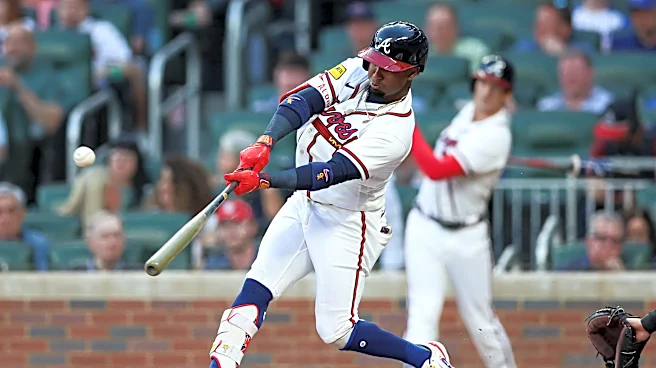
Throughout the course of last season, Riley dealt with a nagging lower abdominal issue which eventually required surgery to correct. When he was on the field, he lamented not being able to adequately adjust his swing path. He described the main problem as being “too steep” through the zone, an issue which negatively affected the quality of his contact and sapped his power numbers.
One thing that has not slipped at any point is Riley’s bat speed.
Since the start of 2023 – when MLB began tracking it – Riley owns the 15th highest average bat speed in all of baseball at 75.7 mph. That trails only teammate Ronald Acuña Jr. (76.7 mph) for the fastest on the club and underscores that Riley’s ability to create hard contact remains intact despite injuries and a drop in production.
Elite bat speed is just one of many factors that comprise a good swing, however.
With plenty of data points to analyze, Riley got to work with Braves hitting coach Tim Hyers over the winter. Among the things Riley wanted to address were issues with his stride that could help him be on time at the point of contact and consistently drive the ball to all fields again.

“I actually started hitting a little bit earlier than normal, right around November, and working on a few things with my lower half that are able to put me in a spot to give myself more room for error and just be in the zone earlier and longer,” Riley said of his winter work. “The offseason went well, working with Tim (Hyers). It led into spring, where I felt really good.”
Riley’s spring training numbers were strong. He batted .357 with five home runs and 13 RBIs while posting a .451 on-base percentage and slugging .786 in 17 games. Unfortunately, those results did not carry over into the regular season. Riley was homerless and hitting just .212 with a .564 OPS through 18 games.
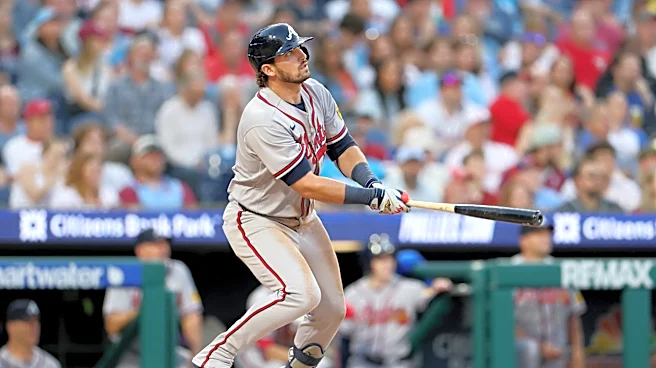
After that slow start, Riley clubbed his first home run of the year and added a double during Wednesday’s 6-3 win over the Miami Marlins. He followed up with a two-homer game against the Philadelphia Phillies on Friday as Atlanta claimed a 9-0 victory.
Those results were due not only to the lower-half adjustments Riley was striving to make over the winter but also owe to honing his approach over the first couple of weeks this season.
“I feel like I am in a better spot when I land (my front foot) to be able to pull the trigger,” Riley said. “Early on, I think I was over-aggressive, then tried to tone it down a little bit. I got soggy with the front side and was trying to find that happy medium.”
Those adjustments can take time to follow a hitter into the game itself. While the work behind the scenes can be focused and methodical in that controlled environment, the paradigm shifts when facing the arsenal of major league pitchers who paid to get hitters out.
Having done so before, Riley understood the degree of difficulty and dedication required to complete the process of incorporating changes at the plate at this level.
“It’s tough because a lot of the stuff I’m working on is stride length and where I’m at (in my swing) when I land (my front foot),” Riley said. “You get in the game with 40,000 fans, adrenaline is rushing, and you’re trying to just slow the game down.”
While his first home run of the season was what many if not most took away from Wednesday’s game, Riley was more enthused about the double to right center field which caromed high off the bricks at Truist Park. That outcome is an indicator that his swing is where it needs to be.
“Staying on the pitch,” Riley said of what felt best about the double. “The last year or year and a half, the way the swing path has been, I was pulling a lot more balls. Obviously, when I’m at my best, I’m driving to the big part of the field. Being able to stay on a slider and hit it with some authority was nice.”
Riley was clearly well aware of where he was hitting the ball a year ago, when his pull percentage on fly balls jumped to a career-high 24.2 percent. Back in 2023 – his most recent 30-homer campaign – Riley was pulling the ball in the air just 16.6 percent of the time versus 23.2 percent to center and 19.2 percent to right field.
Through his first 84 plate appearances this season, Riley’s pull percentage on flyballs is a career-low 13.8 percent, compared to 20.7 percent straight away and 27.6 percent the opposite way.
As Riley rightly pointed out, when he feels his best, driving the ball to center and right field consistently is often the result. His teammates agree with that assessment.
“I’ve watched it since I first got called up and when he’s driving balls to right center, look out,” Braves pitcher Bryce Elder said.

Braves manager Walt Weiss has been on the Atlanta coaching staff for the entirety of Riley’s eight-year career. He’s seen his third baseman navigate the ups and downs of establishing himself as an everyday major leaguer as well as deal with the injury challenges of the past two years.
Weiss is not only encouraged by the recent results but also noted that Riley’s swing is suddenly right where it needs to be, when it needs to be – a dangerous combination.
“Riley’s coming around,” Weiss said. “Austin looks on time to me. The other night, he hit an upper-90s fastball and hooked it into the corner for a double. That’s a really good sign and it just means that he’s more on time. He’s not late. When you’re late, you’ve got to rush and make bad decisions. He just looks more on time to me.”
For his part, Riley has no shortage of motivation to turn this recent success into the type of consistency that he’s been searching for since the start of the 2024 season.
“All the preparation, being hurt the past couple of years, the work I did this offseason, the good spring, you just want to hit the ground running,” Riley said. “Obviously, I hadn’t, but (this is) good momentum to build on.”