



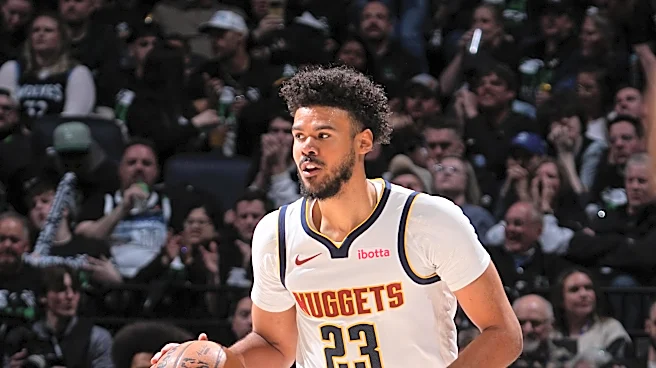
From the dawn of time we came and now, after a season that raised as many questions as it answered, we are finally here. The time of the Gathering is upon us. Until now, Royce and Grayson have coexisted as key veteran contributors off the Suns’ bench, bombing three-pointers in volume and providing experience, leadership, and consistency. Yet in the Dead Money era of Suns basketball, uncomfortable decisions must be made, as the Suns desperately seek flexibility this offseason. In the end: There can
only be one.

Like the hordes of feral pigs rolling Mad Max style over the plains of Texas, the Phoenix Suns’ guard population has overrun the ecosystem. There are not enough minutes to feed the stable of hungry guards, each possessing qualities that warrant playing time and limitations that made fielding balanced rotations difficult for first-year coach Jordan Ott, who relied on running small line-ups in an attempt to field his best five. Saddled with the remnants of Bradley Beal’s time in Phoenix and a draft cupboard full of cobwebs and the echoes of regret, Phoenix is going to have to move someone if they wish to make any substantial changes to its current roster.
And change they must.
Phoenix exceeded their expected win total by nine games, buoyed by oversized performances from key players on undersized contracts. Ishbia has consistently stated that he remains committed to winning. The consensus outside the organization, from the media and fan base, seems to be coalescing around setting the bar for success at a top-six finish in the Western Conference and a competitive first-round playoff matchup.
Can Ishbia bank on Dillon Brooks being one of the best iso scorers in the league again? Is Collin Gillespie going to chase Suns’ history a second year in a row? Jordan Goodwin hit over half of his career total in threes this last season…is that a blip in time or a sign of things to come? While the 2025-26 season may go down in fan lore as a cult classic, the sequel could very well bomb if the shots don’t fall.
While attractive trade-machine deals are scarce when the Suns lack the assets to acquire a name that would charge the fanbase up, Grayson and Royce are both players who can bring back legitimate trade value relative to their expected contributions.
You can never have too many shooters, unless all of them are short and at best kind of mid on defense. Grayson or Royce’s value might be higher on another team with a different roster construction, say Orlando or Detroit. But the Suns made their hay off the three-point shot. Can they really afford to give up both Royce and Grayson, who this past season combined to account for 29% of the Suns’ regular season three-point attempts and 30% of their made three-pointers? How about if I mentioned Devin Booker’s three-point attempts dropped from 551 in 2024-25 to 370 in 2025-26, and that the only member of last year’s squad ahead of Grayson and Royce in those categories was Career Year Collin Gillespie (CYCG).
Opinions may vary, but going forward, I’m operating on the assumption that the Suns will not, and can not afford to, move both Grayson and Royce unless it was in a package for a potential All-Star, and I’m not talking Cam Johnson or Dean Wade. Cough Ja Cough. Until that trade materializes, the Suns need to leverage at least one of their valuable trade pieces to rebalance the roster. So, who should the Suns trade and who should the Suns keep?

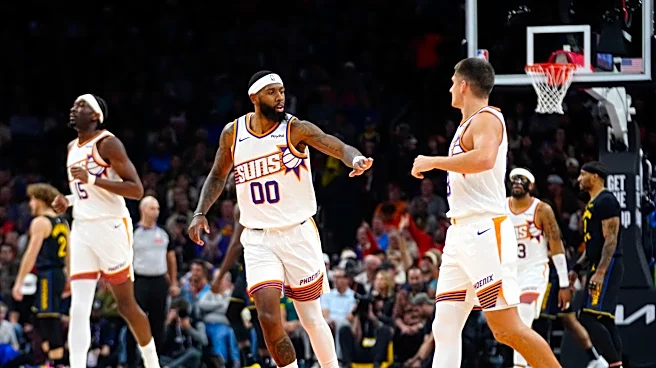
Royce is a rock in the grade 5 rapids that has been the Suns’ past two seasons. While the KD Suns swirled down the pipes of inevitability, Royce finished the season shooting 40.6% from three on 5.9 attempts per game and backed it up the very next year on a revamped roster by shooting 40.8% on 6.7 attempts per game; both career highs. Royce gives you proven solutions in uncertain times, and he’s thrived during his tenure in Phoenix.
Not to be forgotten in evaluating Royce’s value to the Suns is his availability. When you’re starting in a $23.2 million Bradley-Beal-in-street-clothes-shaped hole, spending your money on players that play games becomes vital. Over his 9-year career, Royce has played in 70+ games 8 times, and in the lone season he didn’t reach 70, he played 69. The Suns can not afford to undervalue availability in the Dead Money Era. When you’re down 0-2 in the count, you can’t take a cut at a wild pitch.
Quick to dead the bull like a matador, a phrase lifted from Miguel’s classic song, accurately describes Royce’s defensive journey last season. He olay’d far too many ball handlers into the lane, and I’m not entirely convinced that his time at the four wasn’t spurred by trying to match him up with players he had a chance to stay in front of, especially as the Suns tried to switch five with the Oso-anchored bench unit. The whole league got the tape on the Suns, and ball handlers julienned them on the dribble drive, as Oso tried to block shots just out of his reach.
In addition to his aged reflexes, playing Royce meant sacrificing size at the four. Royce’s production on the offensive end made it impossible for Jordan Ott to find minutes for our young, Stretch Armstrong fours, without sacrificing win totals. Taking Royce out of the equation frees up minutes for Fleming and Dunn, which addresses the Suns’ lack of size with players already on the roster who are both on value contracts.
What could we gain by trading Royce? The rumor mill has been working overtime, but as John Voita noted in the case for trading Royce O’Neale, the first benefit of trading Royce O’Neale is cap flexibility. Trading his $10.9 million contract to a team that can take on extra cap space could free up the money we need to resign Collin Gillespie, Jordan Goodwin, and Mark Williams. Three players whose signing is said to be at the top of the Suns’ offseason priority list.
Another angle is to trade Royce in order to move up in the draft.
Gregory has shown a willingness to work his way up the draft order if there’s a player he wants. In what’s predicted to be a deep but thinning draft, as players withdraw for a payday at the college level, the Suns have signaled interest in trading up to possibly secure a first-round pick. However, even the most optimistic returns for Royce don’t stretch far past the early second round or late first round picks. It’s unlikely the Suns will scoop a day one contributor that late into the draft, so replacing Royce’s three-point production would have to come from players currently on the roster.
What’s the likelihood that the Suns will be able to cobble together an additional 212 three-pointers and 520 three-point attempts? Booker can take more threes, but with teams likely riding with the “take away Book” game plan, too many of those threes are the walk-up off the dribble shots, and to be blunt, Book’s not good at those. Or maybe the young forwards will be able to pick up the slack on shooting. Suns fans cry out for Rasheer Fleming, who shot the three at 40% on 130 attempts, almost exclusively on catch-and-shoots. Can he shoot four times that amount with increased minutes and still put them through at a high percentage? Are we expecting that many open corner threes?
The hard truth of trading Royce, especially as a solo asset, is that it’s not a move that makes the Suns better. They gain the flexibility to sign other important players you might lose to free agency. They free up playing time for the Suns’ young core, which would allow the Suns to play more size and field a better defense. At the same time, they’re losing a sizable chunk of their shooting, and if they run this roster back mostly, it’s still the same roster Vegas predicted would miss the playoffs before the three-point shooting boom pushed us into the Play-In tournament.
Are the Suns still a playoff team if their three-point shooting regresses? I’m not sure. The margin for error is razor-thin, with Gregory forced to spend the next four years trying to make a dollar out of 15 cents.
So, should we trade Grayson?
“Not so fast,” I yell in my best Lee Corso voice as I put on the Grayson Allen mascot head.
This team needs Grayson Allen. He’s developed into far more than a three-point specialist and defensive irritant. The mob has decided we need a point guard to free up Book, but no one knows where to get one. A healthy Grayson Allen could be exactly what this team needs. He handles the ball, he runs pick and roll, and he’s improved his playmaking.
There aren’t a lot of potential playmakers on this roster to pick from, and Book and Grayson have an undeniable chemistry. If the goal is continuity, bringing back one of the longest tenured players aligns with that mission, and Grayson Allen brings so much to this offense when he’s on the court. It’s just that it’s been a couple of years since he’s been healthy.

Grayson’s availability has plummeted with no signs of it bottoming out. It’s been a parade of knee and soft tissue issues. He’s in, he’s out, he’s in, he’s out, and as a result, production has fallen along with his availability.
Since his inaugural year on the Suns, where Grayson played 75 games, and shot a blistering, league leading 46% from three-point range, he’s followed up with 64 games in 2024-25 and 51 games in 2025-26, a season in which we saw his three-point percentage drop to 34.9. So, which Grayson Allen can the Suns expect in the 2026-27 season? Can they afford to add another question mark, even if it’s a verified hooper like Grayson?
Despite the recent health issues, it seems safe to say that Grayson still has value on the trade market. His $18 million would match salaries with a different level of player than you could get for Royce, and you’d be hard-pressed to find many trade machine proposals involving the Suns that don’t include Grayson. One of the more intriguing options that has surfaced is trading Grayson for Cam Johnson.
On the surface, it makes a lot of sense. Cam is a forward and, as a career 39% three-point shooter, would provide spacing without sacrificing size or the minutes of other guards. But if we zoom in for a closer look, Cam has the same availability issues as Grayson and doesn’t bring any of the playmaking that could move Book off-ball. He also brings the burden of an additional salary that would have to be accounted for, either by not bringing back one of our free agents or by trading Royce for a cheaper contract. We all miss the energy of the Suns’ four finals run, but this isn’t a move that brings that back.
In the end, it’s all a balancing act. No team is interested in giving us a good deal; when you gain over here, you lose over there. Yet in the Dead Money era, there can only be one.

It all boils down to three questions: What did we get from these guys that we can’t win without? How well is our roster positioned to replace those things? What value could we gain from trading them?
There’s quite a bit of overlap when comparing the two. Both players have a proven track record of being high-percentage three-point shooters from all over the arc. Both of them are veterans and decision makers. Both guys are continuity pieces who have played multiple seasons for the Suns alongside Devin Booker. Neither of them is going to be a great defender or fix our rebounding concerns. Neither of them has a solution to replace their production on the roster, or a clear trade upgrade that would provide support in a significant area of need. Their trade value lies in gaining cap flexibility and balancing the roster size, which could address our perimeter defense, rebounding concerns, and clear minutes for our young players.
Grayson provides more versatility and could be the key to unlocking Booker’s scoring. Royce is Mr. Consistent. He’ll be available, he’ll work that pump fake, he’ll get up a ton of three pointers, and knock them down around 40 percent of the time. I think we need that.
So much about the upcoming season is up in the air. Are we going to get a second round of oversized performances from Brooks, Gillespie, and Goodwin? Do we know what we have with Jalen Green? Even Booker left last season with question marks about whether he could still wear the number one headband on a championship team and questions about whether he was even playing the right position. We need more players without question marks. Allen has question marks. If you bring back Allen, you’re rolling the dice on his health. The Suns have lost that gamble too many times to hit the atm for another 100 dollars. Not when they owe 23 million in Bradley Beal support, and their fanbase wants designer bags on a dollar tree budget.
If there can only be one. It has to be Royce.

The Quickening empowers me!
– Connor MacLeod
– Royce O’Neale
Welcome to Tom Mildenberger, who is our newest contributor at Bright Side of the Sun!