

With the 2025 Texas Rangers season having come to an end, we shall be, over the course of the offseason, taking a look at every player who appeared in a major league game for the Texas Rangers in 2025.
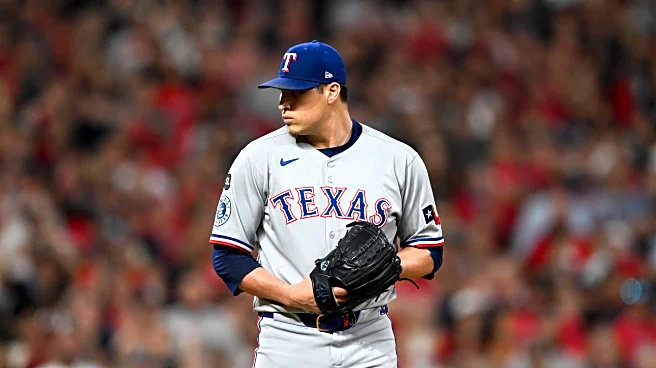
Today we are looking at reliever Robert Garcia.
In the 2024-25 offseason, one of the Rangers moves that immediately looked like a coup was sending first baseman Nathaniel Lowe to the Washington Nationals in exchange for relief pitcher Robert Garcia.
Lowe wasn’t a bad player for the Rangers, by any means.
Acquired from the Rays by the Rangers in the 2020-21 offseason, in a deal that was viewed in these parts with a fair amount of skepticism, there seemed to be an inherent bias against Nathaniel Lowe in these parts. After all, if Tampa Bay was giving him up, there must be something wrong with him. And the Rangers were in full-fledged rebuild mode at the time, so trading three prospects — Heriberto Hernandez, Osleivis Basabe, and Alexander Ovalles — for a current major leaguer without a huge ceiling seemed counterintuitive, even if the major leaguer in question had not yet accumulated even a year’s worth of service time.
That deal worked out great for Texas, as Lowe put up 11.2 bWAR over four seasons for Texas, while Tampa got 94 unproductive plate appearances from Basabe and nothing from Hernandez and Ovalles. None of the three are with Tampa anymore. The Giants purchased Basabe from the Rays a year ago. Ovalles was released after 2023, played Indy ball in 2024, and now appears to be out of baseball. Hernandez became a minor league free agent after 2024 and signed with Miami, for whom he had a nice 2025 season as a COF/DH, though in just 87 games.
By the end of the 2024 season, however, it was becoming clear that Lowe’s time with the Rangers was likely coming to an end. Texas had gotten two pre-arbitration years out of him and two relatively cheap arbitration years after that, but Lowe was now getting more expensive, especially given that he had seemingly plateaued as a good-OBP, middling power, decent starting first baseman. Projected to make $10-12 million in arbitration in 2025, Lowe still had some value, but the delta between open market value and arbitration value was shrinking, and he was only under team control through 2027.
There was talk that Lowe was a non-tender candidate, though that always seemed misguided, since it seemed clear that there would be some market for him at his still less than market value 2025 salary and the potential team control for 2026. It wouldn’t necessarily be a big return, but you’d get something of value for Lowe, it seemed, from a contender (or wanna-be contender) needing a short-term fix at first base.
So the Rangers trading Lowe wasn’t a surprise.
What was a surprise, however, was that Nathaniel Lowe was traded to the Washington Nationals, a bad team that seemed to be in the latter stages of a lengthy rebuild, but was still in rebuild mode.
And not only did Lowe get traded to Washington — the Rangers got in return what appeared to be a pretty good young reliever, one with five years of team control and a full compliment of options remaining.
Yes, at first glance, Robert Garcia wasn’t anything to get excited about, having put up a 4.03 ERA in 91 innings over 97 games for the Marlins and Nationals (well, mainly the Nationals, who claimed him off waivers in 2023 after Garcia had pitched in one game for Miami) in a season plus two months. But Garcia had a 2.78 FIP and a sub-3 xERA in that span. His 4.22 ERA in 2024 belied an impressive K rate of 11.3 per 9, a 2.38 FIP, and a 2.52 xERA, with a .329 BABIP and 57.2% strand rate driving the high ERA and seemingly owing to bad luck and bad defense.
The Rangers appeared to have got themselves a really good reliever, at a relatively low price.
Garcia ended up being a significant part of the Rangers’ no-name bullpen in 2025, and was, I think, a mixed bag. In a reverse of 2024, his xERA (3.81) and FIP (3.71) were significantly worse than his 2.95 ERA. Garcia saw his K rate drop and his walk rate and home run rate jump up.
To be clear, Garcia’s peripherals weren’t bad in 2025 — his K rate was above average and his walk rate about average. He generated a lot of swings and misses, and he avoided hard contact, with a hard-hit rate of 91%. He went from being a ground ball pitcher in 2024, however, to being a fly ball pitcher in 2025, and ended up getting victimized more often by the long ball.
It seemed as well like fans lost trust in him as the season went on. Garcia got a reputation for being someone who would perform well in low pressure situations, but cratered when the game was on the line.
Garcia ended up getting tagged with 8 losses on the season, which seems like a lot. He tied for third in losses for the Rangers in 2025, with Jacob deGrom. Among pitchers who had at least 90% of their appearances coming out of the bullpen in 2025, the only other guys with at least that many losses were his new teammate, Tyler Alexander (14 losses, 12 in relief) and Brandon Eisert (8 losses, all in relief). Garcia’s 8 losses in relief were tied for the second most in the 21st century for a Ranger pitcher, behind Neal Cotts, who picked up 9 L’s in 2014, and tied with Francisco Cordero, who had 8 L’s in 2003.
Exacerbating that perception was that Garcia had an especially bad stretch in the first half of August, when the Rangers were fighting to stay in the playoff race. From August 1 to August 15, Garcia appeared in eight games. He only recorded 15 outs in those eight games and allowed 8 runs (7 earned), including 4 home runs. He blew three saves and picked up a pair of losses in that stretch, as the Rangers went 1-7 in those eight games.
It was really a remarkably awful stretch. Eight of the 26 runs Garcia allowed in 2025, seven of the 21 earned runs he allowed, and four of the eight homers he gave up came in that 15 day period in August. And it was a period when the pressure was definitely on, when the stakes were high, and the Rangers were collapsing.
Through the end of July, Garcia had a 2.61 ERA and a 3.01 FIP. After August 15, he had a 1.02 ERA and 3.02 FIP. Its a great example of how a bad stretch of games can wreck a reliever’s overall season line.
I tend to be dismissive of claims that a player — particularly a reliever — can only pitch well in low pressure situations, that he can’t handle the stress and the pressure of the big moments. You look at Garcia’s splits, and he gave up a 695 OPS with RISP compared to a 683 OPS with no one on and you figure its not a “melting down” issue.
That said…in late and close situations, Garcia allowed an 814 OPS, including 7 of his 8 home runs, in 181 plate appearances. Given he only faced 269 batters in 2025, and allowed an OPS of 676 overall, that would indicate a pretty big split in late and close situations compared to not late and close. And in what B-R defines as high, medium and low leverage situations, Garcia allowed OPSs of 779, 846, and 451, respectively, in 2025. In 2024, with the Nats, it was 752, 786, and 434.
Does that mean Garcia can’t handle high-pressure situations? Not necessarily, but it does give one pause. Especially when one reads the quotes from Garcia about his experience in the WBC pitching for Team Mexico and what he learned from veteran Mariners closer Andrew Munoz. The first two games of that horrid August stretch, Garcia blew saves in back-to-back games in Seattle, which Garcia talked to Munoz about:
“He said ‘I felt for you there’,” Garcia said. “He knew exactly what I was talking about on failure. He said he’s seen it, done it and experienced it. It’s the worst. And sometimes you think: ‘Oh my God; like I can’t do it again. I can’t do this.’ And you stray from the right mindset. So it was about keeping it one day at a time and understanding that very day is a new day.
“He was like ‘Dude, there’s not one guy that I’ve talked to that pitched in the ninth and didn’t have a little bit of nerves going in there. That’s normal.’ Just understand that all you have to do is execute pitches; that’s your job. Once I heard that from him, from a guy who has had a lot of success there, I think that calmed any anxieties I had going into the WBC and about pitching in leverage situations. It was a huge weight off my shoulders.”
If there were issues in regards to pressure, nerves, whathaveyou for Garcia in the past, one can at least hope that working with Munoz, the experience in the WBC, will help in that regard going forward.
Garcia has a strong two-pitch mix with his fastball and his changeup, and misses bats with pitches. His change is his best pitch, a legitimate out pitch that has above average vertical and horizontal break. It neutralizes righthanded hitters and results in him having almost no platoon splits.
Garcia’s third pitch — his slider — is where he has issues. While he goes with roughly 40% fastballs, 40% changeups, and 20% sliders to righthanders, he throws mostly fastballs and sliders to lefties, as one would expect. His slider is rather mediocre, and he too often left it in the heart of the plate in 2025, resulting in it getting hit hard, especially by lefty hitters.
Garcia could end up as the Rangers’ closer in 2026. Even if he doesn’t, he’s going to be counted on to pitch meaningful, high-leverage innings. His ability to handle those situations better in 2026 than he did in 2025 will have a big impact on the team’s 2026 campaign.
Previously: