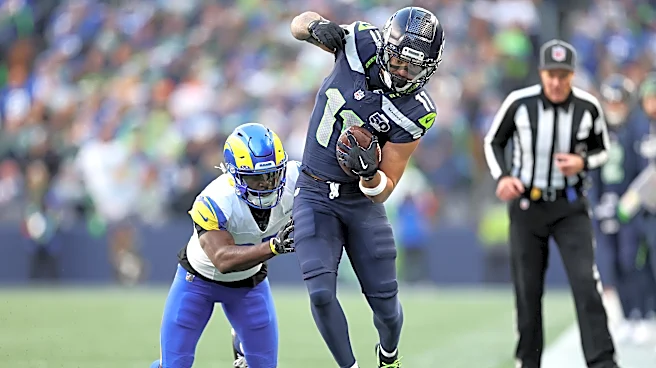





The Seattle Seahawks’ defensive line was one of the driving forces behind their Super Bowl championship run.
With Leonard Williams playing at an All-Pro level, Byron Murphy II taking a major developmental leap, and a deep rotation producing throughout the season, defensive tackle was hardly viewed as an urgent need entering the offseason.
Yet Seattle continued investing in the position after the draft.
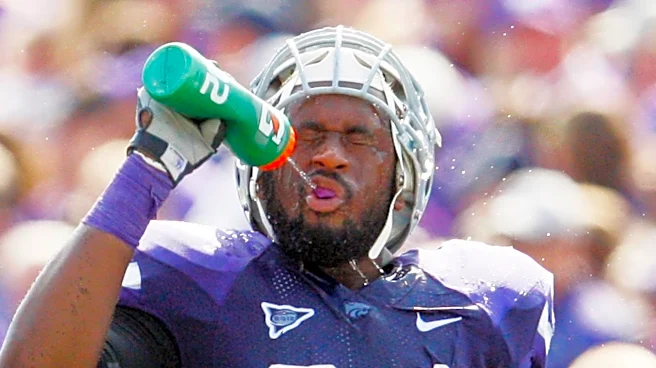
In addition to selecting Deven Eastern in the seventh round, the Seahawks signed former Kansas State
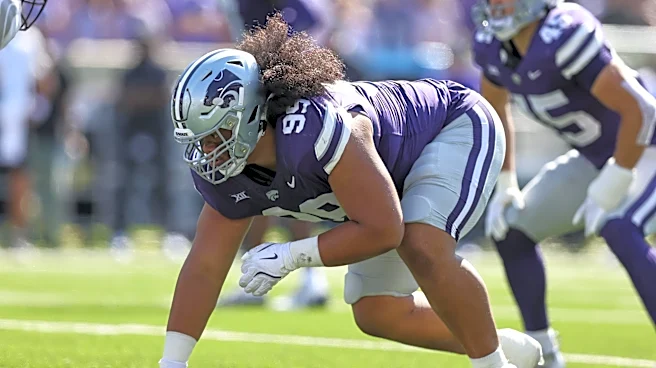
nose tackle Uso Seumalo as an undrafted free agent, adding another competitor to what could become one of the more intriguing battles of training camp.
At first glance, Seumalo looks like just another camp body fighting for the final spots on the roster. He arrives without draft pedigree and joins a room already loaded with established talent.
But once the tape starts rolling, it becomes easier to understand why Seattle saw something worth developing.
For an organization that values trench depth and has consistently shown a willingness to develop players within specialized roles, there is a clear logic behind the investment. The challenge now becomes determining whether the traits that made Seumalo useful at Kansas State can translate into one of the NFL’s deepest defensive line rotations.
Background
Seumalo’s path to the NFL wasn’t the typical journey associated with highly regarded draft prospects.
Before arriving at Kansas State, he began his collegiate career at Garden City Community College, a route often taken by players who need additional time to develop physically or refine their game before competing at a higher level.
His transfer to Kansas State in 2022 ultimately shaped the rest of his football career.
Unlike many players in the transfer portal era, Seumalo stayed put. While college football has become increasingly defined by movement and short-term opportunities, he spent the remainder of his eligibility with the Wildcats and gradually became a valuable piece of their defensive structure.
The production never jumped off the page.
Across four seasons at Kansas State, Seumalo recorded 57 tackles, nine tackles for loss, and only 2.5 sacks. Those numbers help explain why he rarely appeared in conversations about the top defensive tackles in the draft class.
But statistics rarely tell the full story when evaluating nose tackles.
Seumalo’s role wasn’t to penetrate into the backfield and pile up sacks. His job was significantly less glamorous. He was tasked with controlling gaps, absorbing double teams, keeping linebackers clean, and preventing run schemes from creating numbers advantages at the second level.
That type of work rarely appears in the box score. It shows up on film.
Throughout the pre-draft process, Seumalo was viewed as a limited athlete with NFL size and enough experience to compete for a developmental role. He was never a prospect generating significant buzz, but neither was he a player without translatable traits.
His profile always fit the mold of a prospect who would need the right system to maximize his strengths.
What stands out on tape
The most obvious aspect of Seumalo’s game is his understanding of how to play as a true nose tackle.
Many large college defensive tackles survive purely because of size. Seumalo combines his size with a fairly advanced understanding of leverage and positioning.
His first step isn’t explosive compared to modern penetrating defensive tackles, but he rarely wastes movement after the snap. His initial objective is usually to establish contact quickly, lock in his base, and gain control of the blocker before reacting to the play itself.
Rather than trying to win instantly, he often focuses on controlling the rep first.
Against the run, he consistently shows good spatial awareness.
When facing single blocks, he frequently keeps his eyes in the backfield while working his hands into the chest of the blocker. That allows him to identify the direction of the run without completely sacrificing control of his gap.
Numerous snaps at Kansas State follow a similar pattern. The center generates initial contact, but Seumalo stays square, anchors effectively, and prevents vertical displacement. That ability to stop movement is probably the strongest part of his game.
When studying his tape against inside zone concepts, it becomes clear how disciplined he is about remaining square to the line of scrimmage. Rather than immediately chasing the running back, he forces the play to declare itself first.
That patience matters.
Many NFL nose tackles fail because they abandon their responsibility too early in pursuit of splash plays. Seumalo generally avoids that mistake.
Physically, his approximately 330-pound frame gives him the mass necessary to occupy space immediately.
He carries his weight well, with a broad upper body, naturally sturdy lower half, and a frame built to absorb contact. His pad level is also better than expected for a player his size.
Large defensive tackles often struggle to maintain knee bend throughout a rep. Seumalo remains relatively compact after contact, allowing his functional strength to transfer into the point of attack.
Another encouraging aspect is his short-area movement ability.
This isn’t an explosive athlete, nor is he particularly dynamic in space. But for a player carrying that much weight, there is enough burst in his first few steps when he identifies an opportunity.
Against certain gap schemes, particularly when facing slower pulls, he can accelerate into openings and create disruption before the play fully develops. There is enough reaction ability and closing speed to capitalize when the picture becomes clear.
His experience also shows up in how he processes blocking schemes.
After spending four seasons facing Big 12 offenses, Seumalo displays a solid understanding of pre-snap tendencies and run concepts. Coaches often trust players who consistently execute assignments, even if they lack elite athleticism.
That reliability can create opportunities.
Concerns and limitations
The same limitations that pushed Seumalo out of the draft are visible on tape.
The biggest concern is his lack of pass-rush impact.
Even accounting for his role, 2.5 career sacks reflect what the film shows.
He simply doesn’t possess a developed pass-rush toolbox. His first-step quickness is average, and there are very few examples of him consistently winning obvious passing situations through technique.
When blockers secure the initial contact, the rep often ends there.
He lacks the flexibility, lateral quickness, and hand violence that allow many NFL defensive tackles to generate secondary pressure after losing the first phase of the rush. Most of his pass-rush production comes through effort and raw power.
At the NFL level, that usually isn’t enough.
There are also questions regarding positional versatility.
Most of his value comes when aligned directly over the center as a true 0-technique. Outside of that role, there isn’t much evidence that he can consistently provide positive value.
That limitation may complicate his development.
Ironically, one of his strengths can occasionally create problems.
As mentioned earlier, Seumalo generally processes run concepts well. However, there are moments when he becomes too focused on winning the block directly in front of him. He lowers his head, loses sight of the football, and briefly sacrifices awareness of how the play is developing.
The result is occasional late reactions despite otherwise solid instincts.
Final Thoughts
The most realistic outcome for Seumalo in 2026 is probably a practice squad role.
That shouldn’t be viewed as a failure.
Seattle has repeatedly shown a willingness to develop players on the practice squad before eventually promoting them into meaningful roles. Drake Thomas and Ty Okada are recent examples of that developmental pathway.
His clearest route toward a long NFL career involves becoming a specialized run defender.
The competition will be significant. Deven Eastern enters camp with the advantage of being a draft pick and stronger college career, while Brandon Pili already has experience within the organization.
In the short term, Seumalo must prove he can absorb blocks from NFL offensive linemen without compromising the integrity of the defense around him. That will require continued technical development, increased functional strength, and adaptation to the speed of the professional game.
His ceiling likely doesn’t involve major statistical production or multiple seasons as a full-time starter.
The value of his projection lies elsewhere. He profiles more as the type of player who spends years in the league handling highly specialized responsibilities, allowing the stars around him to operate more freely.
That’s precisely why the fit in Seattle makes sense.
The Seahawks don’t need him to become a featured player. With Leonard Williams, Byron Murphy II, and several other disruptive pieces already responsible for generating pressure, Seattle can afford to develop a player whose primary responsibility is maintaining the structural integrity of the front.
In a league increasingly built on specialized roles and deep rotations, that may be enough to turn an overlooked undrafted free agent into another useful piece of the Seahawks’ defensive machine.