


It is certainly not an easy time to be an MSU sports fan right now. Our football program has not been to a bowl game since we defeated Pitt in the Peach Bowl at the end of the 2021 season. Our hockey team spent a large chunk of this past season at the top of the national polls only to suffer overtime defeats in our first game of the Big Ten Tournament and then in the Regional Final of the NCAA Tournament. And then there is our basketball team, which held the distinction of being the last Big Ten team to win
the National Championship for 26 seasons only for that claim to fall to our bitter rivals from ann arbor in a season when they defeated us twice in the regular season.
We can hope for better things in the future, but our football team is facing massive uncertainty as we bring on our 3rd new coach, 4th if you include interim coaches, in the past 4 seasons, and our hockey team just saw a massive exodus of talent to the NHL. So we are left to hang our proverbial hats on the basketball squad and hall of fame coach Tom Izzo. And here is where there could be some hope.
Join the conversation!
Sign up for a user account and get:
- Improved notifications system!
- Fewer ads
- Create community posts
- Comment on articles, community posts
- Rec comments, community posts
In this article, I am going to try serving some green Kool-Aid and arguing that Michigan State should be the favorite to win it all in the 2026-27 season, with the Final Four in Detroit no less. On Tuesday, Mike published a story analyzing the roster composition of all the B1G teams for next season. He detailed what percentage of minutes played last season each team lost and then showed each rosters’ make-up for next year in terms of returning players, incoming freshmen, incoming transfers, and incoming international talent. In short, MSU has the 2nd highest percentage of minutes coming back (behind Minnesota) and also the 2nd highest number of players returning with 9 (behind the 10 of Iowa and Purdue). In addition, the Spartans have just one singular player coming in via the portal or internationally, equaling the lowest mark in the conference (matched by Purdue and Illinois).
Now I am going to expand on Mike’s analysis to include some of the top teams from around the nation, going by On3’s most recent way-too-early top 25, which they released the day after the deadline for players to withdraw their names from the NBA Draft pool. The top ten of this list includes 3 Big Ten teams, including our Spartans. To expedite this a little bit, I am only going to discuss the 7 non-B1G teams. This will not be a statistical analysis, like Mike’s report. Rather, I will talk about the significant names that each team is bringing back from last season and provide some stats on key incoming transfers. Freshmen, while important, don’t really offer a way for me to discuss stats comparatively, so I will just mention the number of 5- and 4-star recruits they are bringing in, again using On3. The same goes for international players.
#1 Florida
The Gators are returning 6 of their top 7 scorers from last season, losing their third-leading guy, Xaivian Lee, who averaged 11.6. The other 6 guys include four who averaged double-digits, one who just missed at 9.6, and the last at 5.5. Three of these averaged at least 30 MPG, and two more were over 20.
Florida does not have a strong recruiting class coming in, ranked #114 by On3. They are bringing in a couple of European players and just one freshman, a 3-star.
The big name from the portal is an interesting one. Denzel Aberdeen actually played for the Gators for 3 seasons, then dressed for Kentucky last season where he had a career best 13.5 PPG in over 30 MPG. He is currently awaiting NCAA approval for a fifth season.
Strength: The frontcourt is a force with Thomas Haugh (17.1 PPG, 6.1 RPG in ’25-26), Alex Condon (15.1, 7.5) and Rueben Chinyelu (10.9, 11.2) all returning. All three of them averaged at least 1 block per game last year as well.
#2 um
#3 UConn
The team that knocked out the Spartans in the Sweet 16 last season lost their top 2 scorers but brings back the next three on the list. Alex Karaban and Tarris Reed, both frontcourt players, have left. A trio of guards returns in Solo Ball (12.8 PPG), Braylon Mullins (12.0), and Silas Demary Jr. (10.1). No other returning player averaged over 5 PPG.
The Huskies have a pair of 4-star, top-50 guards coming in, good for 10th on On3’s rankings. They also have 7 transfer portal players arriving, but that is just the 31st best transfer class in the nation. Nikolas Khamenia, #34 in the portal rankings, scored 5.7 PPG in 19.8 minutes for Duke last year, and Najai Hines, #21, had 6.5 points, 5.5 boards, and 2.2 blocks for Seton Hall.
Strength: It would be easy to say the backcourt with those players coming back, but the actual answer is coaching with Dan Hurley.
#4 Duke
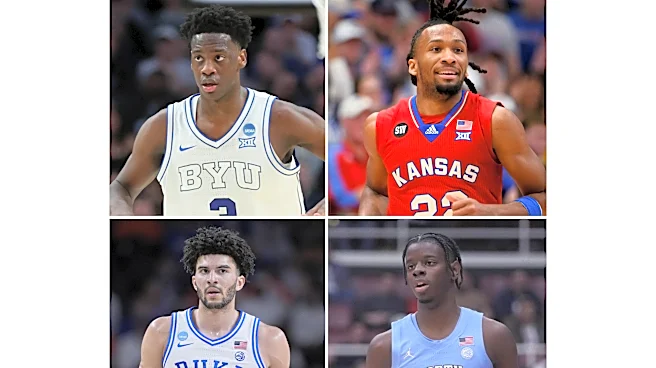
Another team that defeated MSU last season appears above us in this early ranking. Duke lost arguably the best player in the country in Cameron Boozer as well as their second-leading scorer, Isaiah Evans, but they do have a ton coming back as well as the #2 freshman class. The big man in the middle, Patrick Ngongba, as well as a trio of guards in Cayden Boozer, Dame Sarr, and Caleb Foster return, though only Ngongba was a double-digit scorer.
Their 5-man recruiting class includes a pair of 5-stars and three 4-star players. The highest ranked names are the #4 overall guy, PF Cam Williams, and #14, PG Deron Rippey Jr. The Blue Devils also made some noise in the transfer portal getting the 2nd overall player in Wisconsin guard John Blackwell. Blackwell averaged 19.1 PPG and shot nearly 39% from three-point range last season for the Badgers.
Strength: Backcourt. The addition of Blackwell probably makes this guard rotation even better than UConn’s.
#5 MSU
See below
#6 Houston
Of all the teams at the top of these rankings, the Cougars may be the one with the most uncertainty. Their top 4 scorers from a season ago are all gone. The top guys coming back are Joseph Tugler (8.4 PPG in 23.5 MPG) and Mercy Miller (5.0 in 11.9).
But Houston does have On3’s 12th-ranked recruiting class featuring a couple of 4-star guys in 7’ center Arafan Diane from Canada and point guard Ikenna Alozie from Nigeria, and they also have the 15th-ranked portal class. Dedan Thomas, a PG formerly of LSU and UNLV before that, highlights this haul as the 18th-ranked player in the portal. Last year, he had 15.3 PPG and 6.5 APG for the Tigers.
Strength: Mystique? Honestly, I don’t know why this team is ranked as high as they are.
#7 Illinois
#8 Virginia
The Cavaliers bring back their top scorer, Thijs De Ridder (15.6 PPG, 6.2 RPG) and 4 of their top 6. Remarkably, none of the top six last year played over 28 minutes per game. Those four guys all shot the deep ball at least at a 35% success rate, with guard Jacari White tops at 43.4% on over 5 attempts per game. In addition, none of the four turned the ball with a high frequency; De Ridder had the worst mark with 1.8 turnovers. In general, this was a very disciplined team.
The Cavs’ portal haul ranks 36th in the nation. The highest ranked name is Christian Harmon, formerly of Arkansas State where he averaged 12.8 PPG. The freshman class is not that impressive with only a single recruit, 3-star 7’1” center Favour Ibe.
Strength: De Ridder. He was by far their best player as a freshman last year. A second-year leap could easily see him averaging 20 & 10.
#9 Gonzaga
Gone is leading scorer and rebounder, Graham Ike (19.9, 8.0). Back is Braden Huff (17.8 PPG), and two guys who averaged 8.6, Davis Fogle and Mario Saint-Supery (who in the phone book would be listed as “Saint-Supery, Mario”).
I would have thought that teams like Gonzaga, a smaller school from a smaller conference with less access to the NIL money of power conference teams, would get knocked back down a few rungs on the ladder in the new world we live in where teams can just buy talent. But then they went out and got Massamba Diop, the #5 player in the portal. The 7’1” center previously from Arizona State, has a $1.9M NIL price tag. So I guess the Bulldogs aren’t going anywhere. They also picked up Isiah Harwell from Houston who, while falling outside of the top 100 of the portal rankings, was a top-15 high school recruit just a year ago. Gonzaga also has the 40th-ranked incoming class with a couple of 4-star recruits, SF Luca Foster and 6’11” center Sam Funches.
Strength: Balance. While Diop, who will be a sophomore, could be a very scary player if he improves even a little from his very impressive freshman season, what makes ‘Zaga so good is that they won’t have any weak spots in their starting lineup. Diop, Huff, Fogle, Saint-Supery, and international pro Izan Almansa (from Spain, but played pro ball in Australia) are all quality players that give Mark Few a potent starting lineup.
#10 Arkansas
The last team on this list is the team with the #1 incoming freshman class. Coach John Calipari is up to his old tricks. The new guys include two 5-stars, SGs Jordan Smith Jr. and Abdou Toure, along with two 4-stars, and all of them are in the top-20 of On3’s recruiting rankings. It should be pointed out that three of the four are listed as SGs. From the portal, Arkansas is getting Jeremiah Wilkinson from Georgia, the #8 PG and #39 overall in this transfer class.
On the flipside, the Razorbacks saw the departure of six of their top 7 scorers from last year. The lone significant returning player is Billy Richmond III, a guard who scored 11.2 PPG in his second season.
Strength: Individual talent. With such a young team, and with so many highly ranked recruits coming in, the potential is there for a lot of guys trying to be a one-man show and upstaging one another, especially with three of the freshmen all playing the same position. The ceiling for this team will be determined by how quickly Calipari can get them playing as a unit. The longer that takes, and the longer the young guys are focused on boosting their draft stock, the lower this team’s capability becomes.
Now we get to our Spartans. #5 according to On3’s post-draft deadline rankings, MSU has a number of things going for them as we head into the 2026-27 season.
Obviously, this all begins with Jeremy Fears Jr. Going into last season, it was Purdue who claimed the preseason #1 ranking in both polls. This was largely due to them having the preseason player of the year, PG Braden Smith. Smith was going to be a senior and he was largely assumed to be the best point guard in the country; in his junior season, he was second nationally in assists at 8.7, and the only player above him, Gonzaga’s Ryan Nembhard, was off in the NBA. So what happened in Smith’s senior season? Well, he ended up second nationally again in assists, this time at 8.8. And the guy who upstaged him was our very own Fears.
All this is to say that I fully expect Jeremy Fears Jr., fresh from flirting with the NBA Draft, to receive a lot of consideration for, if not being named, preseason player of the year as he goes into his redshirt junior (and presumably final) year for Michigan State. Fears’ 328 dimes last year were an MSU record. If he can get to that number again this year, he will surpass Cassius Winston’s career record of 890.
Fears isn’t just the nation’s best playmaker, though. He also led the team with 15.2 PPG, good for 17th in the Big Ten. Of the 16 names above him from last year, only 4 are back with their team, while twelve have either graduated, left for the draft, or been tossed off the team. It’s not a stretch to think that with a slight improvement in his FG% and fewer missed lob/alley-oops, Fears could average 20 points and 10 dimes.
The second name on the Spartan marquee is Coen Carr. If we were to create a drinking game around MSU basketball, it would have to include taking a sip every time the announcer declares that Carr is “the best dunker in basketball, college or pro.” While dunks are not an official stat, TV networks kept track of it on their own and often showed us that Carr was at or near the top of that list nationally throughout the season. Relive this jawdropper:
The big loss for MSU from last year is the departure of both starting front court players – Jaxon Kohler and Carson Cooper. They were four-year players who got better by the year and ended up exceeding all our expectations. That said, if you go back and look at all the centers and power forwards to have starred for Tom Izzo, I don’t think either Cooper or Kohler would end up in the top ten of their respective positions. I will miss having them as Spartans, but having the two of them as a unit was certainly not a strength for the Spartans.
Next year, we could be looking at some strength in numbers for MSU’s frontcourt. Our only transfer, Anton Bonke, will be the tallest player in Spartan history when he takes the court. The 7’2” Vanuatuan is going to be relied on to be a rim protector and to collect at least ten rebounds per outing. I am not expecting too much offense to go through him outside of lob plays, especially not early in the season, but it is good to know that he can be relied on to step out of the lane and put up jumpers; he shot 34.2% from deep last year for Charlotte.
Behind the presumed starter Bonke, there is a debate as to who will be the #2 center, though I think it will be settled early. Incoming 7’1” freshman Ethan Taylor already looks the part of a Big Ten post player. He is an explosive athlete who will help MSU inflate their blocked shots stat from last season (when no one averaged more than 1.0 and the team only had 4.1). Hopefully, FTs are not an issue for Taylor, as has been reported from his season at Link Academy. And MSU also has Jesse McCulloch, and I hope for his sake that he earns some more consistent playing time in his redshirt sophomore season.
The TOC writers, and TOC Nation as a whole, have had some disagreement as to what the 2-3-4 portion of the lineup will ultimately look like. I’m sure we will see a few different starting lineups until Izzo finds the best version of the team. What we do know for sure is that this roster will have some incredible versatility. At the PF spot, Cam Ward will look to improve on a hot-and-cold freshman year and carve out a bigger role. Some people have argued that Kaleb Glenn could get some time here. My prediction was, and still is, that Carr will be the starting 4 and we will begin games in a small-ball formation. The rest of the lineup has ample size to make up for it.
Along the wings is where MSU has its biggest logjam, even with the portal departure of Divine Ugochukwu. Jordan Scott, Kur Teng, freshman Jasiah Jervis, and the possibility of either Carr or Glenn getting minutes at small forward creates a ton of uncertainty for MSU fans, but that uncertainty does not come with any worry. Whoever gets to be a starter on this roster will have had to earn it. And however the formation ends up, be it small-ball or more traditional, there should be faith that that is the best version of the team, as deemed by a hall of famer.
The NCAA’s best point guard in Jeremy Fears, the 51” vertical of Coen Carr, the height and wingspan of Anton Bonke, the frontcourt depth with Ward, Taylor, and McCulloch, and the wing depth of Scott, Glenn, Teng, and Jervis, and a (expectedly) reliable backup PG in Carlos Medlock has MSU fans rightfully excited.
I have dived into the rosters of the other predicted top teams. I don’t see any team that has a roster as complete, as deep, and as versatile as the Spartans. If I were filling out a preseason top 25, Michigan State would be #1 on my list. I’ll be going into the season with the highest of expectations.