



International play is nothing new to the Toronto Tempo, who, being the first non-American team in the WNBA, play half their games internationally.
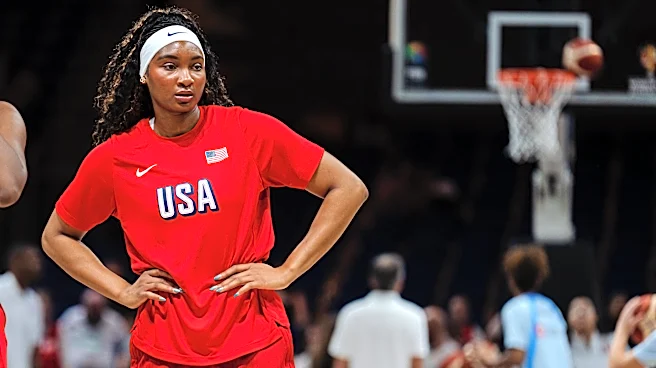
But it was a FIBA Women’s World Cup 2026 break filled with success for the Tempo’s Berlin exports. María Conde took home a bronze medal with Spain, claiming the prize in a third-place match with Germany’s Nyara Sabally and associate head coach (of the Tempo; head coach of Germany) Olaf Lange. The host Germans, one round earlier, knocked out Tempo guard
Julie Allemand and Belgium in what Lange called “the best day in the history of German women’s basketball,” per ESPN’s Alexa Philippou.
While head coach Sandy Brondello’s Australia squad fell in the quarterfinals to Spain, it did so facing a spate of injuries that should be extremely familiar to the Tempo’s inaugural head coach. Star centre Ezi Magbegor, Australia’s captain and a player easily connected with the Tempo for 2027, tore her ACL in the quarterfinal-play-in game against Italy. Fellow starters Alanna Smith and Jade Melbourne were also sidelined during the tournament with injuries, while veteran guard Sami Whitcomb’s injuries held her out of the World Cup from the start. Australia’s 89-66 thrashing at the hands of Conde and Spain wasn’t necessarily indicative of its true talent level, but the game, as they say, is the game.
Back from Break, Briefly
Nothing new for Brondello: entering the World Cup break, Toronto had missed the third-most games to injury in the WNBA this season, per The IX’s injury tracker. The Tempo will be without Brittney Sykes (as they have been for much of the season) and Aneesah Morrow (acquired before the trade deadline and immediately hit with the injury bug) for the last four-game sprint of the season. Marina Mabrey, the team’s leading scorer, is also done for the season. That leaves a lot of minutes to be filled by rookies Kiki Rice, an All-Rookie Team candidate, Laura Juškaitė, and Teonni Key (whose development we previously covered here).
That could play into the Tempo’s hands, since a four-game skid would earn the team at least a share of the top draft lottery odds. Toronto hosts Indiana and New York, two playoff teams fighting for seeding positioning, before heading on the road to Chicago and Connecticut to close out the season (and Connecticut’s time there; the team will move to Houston in the offseason). If the Tempo win none of those games, they’re guaranteed equal odds with Connecticut at No. 1 odds; if they win one, they’d need multiple wins by the Sun (who play three playoff teams) to avoid settling at their current second-best odds for a stacked 2027 draft class.
While watching the ping-pong balls, you can tune into Setting the Tempo, a four-part ESPN series chronicling the creation and launch of Canada’s first WNBA franchise, which will premiere Sunday, September 20, at 5 p.m. on TSN.
Explained: DHOs
Let’s take a look at one way Toronto has created offensive advantages no matter the personnel on court this season. We’ve previously explained “peel switching” and “Spain/Stack pick-and-rolls”; this time, let’s talk about handoffs and dribble handoffs, or “DHOs” (Dribble HandOff) for short.
The most natural advantage that DHOs create is off the screen. Toronto has players like Mabrey and Kia Nurse who are deadly shooters with limited space, and DHOs are a combination of a way to get those players the ball while simultaneously providing a built-in screen to create space. Because Toronto runs a lot of 5-out/delay sets, naturally putting the ball in the hands of a big at the top of the arc, it has plenty of opportunities to run actions involving DHOs (such as variations of “Zoom”) out of that spacing shell. The Tempo, per Synergy, average 0.946 points per possession involving a handoff, an above-league-average mark (one of only three halfcourt play types in which Toronto surpasses the league).
In the first clip, the Tempo’s opening play is designed to create a look for Nurse off a handoff (this rip screen into a DHO is sometimes called a “Peja” action after former NBA player Peja Stojaković). With the space created by the screen, Nurse knocks down the three. Then, Temi Fágbénlé flows into a DHO with Brittney Sykes. Her defender goes under the handoff, enabling Sykes to quickly pull the trigger on a three of her own off the handoff.
A secondary advantage of the DHO is that it facilitates playmaking from non-shooting bigs. Here, defences aren’t guarding Key—a non-shooter—out beyond the three-point line. But that means if she can get a quick handoff to a shooter, there’s nobody to defend against her screen and help the defender chasing the handoff. That’s enough space for Mabrey and Nurse to hit threes.
Handoffs don’t only create threes. They can be a way to get ballhandlers moving downhill, such as on this very nice empty DHO screen flip from Sabally in the first clip:
They can also create looks for bigs.
In the first clip, a “Miami” action (DHO into a ball screen) sets up a tidy pick-and-roll look, giving Isabelle Harrison a downhill lane to the rim. If defenders step up to neutralize the initial handoff, the roll becomes open, as clip two’s baseline inbound handoff does, leading to an open catch-and-shoot three. Finally, the threat of the downhill puts Phoenix’s Marta Suárez into a deep drop, leaving Fágbénlé to step in and take a wide open three.
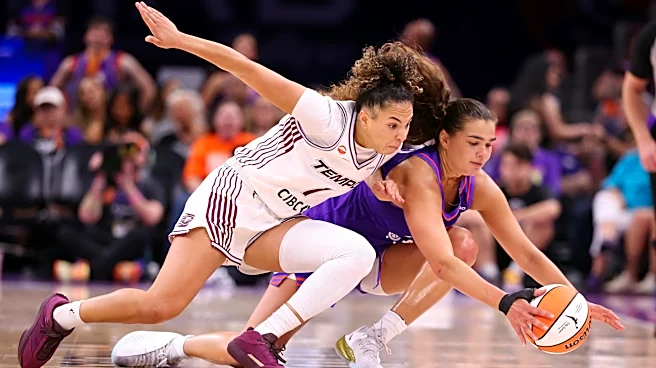
That threat of a handoff can work off the ball, too, as this nice bit of sequencing from the Tempo shows. Toronto runs the same DHO action on consecutive halfcourt plays, and while Juškaitė gets called for a travel after getting downhill the first time, the same action sets up a backdoor cut by Nurse—being overplayed by Lexie Hull to stop an empty wing DHO—the second time.
That’s the sort of offence Toronto can create, even more threatening at full health. It’s not necessarily the sort of offence it needs, though, as the team returns from the World Cup break and eyes lottery positioning more than handoff positioning.