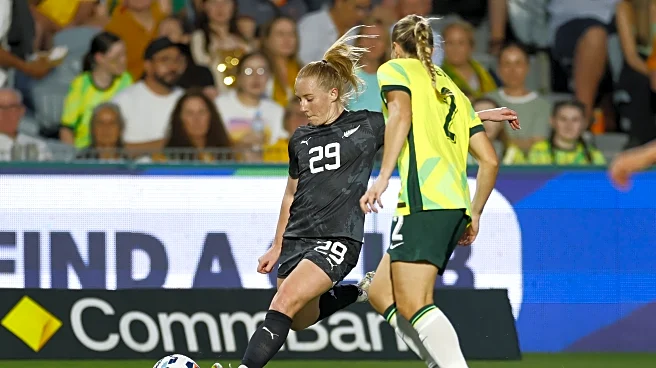


Katie Kitching captaining New Zealand in the final two matches of their Oceania World Cup qualifiers felt like one of those moments in football that arrives quietly but leaves a lasting impression.
It didn’t demand your attention and nor was it a dramatic twist or a shock announcement. Instead, it was softer; something that made you smile and think about the kind of player she is and the kind of person she must be in order to earn that level of trust. It was a moment that said more about her character
than any loud celebration ever could.
When the news emerged, it carried an element of gentle surprise — not the kind that makes you question the decision, but the kind that makes you pause and reflect.
It’s no slight on Kitching to say that she’s not a stereotypical captain, the loudest voice on the pitch or someone who commands attention with booming instructions or sweeping gestures. She doesn’t dominate the space around her and nor does she lead in the traditional sense. Yet the more you sit with it, the more it becomes clear that she is exactly the kind of leader who often goes unnoticed until a moment like this brings her into focus.
Her leadership is quiet, steady and deeply rooted in who she is.
She carries herself with a calmness that settles those around her. She plays with a composure that never feels forced and she approaches the game with a levelheadedness that remains intact even when the tempo rises or the pressure builds.
She leads by example; by doing the work, setting the tone and showing what’s required through her actions. That’s why her captaincy feels so fitting. It’s a recognition of qualities that’ve always been present — even if they haven’t always been labelled as ‘leadership’.

There is something very human about the way she leads.
She doesn’t crave the spotlight and she doesn’t need to be the centre of the huddle or the voice that cuts through the noise.
Her focus is always on the team and the task at hand. She doesn’t complicate matters, create drama or get lost in the emotional swings of the game. She’s there to work, to contribute and to elevate those around her — and that’s what makes her such a compelling captain.
She’s the first person into the trenches; the one who rolls up her sleeves and gets into the thick of it with her teammates. She leads from within, shoulder to shoulder, showing others how to navigate difficult moments by taking the first step herself.
Kitching’s tenacity is one of her defining qualities.
She works tirelessly, never shirking responsibility and never stepping away from the hard moments. She’s both relentless and selfless, and always willing to make the right decision for the team — whether that means taking responsibility herself or creating the opportunity for someone else.
Additionally, she reads the game with intelligence and humility, understanding when to drive forward, when to hold, when to pass, when to press and when to steady the tempo. She’s constantly scanning, constantly adjusting and constantly thinking about what the team needs rather than what she might want. That’s the essence of leadership. It’s not about being the loudest — it’s about being the most dependable.
In the context of New Zealand’s World Cup qualifiers, her presence as captain has been a steadying influence.
The Oceania qualifiers can be unpredictable. The conditions vary, the pitches are not always perfect and the pressure is immense because the expectation is always that New Zealand will qualify.
In those moments, a team doesn’t necessarily need a captain who shouts — it needs a captain who steadies, reassures and keeps the group focused on the fundamentals. Kitching has done exactly that. Her calmness has been a quiet anchor, her composure has been a guide and her ability to stay level-headed regardless of the situation has helped the team to maintain a sense of clarity and purpose.
There’s a particular kind of leadership that emerges in environments where the margins are thin and the expectations are heavy.
It’s not the leadership of noise or theatrics — it’s the leadership of clarity, presence and of someone who understands that the most important thing is to keep the group grounded. Kitching has shown that she’s capable of doing exactly that. She’s shown that she can guide a team through pressure without adding to it, and that she can be the calming presence in the storm.

Her captaincy also invites a reflection on how we view her role at Sunderland.
When a player becomes an international captain, it often prompts a re‑evaluation of how they’re perceived at club level, but with Kitching, it raises the question of whether we unintentionally downplay the her influence on the Sunderland dressing room.
Perhaps we’ve been conditioned to look for leadership in certain shapes and sounds, and in doing so, we overlook the leaders who don’t fit that mould. Sunderland’s squad is full of strong personalities, experienced professionals and natural communicators. It’s easy to assume that leadership belongs to the most vocal or the most senior, but leadership is rarely that simple. It’s layered, shared and expressed in many different ways.
Kitching’s leadership at Sunderland has always been present, even if it hasn’t always been highlighted.
She sets standards through her preparation, her consistency and her professionalism. She works tirelessly in training, never shirks responsibility, plays with intelligence and discipline and treats every match with the seriousness it deserves.
Her teammates trust her because they know she’ll never let them down. That trust is earned over time, through countless small moments that often go unnoticed by those outside the dressing room, as well as reliability, humility and a willingness to do the hard work without seeking recognition.
Her captaincy of New Zealand shines a light on those qualities and invites us to reconsider what leadership looks like in the Sunderland environment.
It reminds us that leaders aren’t always the ones who speak the most. Sometimes they’re the ones who listen the most; who observe, think and understand the rhythm of the group and how step in at exactly the right moment with exactly the right action. Sometimes they’re the ones who simply do their job so well that others naturally follow.
There’s a quiet authority to the way Kitching plays.
It’s not dominant — it’s competent, th authority of someone who knows what she’s doing and does it well. It’s that of a player who understands the game deeply and plays it with intelligence, and the kind of authority that doesn’t need to be shouted about, as it’s felt, recognised and respected.
Kitching’s journey to this point adds another layer to the story.
She’s worked hard for every opportunity. She’s developed her game with patience and determination and has grown into her role at Sunderland, becoming a key figure in the squad. She’s embraced the challenge of international football with New Zealand, adapting to a new environment and earning the trust of her coaches and teammates. Her captaincy isn’t a gift — it’s a reflection of the respect she’s earned.
There’s something quite beautiful about the way she approaches the game.
She plays with purpose, intelligence, heart and a sense of responsibility that goes beyond her own role. She understands the collective, the importance of unity and that football isn’t about individual glory but shared effort.
That understanding is at the core of her leadership, and her captaincy also speaks to her character.
She’s grounded, humble and focused. She doesn’t seek attention but she does seek improvement, progress and results. She elevates those around her simply by being herself — a rare quality and one that managers value deeply and that teammates appreciate.
It’s also something that fans often recognise only in hindsight, when they look back and realise how much she contributed to the identity and resilience of the team.

During New Zealand’s qualifiers, her leadership has been invaluable.
She’s helped to guide the team through the pressure of expectation, keeping them focused on the fundamentals and providing a steady presence in moments that could easily have become chaotic. She’s shown that leadership doesn’t need to be loud in order to be effective — it needs to be consistent, honest and rooted in the values of the team.
Her captaincy also highlights the importance of recognising different forms of leadership within a squad.
Sunderland have a number of strong leaders, each with their own style. Some are vocal. Some are strategic. Some are emotional anchors and some are motivators, but Kitching is the steady one, the one who keeps things grounded, who leads by example and who shows others what is possible through her actions.
That kind of leadership is easy to overlook because it’s not always dramatic but it’s essential, the foundation upon which teams build trust and resilience.
There’s also a wider conversation to be had about how we define leadership in women’s football.
The game has grown rapidly. The expectations placed on players have increased, the scrutiny is greater and the pressure is higher. Within this environment, leadership needs to be adaptable, thoughtful and inclusive, and Kitching embodies those qualities.
She leads with empathy, intelligence and a deep understanding of what her teammates need in different moments — as well as a sense of responsibility that’s rooted in her commitment to the collective.
Her international captaincy is a testament to that — a recognition of her influence, her character and her ability to guide a group through challenging moments.
It’s also a reminder that leadership isn’t about fitting a stereotype but about being the person the team can rely on. It is about being the one who steps forward when it matters and the one who sets the tone through action, instead of noise.
For Sunderland fans, it’s an opportunity to appreciate her in a new light; to recognise the leadership she brings to the dressing room, to understand that her influence goes beyond her position on the pitch and to see that she’s one of the players who shapes the culture of the team, even if she does so quietly.
Her captaincy of New Zealand doesn’t change who she is. It simply highlights what’s always been there.
Her story is a reminder that leadership comes in many forms. It is not always loud, dramatic or obvious. Sometimes it’s steady, calm and quietly powerful. Sometimes it’s expressed through consistency, humility and selflessness, and sometimes it’s embodied by players like Kitching, who lead not because they seek the role, but because they embody the values that leadership requires.
Her captaincy is wonderful to see because it feels earned.
It feels authentic, like a natural extension of who she is and a celebration of the qualities that make her such an important player for both club and country. It’s also a reminder that football is full of leaders who don’t fit the traditional mould but are every bit as influential. It’s a moment that invites us to look more closely at the players who lead quietly, work tirelessly and elevate those around them through their actions.
Kitching is one of those players.
Her leadership of New Zealand is a testament to her character, her commitment and her leadership — as well as a recognition of the qualities that have always defined her.
It’s a reminder that leadership isn’t about noise. It’s about presence, responsibility and being the person others trust. Kitching has earned that trust. She’s earned that responsibility, and she carries it with the same degree of calmness, composure and selflessness that defines her game.
Her story encourages us to broaden our understanding of leadership; to recognise the leaders who don’t shout, to appreciate the players who lead through actions and to value the qualities that are often overlooked.
It invites us to see leadership not as a single trait, but as a spectrum of behaviours and values. It invites us to celebrate the players who embody those values quietly, consistently and authentically.
All of this applies to Kitching.
Her captaincy is a reminder of the power of quiet leadership and a celebration of the qualities that make her an exceptional teammate, an intelligent footballer and a natural leader.
It highlights her journey, her character and her influence, and it’s a reminder that sometimes, the most effective leaders are the ones who simply get on with the job, who lead from within and who show others the way through their actions.