

This was a deeply disappointing offensive performance. There were positives on film, and I do not want to ignore them. However, those positives existed within an offense that still doesn’t fit together.
Right now, the Eagles look like they are running two separate offenses. They have a shotgun passing game and an under center running game. Those two worlds barely connect. The Eagles ran for 107 yards on 19 attempts, but that success didn’t produce the explosive play-action passes it should. The numbers
were ugly. The Eagles finished with 14 first downs and 248 net yards. They went 2-for-9 on third down, 0-for-5 on third-and-long, and 0-for-2 on fourth down. They reached the red zone twice and came away empty once. Andy Dalton’s interception was the single biggest win-probability swing of the game. We will get into that because I’m still angry…
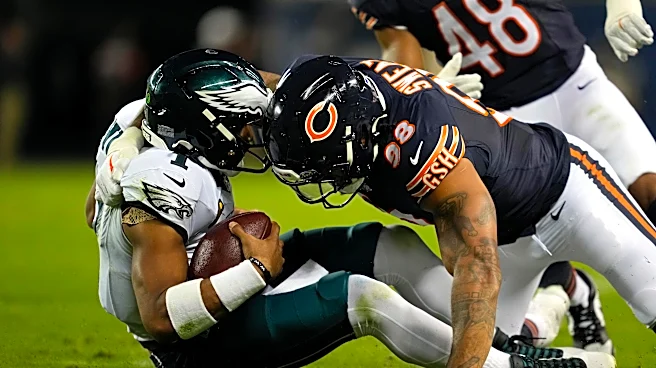
For me, the biggest problem was pass protection, particularly against pressure. I’m saying pass protection rather than offensive line play. Cam Jurgens had a poor game in pass protection, but the recurring free rushers were not simply five linemen losing individual blocks. The Eagles repeatedly looked confused about who they wanted to block and which defender they were prepared to leave free. That is a schematic and coaching problem first. Jalen Hurts was largely fine for three quarters before his play deteriorated once the Eagles fell behind by 20. The quarterback was not the main reason this offense failed.
Offense
It all started so well. The Eagles used pistol, paired the backfield action with a fake toss, and created an easy completion to Makai Lemon. Pistol gives the offense access to a downhill run action without forcing Hurts to turn his back completely on the defense. The fake moved the Bears in the wrong direction, and Lemon came open with ease.
The frustrating part is that the Eagles used it once. One snap doesn’t mean pistol is the answer to everything, but this offense needs formations that connect the running game to the passing game. This did exactly that. Maybe use it again? Try running out of pistol next week and see if we can get something going?
The outside zone running game was one of the clearest positives. It’s been bad through two weeks, but it was significantly better this week. The Eagles attacked the left side of the Bears’ defense, as I suggested they should in the preview, and created real movement. Jurgens and Drew Kendall produced some excellent combination blocks, and Kendall once again looked comfortable climbing and finishing at the second level. He looks like he might belong as a starter this year, but it’s still early days. Barkley finished with 82 yards on 15 carries, and the run blocking was significantly better than in the first two weeks.
The Bears’ run defense is not good, so I am not ready to declare every issue fixed. But the execution was better, and the Eagles found something they could lean on throughout the game. The maddening part is what did not come next. If a defense is flowing hard toward outside zone to the left, the natural counter is boot action with Hurts moving back to his right. The run game should create that throw. It never really did.
That is the central problem with this offense. A successful run should make the next pass easier. Here, the run game existed in isolation. There was no sense that one concept was setting up another.
This is why the pass protection has to be the Eagles’ first priority this week. Under center, play-action cannot function if Hurts turns his back to sell the fake and immediately finds an unblocked defender in his face when he turns around. The routes have not reached their useful point, the back is still following the fake, and the quarterback has no clean platform to throw. It doesn’t matter whether the play design created an open receiver if the protection doesn’t give Hurts enough time to see him.
Not every pressure came from the same error. Some snaps raised a protection-count question. Others exposed a problem with the play’s construction. Even if the line blocked the defenders they were assigned, who was responsible for the linebacker attacking the space vacated during the fake? This was a consistent issue, and when the same broad issue appears repeatedly, the coaches need to provide a dependable rule that everyone understands.
The Eagles have several possible answers. If they want a long fake and a deep crossing route, they can keep a tight end or second back (fullback, anyone?) in protection and accept having fewer receivers in the pattern. They can shorten the fake and ask the back to scan inside before releasing. They can change the slide toward the likely A-gap pressure, move Hurts’ launch point, or build in an immediate throw behind the linebacker as soon as Hurts completes his turn. There is no single magic solution. The unacceptable option is to keep combining a long-developing fake and route concept with protection that acts like the ball should already be gone.
My preferred answer is to split the under-center play-action package in two. Use sturdier protection when you want the deep crosser. If the back is going to sell the fake and release, give Hurts a route he can throw immediately when he turns around. Right now, the Eagles are asking the protection to survive longer than the backfield action allows. That mismatch is killing good concepts before they can develop.
This also feels uncomfortably familiar. Before Kellen Moore, the Eagles too often appeared to treat Hurts creating outside structure as their answer to pressure. Moore improved that area. Now it feels as though the offense is drifting back toward ‘Hurts must create’ as the protection plan. That cannot be the solution. The Eagles ran under center play-action 3 times in this game, and every time Hurts didn’t stand a chance. That’s a nightmare.
The Eagles have had some success with Mesh Rail this season, and this is another good example. I have already seen screenshots of Dontayvion Wicks standing open on the right side, followed by criticism of Hurts for not throwing him the football. Ignore those screenshots; they aren’t worth engaging with.
Hurts is reading the left side. The beauty of Mesh is that the crossing receiver eventually enters the quarterback’s line of vision from the opposite side, so Hurts does not have to read every route independently across the entire field. Wicks is not part of Hurts’ initial progression here, and Hurts has no reason to expect him to be uncovered before he comes into view. A still image can make any quarterback look wrong. This is not a miss.
Here is another excellent run behind Jurgens and Kendall. The Eagles attacked the left side again, but this time from a two-back look. The two-back shotgun set stops the backside edge defender from simply chasing the run down from behind because he has to respect the backfield action.
The tight-end blocking was also competent for the first time in a while. E.J. Jenkins did an excellent job on this rep, and that matters because poor edge blocking has undermined the run game too often, especially at tight end. My only complaint is that I wanted him to finish it. Take on the safety and score!
This is the type of shotgun run that can help marry the offense together. The answer is not to abandon under center. But they have to find a way of connecting the two.
This is unacceptable from Andy Dalton. The Eagles had driven to the Bears’ 2-yard line and were in position to score. Dalton faced no pressure, floated a lazy ball toward the back of the end zone, and it was picked off. According to the win-probability data, it was the biggest swing of the game at 13 percent.
I have criticized the Eagles’ handling of the backup quarterback position since the summer. Dalton fell into this job despite a poor preseason and disappointing reports from training camp. A backup has to be ready to enter at any moment. Dalton was not ready here. He is better than this, which makes the lack of preparation even more irritating. This was really, really poor. I could say more, but I will bite my tongue for now. I was so mad watching this live, and I feel just as bad now.
The Eagles had a nightmare in pass protection throughout this game. This completion does not change that. They have six players in protection against seven rushers, so somebody has to come free. That is football. Fine. The problem is identifying the free defender.
You can’t let the linebacker aligned directly over the A-gap have a straight path to the quarterback. If the protection is going to lose a rusher because the defense has brought one more player than the offense can block, the free defender should be the player furthest from the quarterback and the line of scrimmage. This is basic Football 101. That gives Hurts the maximum possible time to complete the throw. Instead, the most immediate inside threat comes clean. Hurts completes the pass, but the protection rule still makes no sense.
That is why I don’t want the discussion reduced to one bad block or one bad player (Jurgens wasn’t good in pass protection, but still, not everyone can be perfect). Did the line identify the pressure incorrectly? Was there a missed adjustment? We cannot know the exact call. What we can see is that the result placed the free rusher in the most dangerous possible location. That has to be corrected schematically.
In better news, what a route from Wicks. His ability to stop, sink, and cut at his size is outstanding. This was also another reminder that the passing game looked much better when the Eagles let Hurts operate from shotgun and push the ball downfield. Hurts is at his best when he can see the defense, play in rhythm, and attack intermediate areas. The Eagles got too conservative because they didn’t trust their protection.
That lack of trust produced one of the worst parts of the game plan. The repeated swing passes behind the line of scrimmage. AGAIN! I am not even posting a clip. You all watched them. They were an embarrassment. The Eagles seemed to treat those throws as their answer to the Bears’ double A-gap mug looks, but the answer never threatened the defense’s structure. The Bears could crowd the middle, drop linebackers underneath quick in-breaking routes, and rally to the swing pass without being punished vertically. At times, the Eagles called the swing pass to the boundary side (the side with less space), which gave the receiver even less chance to find space. It was bizarre.
The Eagles needed to attack beyond those dropping linebackers. That does not mean calling reckless deep shots on every snap. It means using seams, deep crossers, slot fades, and layered concepts that force the defense to defend space downfield. The offense cannot keep responding to pressure by throwing the ball sideways and hoping someone creates yards after the catch. It isn’t working.
This is the most frustrating protection failure of the game because the concept works perfectly. It’s a wonderful concept and exactly what we wanted to see from the new offense. The play-action fake influences the defense and Lemon creates separation across the field. The Eagles have generated exactly the opportunity they want. Hurts simply cannot access it.
Hurts turns his back to sell the run, pivots around, and has to avoid pressure before he can plant his back foot. By the time he regains his balance, the play is already compromised. Jurgens appears to leave the defender in front of him and work toward a linebacker further away, which looks baffling on film. Again, I am hesitant to make this entirely about Jurgens without knowing the protection call. If the scheme tells him to work there, the scheme has exposed Hurts. If the assignment was wrong, the communication and rules still need fixing.
The interception is awful. Hurts shouldn’t throw this ball, although on fourth down I understand why he felt he had to give somebody a chance. The game situation explains the decision, but it doesn’t make it good.
The design deserves criticism too. There is no motion, no disguise, and nothing to change the picture for the Bears. T.J. Edwards and the other linebackers had repeatedly threatened the A-gaps before dropping underneath in-breaking routes. Edwards had already come close to an interception earlier in the game. The Eagles saw the same tactic repeatedly and found no answer. Calling another static concept into the same defensive structure was asking for trouble.
Hurts’ play deteriorated late, especially after the Bears went up 20, and this throw is part of that. I am not excusing it. But bad quarterback play and a bad call can exist on the same snap. Overall, I didn’t come away with any worries about Hurts. I think, if anything, he was a touch better on the All22 than I thought he was live. I came away a lot more critical of the scheme than the players this week.
I haven’t been that impressed with Lemon through the opening weeks, but this play reminds me what he can do. He understands how to find space in the middle of the field, presents a clear target, and gives Hurts an easy completion. Hurts does a good job finding him as the coverage opens.
The Eagles need this relationship to develop. Lemon should help them attack the intermediate middle, especially against defenses that want to mug the A-gaps and then drop linebackers into underneath windows. Get him vertical from the slot, let him work between levels, and stop forcing him into swing passes that do not suit what he does best. The offense desperately needs another reliable answer in this area.
Final Thoughts
There were positives. But the overall performance was still poor, and the biggest issue was the scheme rather than any one individual.
The Eagles can’t keep running an under-center game and a shotgun passing game that barely work together. They need shotgun runs, under-center passes, pistol, boots, and play-action concepts that look like the runs they are built from. Most importantly, they need protection rules that identify the most dangerous rusher and give Hurts a realistic chance to execute the call. If they want a deeper route, protect it. If they want to release the back, shorten the fake and give Hurts an immediate answer.
Right now, too many plays appear to end with Hurts being asked to rescue a concept after the protection has already failed. That is not sustainable offense. The Eagles have enough talent to be far better than this, but talent alone can’t connect two separate systems. The coaching staff has to marry the run and pass games and fix the protection. It has to happen pretty quickly, or we are all going to lose faith.
Thank you for reading! I’d love to hear your thoughts, so feel free to comment below and ask any questions. If you would like to support me further, please check out my Patreon here!