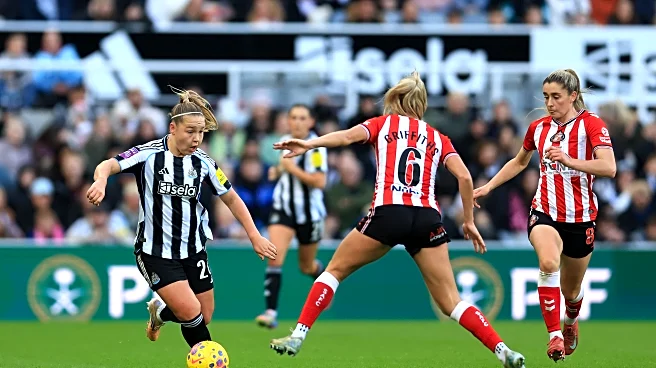

In a Sunderland Women side that’s evolved consistently over the past several seasons, few figures embody continuity and steady progression quite like Louise Griffiths.
Her story is one of gradual and deliberate
development; of patience rewarded and of a young player who’s become a long‑standing presence despite still being in the early stages of her career.
In many ways, Griffiths represents the very essence of Sunderland’s identity: grounded, hardworking, technically assured, and quietly ambitious. To understand her role in the squad today, it’s necessary to trace her journey from academy prospect to first‑team mainstay and to appreciate the subtleties of her game that make her such a dependable left‑back in a league where consistency is often the rarest commodity.
Griffiths’ pathway through the Sunderland academy system mirrors that of many who have come before her, but the way she’s navigated it sets her apart.
She didn’t burst onto the scene with the fanfare that sometimes accompanies young talents; instead, she accumulated minutes gradually, earning trust through reliability rather than spectacle. Her early senior appearances were characterised by a sense of composure that belied her age — and even when she was only beginning to integrate into the first team environment, she played with the calm assurance of someone who understood the demands of senior football and was prepared to meet them without fuss.
This steady introduction allowed her to develop organically, without the pressure of being thrust into the spotlight before she was ready.

Over time, Griffiths became a familiar name on the teamsheet — not because she was the loudest presence or the most flamboyant performer, but because she was dependable.
Sunderland have long valued players who embody the club’s ethos. Griffiths fits that mould perfectly and her presence in the squad is a testament to her professionalism and her ability to adapt to the evolving tactical demands placed upon her.
She’s been part of the team through periods of transition; through changes in personnel and style, yet her role has remained remarkably consistent: that of a no‑nonsense defender who provides stability on the left side of the pitch.
However, Griffiths’ 2023/2024 season posed a challenge that tested her resilience in a way she hadn’t previously experienced as a long‑term injury kept her sidelined for a significant portion of the campaign and deprived Sunderland of one of their most reliable defensive outlets.
For a player whose game is built on rhythm, positioning, and timing, such an absence could easily have disrupted her momentum, yet when she returned, the sense of relief among supporters and teammates alike was palpable.
Her comeback wasn’t marked by dramatic moments but by the quiet re‑establishment of order on the left flank, and it was as though a missing piece had been restored, allowing the defensive structure to settle once more. Her return also served as a reminder of how integral she’d become to the team’s balance — even if her contributions weren’t always the most visible.
Griffiths’ defensive style is rooted in clarity and intelligence; first and foremost, she’s a defender who understands her priorities.
Her approach is no‑nonsense in the best possible way: she clears danger decisively, tracks runners diligently, and refuses to overcomplicate situations in her own half. There’s no attempts at cute passes across the back line or to take unnecessary risks in possession. Instead, she reads the game with maturity, stepping out at precisely the right moments to intercept or delay an opponent’s attack.
Her timing in the tackle is one of her most underrated qualities. She isn’t reckless and nor is she overly aggressive; she commits only when she knows she can win the ball cleanly, and does so with a level of composure that prevents Sunderland from being exposed in transition.
Her ability to backtrack and chase down runners is another defining feature of her game.
In a league where pacy wingers are increasingly common, full backs must be able to recover quickly and intelligently — and Griffiths excels in this regard.
She rarely appears panicked, even when isolated one‑on‑one. Instead, she positions her body well, shepherds attackers into less dangerous areas and uses her acceleration to close down gaps that might otherwise become problematic. This defensive reliability forms the foundation of her value to the team, but it’s only one aspect of her development.
What’s also become increasingly evident over the past two seasons is the evolution of her attacking contribution.
Early in her career, Griffiths was primarily a “stay‑at‑home” full back, being focused on defensive solidity above all else, but as Sunderland’s tactical approach has shifted, so too has her role. She now makes more frequent forays up the pitch, linking play with midfielders and wingers, and offering width in advanced areas.
Her confidence on the ball has grown significantly, allowing her to carry possession forward with purpose rather than simply recycling it. This added dimension has made her a more complete full back, capable of contributing in both phases of play.
Whilst it would be exciting to see her register more assists or deliver more crosses into the box, this is less a criticism of her individual output and more a reflection of Sunderland’s broader attacking patterns this season.
The team as a whole has struggled at times to create high-quality chances from wide areas, and Griffiths’ crossing opportunities have often been limited by the structure of the attack. When she does get forward, she links play intelligently, choosing the right moments to overlap or underlap, ensuring that her defensive responsibilities are never compromised.
Her attacking improvement is clear and with continued development in the final third, she has the potential to become one of the most well‑rounded full backs in the league.

Leadership is another area in which Griffiths contributes quietly but significantly, even if she isn’t the type of player who commands attention through vocal presence or dramatic gestures.
Instead, she leads through consistency, the reliability of her performances and the example she sets in her approach to the game. She’s the kind of player who rarely wins “Player of the Match” awards — not because she’s undeserving — but because her position and style don’t lend themselves to the kind of standout moments that typically attract such recognition.
Full backs who do their job with minimal fuss are often overlooked, yet they’re essential to a team’s stability and Griffiths embodies this understated importance. She rarely puts in a poor performance, even when the team as a whole struggles, and her ability to maintain high standards regardless of circumstances is a hallmark of her professionalism.
Her reading of the game is one of the qualities that elevates her beyond the status of a solid defender.
She anticipates danger early, allowing her to step out and intercept passes before they reach their intended target. This proactive approach not only disrupts opposition attacks but also helps Sunderland regain possession in advantageous areas.
Her interceptions aren’t the result of guesswork but of careful observation and an understanding of patterns of play. She’s a step ahead when watching a game unfold, and this vision allows her to make interventions that appear simple but are in fact the product of tactical intelligence.
Looking ahead to the second half of the season, there is every reason to believe that Griffiths could showcase her abilities even more prominently.
Following Keira Barry’s departure, the dynamics on the left side of the pitch are shifting. This opens the door for new partnerships to form, and Griffiths’ adaptability makes her well‑placed to thrive regardless of who plays ahead of her.
Izzy Atkinson’s return from injury presents an exciting possibility, as her pace, creativity, and directness could complement Griffiths’ defensive stability and measured forward runs, creating a balanced and effective left‑side combination.
Alternatively, Ellen Jones may stake her claim for the starting role on the wing, offering a different style of play that could also mesh well with Griffiths’ strengths. And of course, there’s the established understanding she has with Emily Scarr, whose potential return to a more advanced role — particularly if Eleanor Dale re‑enters the squad as the designated striker — could reignite a partnership that’s previously served Sunderland well.
These potential combinations highlight one of Griffiths’ most valuable traits: her ability to adapt to the players around her.
Whether paired with a winger who prefers to cut inside, one who stays wide or who interchanges positions fluidly, she adjusts her positioning and decision‑making accordingly. This tactical flexibility is crucial in a team that’s undergone significant changes and continues to evolve.
Beyond her on‑pitch contributions, Griffiths represents something deeply important to Sunderland: loyalty.
She’s grown with the club, weathered its challenges, continues to develop year after year. Despite already feeling like a long‑standing member of the squad, she still has many years ahead of her, and the prospect of her remaining at the club long‑term is an exciting one.
Her longevity isn’t a sign of stagnation but of continual growth.
Each season, she adds new layers to her game, refines her strengths, and addresses areas for improvement. This commitment to development is part of what makes her a fan favourite. Supporters appreciate players who give everything for the shirt, who embody the club’s values and who show steady progression rather than fleeting flashes of brilliance — and Griffiths fits this profile perfectly.
In a football landscape that often prioritises flair, spectacle, and instant impact, Griffiths stands out precisely because she offers something different.
She’s the steady heartbeat of the left flank; the dependable presence who allows others to take risks knowing she will cover behind them and the player who’s rarely in the spotlight but whose absence is felt immediately.
Her journey from academy prospect to first‑team regular is a testament to patience, hard work, and resilience, and her return from injury a few seasons ago demonstrated her mental strength and her importance to the squad.
Griffiths’ defensive intelligence, composure on the ball and growing attacking contributions make her a vital component of Sunderland Women’s identity and tactical structure, and as the team continues to push forward, seeking to refine its style and climb the table, she’ll remain central to that effort.
She may not always be the player who grabs the headlines, but she’s the one that ensures the foundations are solid. And in football — as in life — the foundations are everything.
Sunderland are fortunate to have her, and the supporters know it. Her story is still being written and if her trajectory so far is any indication, the chapters to come will be marked by the same quiet excellence that has defined her career to date.

There’s also something profoundly emotional about the bond between Griffiths and the Sunderland fanbase, a connection that’s grown quietly but meaningfully over the years.
Supporters have watched her journey from academy hopeful to first‑team regular with a sense of pride that goes beyond the usual appreciation for a homegrown player.
There’s a sense of protectiveness around her; a collective desire to see her succeed not because she demands attention, but because she represents the values Sunderland fans hold dear: graft, humility, and a refusal to cut corners. She plays football the way Sunderland supporters expect their players to play — with honesty, heart and deep respect for the shirt.
When she was sidelined for a long period during the 2023/2024 season, the absence felt heavier than simply losing a left‑back.
Fans missed the calmness she brought to the pitch, the assurance she provided in moments of pressure and the way she quietly stitched the defensive line together without ever needing to be the loudest voice. Her return was met with genuine warmth, the kind that comes from supporters who understand how hard a player has worked behind the scenes. There was no dramatic fanfare and no grand announcement — just a collective exhale and a sense that something important had been restored.
Part of the emotional connection stems from the way she carries herself.
Griffiths doesn’t court attention or thrive on the spotlight. She’s the type of player who jogs back into position without fuss after a perfectly-timed tackle, who acknowledges the crowd with a small nod rather than a theatrical celebration, and who seems almost embarrassed when singled out for praise.
That humility resonates deeply with Sunderland fans, who’ve always valued substance over spectacle. In a squad that’s seen its share of upheaval, she’s become a reassuring constant; the kind of player supporters point to when explaining what makes this team special.
There’s also a sense of shared growth between Griffiths and the fanbase.
Supporters have seen her evolve season by season, adding new layers to her game, becoming more confident in possession, more assertive in her forward runs and more vocal in her organisation of the back line. Watching her develop has felt like watching a younger sibling grow into themselves — a mixture of pride, affection, and excitement at what might come next.
Every time she steps onto the pitch, there’s a quiet murmur of appreciation from the stands, a recognition that she is one of their own — someone who’s earned their place not through hype but through hard work.
Her loyalty to the club only strengthens this emotional connection, and in an era where players move frequently and allegiances shift quickly, Griffiths’ continued presence feels grounding. She’s been part of the club through its highs and lows, through structural changes and squad rebuilds, and she has remained committed throughout.
Fans see that and they value it. They know she could continue to grow elsewhere, but they also know she’s chosen to grow here. That choice matters.
Looking ahead, supporters are excited — not just about what she already brings, but what she could become. There’s a sense that her best years are still ahead of her, that she has another level to reach, and that Sunderland will be the place where she reaches it.
The prospect of her forming new partnerships on the left — whether with Atkinson, Jones or the returning Scarr — adds another layer of anticipation. Fans want to see her flourish, to see her contributions recognised more widely and to see her become one of the defining players of this era.
Yet even if she never becomes the headline act, even if she continues to be the quiet constant rather than the star attraction, she’ll remain cherished. For Sunderland supporters, Griffiths represents something rare and precious: a player who gives everything, asks for nothing and embodies the spirit of the club with every performance.
She is, in many ways, the emotional heartbeat of the team — steady, reliable, and deeply adored.