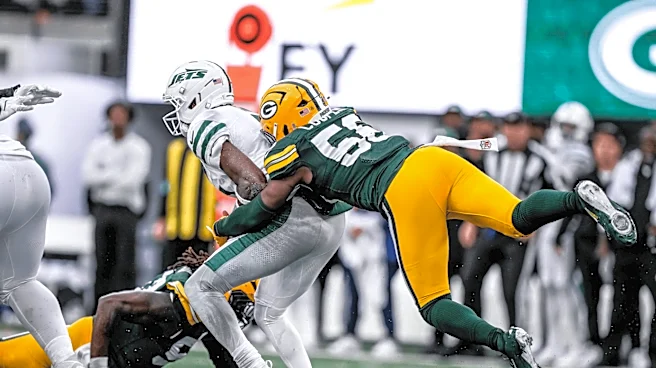


As Jonathan Gannon prepares the defense each week, layers and layers are added to build a versatile defense capable of handling any situation. The layering includes adding new ways to generate pressure without sending five or more. One way Gannon accomplishes this is through a defensive line stunt.
A stunt is a pre-planned pass rush where defensive linemen trade their usual rush lanes after the snap. One rusher attacks first as the penetrator, trying to get the adjacent blockers to commit, while a teammate
follows as the looper and wraps behind him into the space that reaction creates.
A stunt doesn’t try to win with raw strength. It attacks the offensive line’s communication: blockers have to recognize the movement, pass rushers off from one lineman to another, and keep the pocket connected.
“Flush” describes what the stunt is trying to do rather than one universally defined call, and teams name their line games differently. A flush stunt is built to make the quarterback leave his spot. A sack is a bonus, not the main goal.

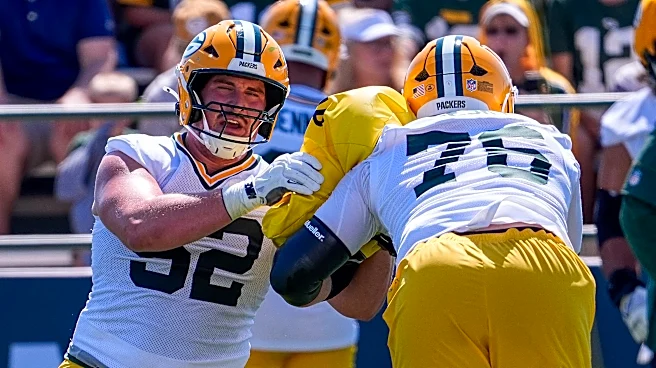
The Packers front is aligned with five across the line of scrimmage, forcing the offense into a 5-0 protection call. In a 5-0 protection call, the five offensive linemen are responsible for the five most dangerous rushers. Often this is man protection (“big on big”), with the center or quarterback identifying the Mike linebacker to set the count.

The design usually collapses the area where the quarterback wants to step up, which forces him to bail out of the pocket in a direction the defense has already planned for.
A loop into the middle can close the space the quarterback expected to step into, and the looper doesn’t need a clean sack to succeed if he pushes the quarterback off his spot, speeds up the throw, or flushes him toward another defender.

Here, Edgerrin Cooper is the MIKE linebacker and aligned as an interior rusher over the center. The interior rushers crash hard toward the guards with the two penetrators on the left side of the defensive line slanting inside to the opposite gap.

Brenton Cox Jr. and Lukas Van Ness collapse the right side of the offensive line to the middle of the pocket.

Cooper loops around the perimeter and works wide to cut off one escape lane.
The only way out is to the other side, where a contain rusher, a spy linebacker, or a defender dropping into the throwing lane is waiting. Some four-man games slant both ends inside to occupy the tackles while the tackles loop outside to attack the edge, a setup designed to flush the quarterback out of the pocket or force a quick throw.
The payoff is subtle. Timing-based passing games depend on the quarterback hitting the top of his drop and throwing on rhythm. Force him to move, and receivers are running routes that no longer match his timing, while throwing lanes shift.
Offenses have answers. Linemen who communicate and pass stunts off cleanly shut them down before they start. Quick passing takes away the time a stunt needs to develop, since loopers take an extra beat to arrive.
Screens and draws punish defensive linemen who are rushing on angles rather than playing their gaps. A mobile quarterback who escapes toward the defense’s intended trap and still throws on target turns the stunt into a big play for the offense.