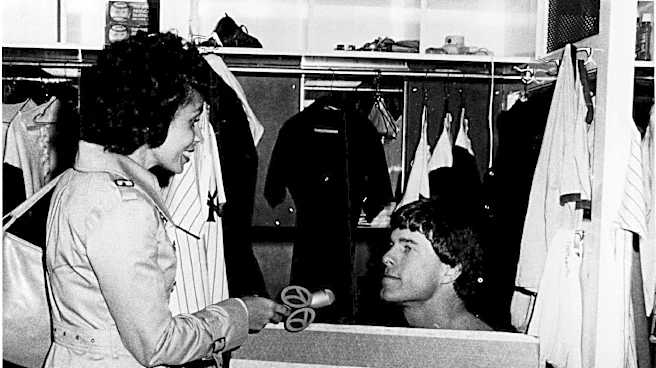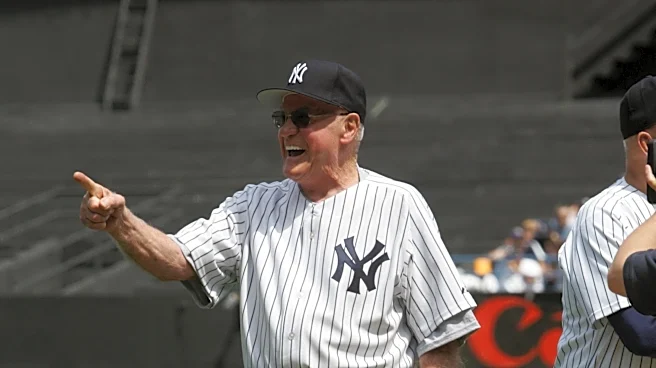




If you’re a baseball history buff, you probably recognize the name Hank Bauer. While he was never the team’s main star, he had a very good career on some very good Yankees teams, winning seven World Series titles. However, so much about him gets overlooked if you just know that about him. Hank Bauer had quite the life in baseball.
Henry Albert “Hank” Bauer
Born: July 31, 1922 (East St. Louis, IL)
Died: February 9, 2007 (Lenexa, KS)
Yankees Tenure: 1948-59
Bauer was born in 1922 to immigrants from Austria-Hungary.
It’s theoretically possible that the assassination of Archduke Franz Ferdinand had some sort of butterfly effect that led to Bauer eventually playing for the Yankees. Hank was the youngest of nine children and had a bit of a hard scrabble life growing up. His father lost a leg in an accident, requiring the children to help bring in some income.
As for baseball, Hank followed his older brother Herman into the sport. Herman was signed by the White Sox and was a well-rated prospect, who got Hank a minor league tryout. The Oshkosh Giants signed Bauer out of that tryout, and he had a brief run with them in 1941.
However, Bauer’s run with Oshkosh was cut short, for reasons you might be able to deduce from the date. The United States entered World War II in December 1941, and Bauer enlisted in the Marine Corps soon after. In his time in the military, Bauer suffered a shrapnel injury and also battled malaria while serving in the Pacific Theater. However, his brother Herman suffered an even worse fate, as he was killed in action during the Normandy Landing in 1944.
Due to his wounds and injuries, Bauer had assumed his baseball career was over, but Yankee scout Danny Menendez remembered Bauer from before the war, signed him and got him a tryout with the Quincy Gems. There in 1946, five years after his last minor league game, Bauer returned to pro baseball. From there, he quickly made his way through the Yankees’ minor league system. By the end of 1948, the Yankees called him up for a September cup of coffee. The next year, the Yankees had some injury problems in the outfield, leading new manager Casey Stengel to give some chances to young players, including Bauer. He made the most of his opportunity with a solid season, locking down a place in the Yankees’ lineup for years to come.
In 1949, Bauer became a reliable bat for a Yankees team that won five World Series titles in a row starting that season. Over those years, Bauer steadily got better, posting his best career hitting seasons in the final years of that five-peat: a 132 OPS+ in 1952, and a 131 in ‘53. He also emerged as a favorite of Stengel as well as a leader in the clubhouse.
Throughout all that, Bauer also had some big moments. In 1951, his three-run triple in the sixth inning of Game 6 gave the Yankees the lead for good, as they won that game to clinch the series. Later that game, he made a sliding catch for the final out of the series, as the Giants threatened a comeback.
Later in his career, Bauer recorded a hit in 17-straight World Series games over the course of the 1956-58 series. In the ‘58 Series, he put up a 1.032 OPS with four home runs in a seven-game victory over the Braves. Were it not for Bob Turley’s heroics on the mound, Bauer could’ve been named MVP of that series.
Bauer was also known as someone who didn’t take much crap. Whitey Ford described one incident where after he came in worse for wear after a night out, Bauer pinned him against the wall and said that Ford was “messing with (Bauer’s) money.” Bauer was also one of the notable participants of the “Copacabana Incident.” While the outfielder always said he played no part in the brawl that happened that night, one person sued him claiming that Bauer had punched him. The charges didn’t stick, and Bauer was later proven correct decades after the fact.
Despite his World Series hit streak, Bauer had begun to fall off by the end of the 1950s. In 1959, he rated as a below average hitter for the first time since his 1948 big league cameo. The Yankees decided to move on, and Bauer was included in a trade with the Kansas City Athletics that brought a certain Roger Maris to the Bronx.
Bauer spent two seasons as a player in KC. In the second of those, the, uh, “eccentric” Charlie Finley named Bauer the team’s manager partway through the season. He led the team through the 1962 season before being let go, but the A’s were a mess at that time, as the Maris trade was hardly the only one they made that massively benefitted the Yankees.
After his departure from the A’s, Bauer joined the Baltimore Orioles coaching staff. Following a disappointing 1963 season, Baltimore elevated Bauer to the manager. In his first two years, Bauer led the O’s to 90+ win seasons, but third place finishes in the AL. Following the addition of Frank Robinson in 1966, Baltimore won the pennant and then swept the Dodgers in the World Series.

Injuries hampered the Orioles over the next couple seasons and Bauer was eventually let go in favor of Earl Weaver in 1968. Bauer took up the helm of the A’s again next year — with the team now in Oakland — but Finley fired him after a late season slump. Although Bauer managed in the Mets’ minor league system after that, he eventually gave that up after no other big league team was willing to give him a shot.
Bauer eventually rejoined the Yankees as a scout, but otherwise left baseball and settled down back in Kansas. He occasionally returned for Old-Timers’ Days at Yankee Stadium and lived in The Sunflower State until he passed away from lung cancer in 2007.
While he was a very good player for a long time, Hank Bauer wasn’t on a Hall of Fame level. However, he still had quite the life in baseball regardless.
See more of the “Yankees Birthday of the Day” series here.