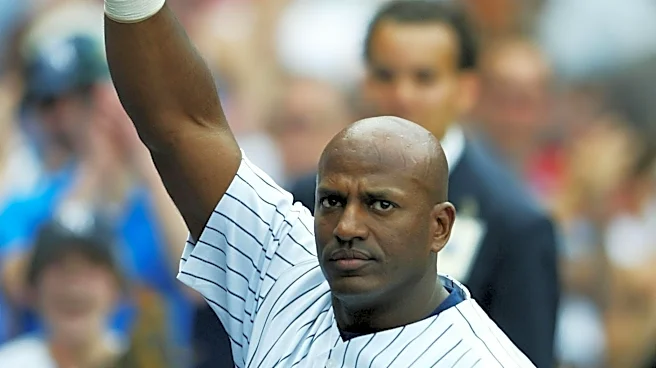




After bursting onto the scene in the late 1980s, Rubén Sierra went on to play for nine franchises over the course of his 20-year Major League career. The Yankees got to see two different stints from him over all those years, and had two very different experiences.
Rubén Angel Sierra Garcia
Born: October 06, 1965 (Rio Piedras, Puerto Rico)
Yankees Tenure: 1995-1996, 2003-2005
Born in Puerto Rico, Sierra lost his father when he was just four years old. Growing up in the Jardines Selles projects inspired
Sierra to do one thing: get him and his family out of there. Excelling as a multisport athlete in high school, Sierra was signed by the Texas Rangers in 1982 and started his professional journey at just 17 years old in 1983.
Sierra, an outfielder who batted from both sides of the plate, quickly climbed through the Rangers system. So quickly that in 1986, the barely-not-a-teenager found himself on the doorstep of the majors in Triple-A. Later that summer, the Rangers called the kid up, and he homered in his second big league at-bat. Sierra went on to play in 113 games, launching 16 homers to go along with 13 doubles and 10 triples, for a baseball triple-double, if you will, good enough for a sixth-place finish in the American League Rookie of the Year voting.
That performance his rookie season was good enough to make him stick with the big league club moving forward. Sierra followed up his rookie campaign by hitting 30 home runs in 1987 and had a decent season again in 1988. The 1989 season would go down as one of Sierra’s best. He batted .306 with 29 big flies and led the major leagues with 14 triples and RBIs with 119. For the first time, he was selected as an All-Star and finished second to Jeff Kent in the MVP race. Sierra cried and argued he deserved the MVP in a moment that would have been meme’d and gone viral if it had happened 30 years later.
Following the meltdown, Sierra had a down season. However, the still-young rising star rebounded in 1991. Making his second All-Star team, he hit 25 homers with 116 RBIs while batting .307 on the year. Following the season, Sierra fought with the club over salary and eventually won in arbitration. However, Sierra took the process very personally. An already rocky relationship with manager Bobby Valentine finally came to a head, and a frustrated Rangers front office fired Valentine. Sierra was then traded, a few weeks after his third All-Star appearance, to the Oakland A’s on August 31, with Jeff Russell and Bobby Witt for Jose Canseco.
Sierra played in Oakland for the rest of the 1992 season and into the 1995 season. While in Oakland, Sierra clashed with another manager, this time Hall of Famer Tony La Russa. The two openly fought in the sports pages, with Sierra bashing the get-on-base approach La Russa wanted. Despite playing well enough to be an All-Star again in 1994, the club had soured on Sierra to the point where they traded him with Jason Beverlin to the Yankees for Danny Tartabull.

The first stint in the Bronx for Sierra started in 1995 and ended almost a year to the date in 1996. The reason for the short stint was manager conflict again. Sierra clashed with Buck Showalter after he started using Sierra in a platoon role with Darryl Strawberry. Sierra had his agent call Showalter to complain, which set off Showalter. Joe Torre took over the Yankees in 1996, and Sierra again found a way to immediately get off on the wrong foot with the skipper. Torre would later say Sierra was the hardest player he ever had to coach and said he only cared about statistics and did not understand baseball. After one calendar year, the Yankees had enough and traded him with Matt Drews to the Detroit Tigers for Cecil Fielder.
Following his trade to Detroit, Sierra embarked on a four-year stretch playing for five different clubs. His production plummeted during this journeyman phase, eventually forcing him into a brief hiatus from the major leagues to completely retool his swing. Sierra found himself playing in Mexico, and over this stretch, his attitude changed and he started showing maturity, reaching out to mend a lot of broken relationships, including burying the hatchet with Torre.
Sierra got his swing back on track and was given a chance to revive his career back with the Rangers. In his comeback season, he won the 2001 American League Comeback Player of the Year award. Sierra then made a one-year pit stop in Seattle before bouncing back to the Rangers for the 2003 season. In June of 2003, he was traded by Texas back to New York for Marcus Thames.
The second stint in the Bronx saw a reinvented Sierra. He was selfless and a productive veteran bench piece who became a beloved clubhouse presence. Sierra delivered a few clutch moments for the Bombers, most famously hitting a game-tying three-run home run off Francisco Rodriguez in Game 4 of the 2004 ALDS. By the time his second stint concluded after the 2005 season, Sierra had rewritten his legacy in New York. Across five seasons in pinstripes, Sierra hit 45 home runs while batting .254 over the span of 383 games.
Over his twenty-year career, Sierra got 2,152 hits and had a .268 career batting average. He hit 306 home runs and drove in 1,322 RBIs across 2,186 games. After his playing days, Sierra started focusing on his lifelong love for salsa music. He has released several salsa albums and spent much of his retirement actively touring, performing, and singing at live music venues and events. Sierra was inducted into the Texas Rangers Hall of Fame in 2009.
Happy birthday, Rubén!
See more of the “Yankees Birthday of the Day” series here.