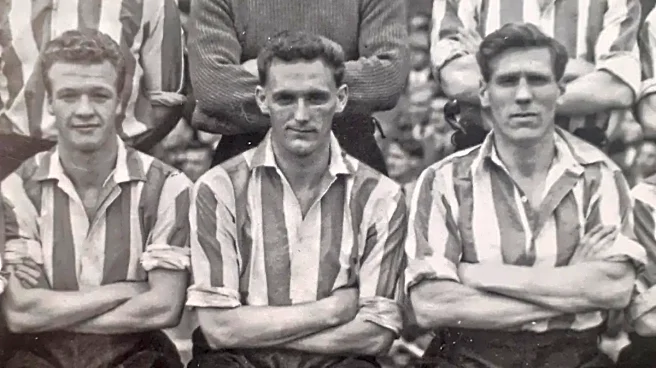



Ray Daniel made his debut for Sunderland against Charlton Athletic at The Valley in the opening fixture of the 1953/54 season. He was one of three debutants, as free-spending Sunderland continued their pursuit of success by bringing the best that money could buy to Roker Park.
Bill Murray’s Bank
of England team was packed with stars, and the purchase of Daniel from the reigning league champions Arsenal added to the list of top players in the Wearsiders’ ranks.
The cost of £27,500 for the Welsh international was a record fee for a defender at the time. His signing was considered something of a coup, as Daniel had just helped Arsenal win the league championship and looked set for a long run in a very strong Gunners team.
However, behind the scenes, all was not well. Daniel was at something of an impasse with Arsenal manager Tom Whittaker about his style of play. Daniel loved to move forwards with the ball and join the attack whenever he could. This, of course, left the defence exposed at times and goals had been leaked. Daniel was under pressure to curb his natural attacking instincts and he was not happy about this.
Bill Murray stepped in with an offer that Arsenal could not refuse, and Daniel was happy to accept. The man considered to be one of the best half-backs in British football was on his way to Roker Park, presumably with guarantees from Murray that he could play his natural attacking game. He was one of the best at this, in an era when brawn was often valued more highly than skill in defenders.

Ray Daniel made his debut alongside £16,000 Scottish goalkeeper Jimmy Cowan and a £26,000 winger from Burnley who would go on to become a top servant to Sunderland not only as a player, but also as a coach and acting manager – the irascible Billy Elliott.
Daniel made his debut alongside his international colleague and friend Trevor Ford. Also in the team were Jack Hedley, George Aitken, Tommy Wright and Len Shackleton, with whom Daniel would become good friends as well as entertaining teammates.
There are many tales alluding to Ray ‘Bebe’ Daniel being a good lad to share a dressing room with. Many of his former playing colleagues allude to his sociability and generally constant good nature. Daniel was a good-looking man who, with his slicked-back hair, looked very like the Hollywood actor Robert Mitchum. Rumour has it he could deliver a more than good impression of the iconic star, and he wasn’t averse to dropping a quote or two from the latest blockbuster at the most hilarious moments. Daniel also had a cracking singing voice and was something of a crooner. Not really the shy, retiring type, he took little to no persuasion to entertain the company.
Inadvertently, it was his crooning that may have contributed to the end of his international career with Wales.
Daniel had actually won his first cap for Wales against England in 1950 at Roker Park, a game in which Trevor Ford scored two goals for Wales. He went on to win 21 caps for his country. However, the emergence of the great John Charles saw Daniel’s game time with Wales restricted to covering for injuries as they commenced their 1958 World Cup campaign.
Undertaking a double-header behind the Iron Curtain against East Germany and Czechoslovakia, Wales found themselves with only ten fit men heading to Prague after being beaten by the East Germans.

Daniel was actually on a family holiday, but was tracked down and responded to his country’s call and hurried off to Prague for the game. Arriving without boots, he purchased a new pair but in no time at all was struggling with blisters. This may have contributed to his poor game, in which he scored an own goal in the two-goal defeat.
Never one to be too downhearted after a defeat, he burst into song on the bus with a number from the hit musical of the era, Guys and Dolls. This did not sit well with a number of the Welsh officials, who viewed this genre as the music of the devil. Secretary of the Welsh FA Herbert Powell was particularly incensed; he believed that hymns only should be sung. Daniel was reprimanded on the bus and was never selected in a Welsh squad again, missing out on Wales’ fantastic run to the 1958 quarter-finals of the World Cup, where they were knocked out by Brazil and their young debutant Edson Arantes do Nascimento, otherwise known as Pelé.
Sunderland had not just paid such a whopping fee for a likeable, good-looking crooner who lived life to the full. They really did have a player on their hands. Daniel was a very quick and elegant player. His skill set would see him fill in at centre-forward for Sunderland and, by all accounts, do a very good job. He would also captain the team for a period, such was the regard in which he was held.

His colleagues would attest to him playing some of his best games when facing the best centre-forwards.
He reputedly had, shall we say, an interesting attitude to training. Not too fond of gruelling fitness work, he would often turn on all his charm to get trainer Jack Jones to get the balls out and get some kind of competitive drill or game going.
He was often part of a quartet – Shack, Ken Chisholm and Ted Purdon – who would sneak into the gymnasium beneath the Roker End terracing and play a version of head tennis that saw money exchanging hands. Whilst Shack was a master of this game (any part of the body could be used to keep the ball off the ground), Daniel was no mean player for a tall lad, displaying an exquisite touch and good control that used to decorate his game out on the pitch.
One amusing anecdote concerned Shack’s legendary trick with a coin, where he would flick it from one foot to the other, up into the air and drop it in his top pocket. Daniel allegedly spent many an hour trying to perfect this trick and could be triggered to lose his legendary good nature when it would not happen for him, much to the amusement of Shack and company.
Len Shackleton had been on Arsenal’s ground staff as a youngster with Ray Daniel’s brother Bobby, who joined the RAF at the outbreak of the war and was killed in action. Shack and Daniel remained lifelong friends from their time at Sunderland.
In 1957, the Mr Smith scandal saw Ray Daniel suspended as part of the illegal payments investigation. Billy Elliott, Willie Fraser, Johnny Hannigan and Ken Chisholm were also suspended. Whilst the suspension was eventually lifted, Bill Murray resigned from his position as manager and hard-line Alan Brown was appointed to the post, with a remit to clean up Sunderland’s image as well as bring success.
One of Brown’s first buys was young Charlie Hurley, another from the ball-playing, attack-minded defender stable. Hurley had allegedly looked forward to playing with Daniel, but did not get too many opportunities to do so as Daniel was sold to Cardiff City in October 1957 for £10,000.
Whilst Charlie had been keen to play with Daniel and many other great names in the squad, he had been a little taken aback at the attitude to training. He recounts a tale of Daniel coming into the changing room and looking in the mirror, debating whether to take his overcoat off for training. There was also the tradition of sorts that some players would not even change on a Friday, taking a stroll around the pitch in their suits. Hurley reported that Alan Brown “sorted them out”. Others around at the time do back this up, but players like Stan Anderson believed that Brown cleared some of those experienced players out a bit too soon.
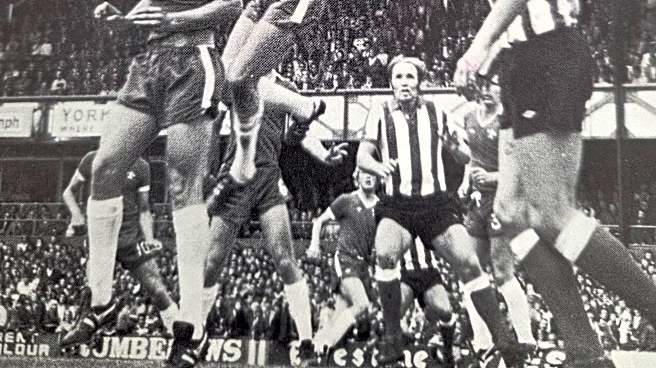
Almost fifty thousand spectators turned up at The Valley for Charlton’s first game of the season against the Bank of England team, with their three debutants. They saw a high-scoring game in which two of the debutants did not have the best of games. Charlton won the game 5-3 and went three goals to one up. Daniel was given a pretty harsh write-up in two of the national sports pages, which referred to him not being sure what position he was playing and being caught upfield and out of position for at least three of the goals.
Goalkeeper Cowan was blamed for the two second-half goals that Charlton scored after Trevor Ford had scored a brace to bring Sunderland level. So, a difficult start to Daniel’s Sunderland career.
He did recover and became a firm favourite with the Roker fans, as a skilful, ball-playing defender with an instinct for attacking. He played 153 games, scoring seven goals between August 1953 and October 1957.
After a short stint at Cardiff, he went back home to play for Swansea in March 1958, where his career had started as a fifteen-year-old. He then took up the offer of player-manager at Hereford, stepping down as manager in 1963 but continuing to play until 1967, when he retired to work in sales and then as a sub-postmaster until 1989.
He passed away aged 69 on 6 November 1997 in Clevedon, North Somerset, where he had lived for some years, remembered as a skilful and elegant member of the Bank of England team and a real character in the changing room, who lived life to the full.
Division One
Date: 19.08.1953
Venue: The Valley
Attendance: 49,762
Charlton Athletic 5 – 3 Sunderland
Goal scorers: Firmani 3min; T Wright 15min; Leary 20min; Firmani 32min; Ford 47min; Ford (pen) 51min; Lock (pen) 67min; Hammond 83min.
Charlton: Bartram; Hewie; Lock; Fenton; Chamberlain; Hammond; Hurst; O’Linn; Leary; Firmani; Kiernan.
Sunderland: Cowan; Stelling; Hedley; Aitken; Daniel; A Wright; T Wright; Kirtley; Ford; Shackleton; Elliott.