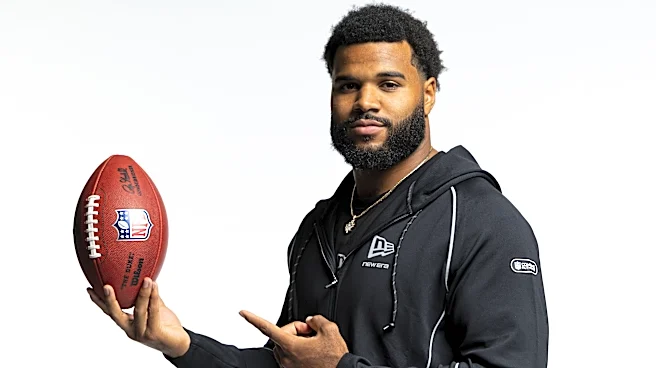



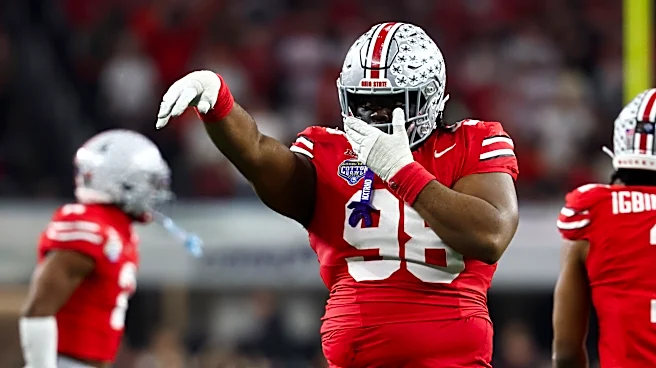

Akheem Mesidor just celebrated his 25th birthday, and as such he poses a quandary for NFL teams trying to decide whether or not to invest a premium pick in selecting him. To be clear, concerns over his age are not about whether or not he will be an impact player into a second contract–even though that is the frequent “straw man” argument erected to defend why his age is not a cause for concern. Instead, the concern comes because there is a notable history of older players struggling in the NFL on their
first contract.
The argument prior to the dawn of NIL has been that each time a player returns to college without coming out is a year that he did not seem to stand out enough to get a favorable draft position. So, imagine a player who is draft-eligible at 21 being advised he will be a late pick or UDFA. He might return for another year and try to develop skills and increase his chances; but after a year he is again advised that he has a low ranking. And so on. Odds are, when he is finally forced to come out due to eligibility limitations, he is likely still not competitive with the players who flash right away. By contrast, a player who stands out early might enter the draft as soon as he is eligible, to begin making money as soon as possible–and before an injury steals his chance to earn that money at all. With respect to this argument, NIL is likely changing the equation.
However, there’s another argument, and it is that a player who relies on increased physical development to perform well in college will lose that advantage in the NFL, where almost everyone is a fully mature adult. A quick look at all players drafted from 2011-2020 tends to support this line of thinking. Here are these 2500 players sorted by round based on games played during their first five years in the league.

While that is not a “smoking gun”, it does suggest that even right away, older players do not make the field as often as younger players. Here is the same information based on starts instead of games played.

This is still suggestive, of course, but still not remotely conclusive. It does indicate that the older players taken in Round 3 and Round 4, especially, might be reaches. Perhaps this is where some GMs take chances on prospects who show some promise.
Importantly, this data suggests that there might not be that big of a gulf between players taken in the first and second rounds depending on their age. Of course, it could also just show that teams feel compelled to play their early picks regardless of performance.
Only one Edge defender over the edge of 23 taken in the decade studied was a first-round pick, but we still have access to one more line of analysis. While even post-COVID the number of Edges over 23 who have been drafted in the first round is negligible, it is unlikely that age only matters at 25. If the effect is real, then older players entering the league should perform worse than younger players entering the league. That is indeed what we find when looking at all Edge defenders taken in the first three rounds.

Players who are older when they enter the NFL perform worse than players who are younger when they enter the NFL. One reasonable counterargument, though, is that the better players entered the league sooner (as mentioned at the top of the article). To compare apples to apples, here are only the players taken in the main part of Round 1 (i.e. outside of the top third where “blue chip” players go but still taken with premium picks and five years of contract control). These are players with high grades, as close as we can get to Mesidor’s peers.

As their draft age increased, the production in defensive stops by first round selections outside of the Top 11 decreased. Is it by a lot? That depends on how big of a difference is seen in an additional ten sacks (and ten tackles for a loss) over the course of a five-year contract. Now, these are not the only ways to measure a player’s impact, and there is variation within these groups. However, within these easily-tracked markers, there is a clear trend even among players with high grades.
To further illustrate the point, here are the general trends for players drafted in the “main” range of the first round (i.e. after Pick 11) and those drafted in the 3rd and 4th round.

Unsurprisingly, the first-round players have a clear and distinct advantage across the board. Now, here are players selected in the same range but with only the first-round players over the age of 22 included and only the Rd3/Rd4 players under the age of 22 included.

With the exception of defended passes, the advantage has swung to the players taken more than a full round later, solely when sorted by age. Even if there are factors in an individual player’s favor, a player entering the league older than most of his peers does seem to serve as at least a cautionary sign that there might be reasons to worry about his likely performance. As elite players stay longer in the college ranks, it will become increasingly important that teams can sort out which traits are likely to allow them to success in the league and which are likely going to falter.
None of this is to say that teams should not draft Akheem Mesidor. None of this provides irrefutable evidence that a player over the age of 23 is never worth a first-round pick. There is room for nuance, and Mesidor might very well become an elite player despite his age and injury history. However, there are reasonable concerns over his likely performance over the length of his first contract, and those concerns are grounded in actual historical precedent, not the imagination.
Author’s Note: In addition to continuing to write for Windy City Gridiron, I am also placing draft research at my new site, The Draft Codex. It’s a work in progress, so please be patient with any issues!