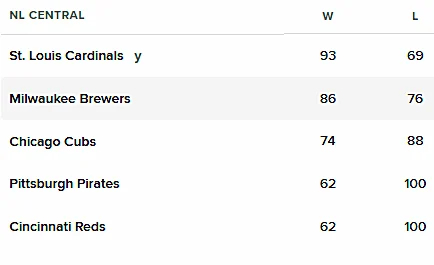

A fun and thought-provoking conversation between Derrick Goold the Post-Dispatch and our own VEB writers here sparked an idea for an article, one that seems well timed for a post-Thanksgiving, pre-lockout respite. In that podcast, a discussion broke out centered around the question of when can Cardinal fans begin to measure the team on number of wins (and losses) again. Goold pointed out the fascinating dichotomy that the Cardinals were, by wins and losses, actually a worse team in 2026 (77 wins)
than they were in 2025 (78 wins), yet fans seem to generally think it was a better season. What?!?! Those were the words that came out. The face perhaps read slightly differently, as in “What the [heck]?!?!” Derrick’s own summary (from X-Twitter) read thusly:
This was a good discussion about how every fan can, maybe even should, measure the #stlcards by wins period — and how when the team isn’t doing that it creates a disconnect.
Some of you may recall an article I wrote entitled “Cardinals have an attendance problem”. The closing line of that article resonated with a fair number of readers (also fans). The whole article struck a chord as the readership has outrun that of any other article I’ve written by like 10,000 viewers. The closing line?
It makes one wonder how much of the “connection” the team has with its fanbase has been disrupted. And how they get that back. Or IF get they get that back.
I’ve had in the back of my mind to come back to this topic. The podcast provided the impetus. Do those two ideas tie together? The idea of a team not measuring itself on Wins-Losses and the idea of a team has had its rather unique fan relationship disrupted?
It got me to thinking about how I (perhaps “we”) measure the Cardinals, and the product they put on the field. Is it really about wins? Or World Championships? Or playoff appearances?
To dig a little deeper: Why am I a fan? Why do I spend money? Why do I follow the team? How do I measure them? Am I different or is my experience typical of a larger fan cohort? Some thoughts fell out, as follows:
First off, I’m a fan of the game of baseball. I watch baseball at all levels and spend time helping young children learn to play. I drag my wife, kids and grandkids to games all along the west coast, including right here at home where the SF Giants High-A team plays and the Savanah Banana’s make an odd appearance. Aside from the hoot provided by little kids running the wrong way on the bases, my first two impressions of a team or even just a game are 1) was the atmosphere relaxed and comfortable? And 2), was the game well played? Nothing will ruin an outing faster than drunken Bubba screaming profanities at the umpire from section 321 or otherwise making everyone around him uncomfortable, while the ushers make themselves scarce. Or that over-bearing parent who screams at little Caden for missing a ground ball (the first of his life!). Talk about a wet blanket.
Likewise, a big-league game that is poorly executed is something that turns me off, led by pitchers who can’t throw strikes. I like good (great) pitching. I also like offense, but I can’t stand interminable at-bats of pick-and-nibble by the man on the mound. Game in, game out, these features will influence my long-term perspective on the team more than a win or a loss.
My favorite time of the season is Spring Training. It isn’t the best baseball sometimes, as the latter part of games devolve into AA scrimmages, but the atmosphere is undefeated. Warm (gratefully, after a long winter) and relaxed. Even the John Deere Lawn Mower Guy is akin to a requiem for winters’ harsh grip. Wandering around timelessly to watch bonus baseball on the back fields doesn’t hurt, either. The ubiquitous sounds of ball to leather or ball to bat touches the soul. If one wanted to measure my fandom, I spend more money going to Spring Training baseball than I do any other baseball event. Clearly, then, I must not measure the Cardinals by wins and losses, because I don’t even pay attention to W-L in spring and could care less about the Grapefruit League Championship.
However, I follow the Cardinals, not just any baseball team. Why? Let’s be real. Brand loyalty is a thing, an innate thing that affects me, too. I started out, long ago as a Cardinal fan because I got free tickets as a kid from the P-D/Cardinals Straight A tickets program. I couldn’t tell you who won or lost those games, but I can remember watching a young Gary Carter hit one of his first career HR off an aging Bob Gibson. So maybe I’ve never measured in W-L. Not then, not now.
There are three main parts to brand loyalty (the hook, delighting the customer, and retention). Baseball, like any product, has to delight a customer in some way and be priced in a way that they perceive as a good value. If not, they won’t come back and buy again.
Brand loyalty brings customers back. Baseball has an interesting loyalty generation scheme. Something has to hook us, just like another other product, but after it does, we can follow and consume that product for virtually nothing (even though we still spend). Very clever! I can follow the Cardinal’s radio broadcasts ~180 times a year for the mere pittance of $5/month MLB AtBat/Gameday Audio subscription. Something on the order of 30 CENTS per game. Now there is stretching your entertainment dollar! With AirBuds and my own John Deere Lawn Mower, I can do chores and consume the game all at once. And I can read VEB for free! And later, when I get a little extra time in life and money in my pocket, I drag Mrs. ORSTLCardsfan and grandkids to various venues and buy tickets (and food).
Once hooked, the team has to provide the return customer an experience that doesn’t fail in the atmosphere and quality expectations all too often (everyone has a bad day now and again, especially if Bubba is in the house) and must occasionally exceed those expectations, sometimes wildly, repeating the delight we originally experienced eons ago.
As for delight, I can remember the euphoria at the end Game 7 of the 1982 World Series more than I can remember the game itself. Delighting your customers is never a bad thing, if you want to build brand loyalty. 12 World Championships means they’ve thrilled us to the max more than once, which is even better. Playing in a World Series is no bad consolation. I’ve watched 1968, 1982, 1985, 1987, 2004, 2006, 2011 and 2013. Long time spans, but memories of unbridled joy span years, if not decades (just ask a Cubs fan). Much in the same way the smells of Grandma’s kitchen linger in our mind a generation later.
In between those highlight moments, I’ve wondered if the greatness I experience game-in, game-out that brings me back is really the broadcasters I listened to, first on my transistor radio and now on my iPhone (which bears an eerie resemblance). Haray Caray->Jack Buck->Mike Shannon->John Rooney is an endless line of easy listening and consummate storytelling that has made me wonder if the stars the Cardinals really rely on are in the booth. When I read all the moaning and complaining about broadcasters on the VEB boards, I become convinced. While the best announcer can’t make a bad team good, the Cubs were rarely while Haray Carey was, and they have a loyal fan base. That brand loyalty certainly wasn’t built on Championships, or even a positive W-L record.
Once brand loyalty is established, a company has to keep it. It seems to me that the string of World Series appearances (or otherwise successful seasons), the daily radio broadcasts, the price point for being a fan and the overall atmosphere of the game has more to do with my loyalty than the number of W-L in a given season. Obviously, the wins and losses has to be good in order to make the World Series, but it doesn’t have to be good every year or every home stand. But does loyalty have an expiration date?
Do wins and losses even play a part in my fandom, or brand loyalty? I suppose. Where I feel it is when I look at the game I’m going to – the teams, the pitching matchup, etc. and I find myself expecting the team to win. Looking forward to an event is better than dreading it. Even when they don’t actually win, it is nicer to expect them to and be surprised when they don’t. Moreso than expecting them to be bad and being surprised when they aren’t. I mean, it never hurts for a business to pleasantly surprise, but not a great strategy to under-perform consistently and then surprise when they actually do well. The Cardinals, unfortunately, now tread in these waters.
Probably the last element touches back on the atmosphere of the game and how it hooks us. Baseball is a family event for many, one that spans (and binds) generations. My dad saw Red Schoendienst as one of the best second basemen in the NL. I knew him as a kindly old man on a golf cart in spring. I saw Willie McGee and Ozzie Smith in their (phenomenal) athletic prime. My grandson sees Willie and Ozzie as greybeards in spring but admired the hip-hop that is Tai Peete. I, perhaps more than he, recognize the lineage and linkage that binds.
As to how the atmosphere that permeates baseball and captures us fans and builds brand loyalty like no other … I can call my grandson in Denver and ask him if he wants to go to a baseball game and the answer will be YES with a huge smile. Good food (for those who consider ballpark dogs and cotton candy good, which kids often do). He doesn’t care (or know) that the Rockies lost 100 games. He is thrilled to go. Turns out, delighting a customer’s grandchild is a good strategy, too.
This summer, he played on his first team and I brought to him one of my old leather, weather worn infielder gloves to replace the cheap, plastic glove mom and dad got him (they don’t understand ball). I think he sleeps with that glove. He has a connection to baseball, but not yet a brand loyalty to the Cardinals. That may come with time, or it may not. I deeply suspect that if the Rockies become good and make the playoffs and I take him to a game, he would be delighted and they will win his heart. And it won’t really matter a wit if they win, or lose.