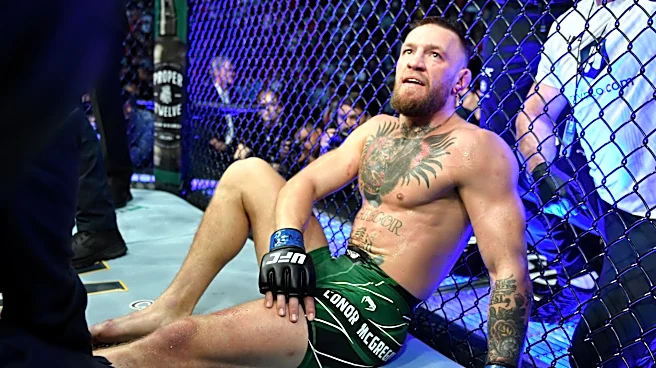










Conor McGregor and the UFC are not happy with any insinuations that “Notorious” did anything wrong during his five-year absence from the UFC.
Last week, the New York Times reported that in 2021, McGregor used “powerful, banned drugs” to aid in his recovery, following his gruesome leg break injury suffered at UFC 264. The report claimed that McGregor sought an exemption from USADA, then partnered with the UFC as its anti-doping organization, for special banned drugs, but was denied, despite support
from his surgeon, Dr. Neal ElAttrache.
Ultimately, McGregor removed himself from the USADA testing pool so he could “focus fully on his recovery,” later re-entering when he was preparing to fight Michael Chandler at UFC 303. And while McGregor still did not address the veracity of the report, he did allow that he was shocked about the entire situation.
“Shocking! Shocking! A man’s private medical, from the most devastating injury that you’ll see in combat sports. The whole thing is strange to me,” McGregor told Yahoo Sports. “You have an injury like that, you’re not going to walk again! The objective should be to get that athlete, that fighter, who has given his life, his limb, his livelihood for the entertainment of the people and for the profit of the company, it should be, ‘Get this man back on his feet.’ And that was not the case.
“Not with the UFC, but with the former body that was there prior. And I find that strange, and I find that wrong. All I cared about was, I’m airlifted out of this f*cking arena, with my leg hanging off, how am I going to walk again? A bar, do this, do that, do it. That’s it. And that was that. So the fact that five years after the fact, I find it strange, to be honest. And I feel the game should change to accommodate a situation like that.
“If a doctor is prescribing certain medications and certain things to come back, otherwise you’re not going to walk again? There’s a chance, there’s like a 20 percent chance that that leg doesn’t join together again. It’s called a non-union, where the bone doesn’t join. You’re left on a wobble forever. That’s what’s at stake here! F*ck this fighting game, are you crazy?! I have children to raise and play with. So, I was a bit shocked that that was the case.”
McGregor went on to say that he doesn’t even know what drugs he took during his recovery, and reiterated that he’s been in the testing pool for months and has never failed.
“But, whatever. I took myself out of the pool, listened to my doctors, didn’t ask questions,” McGregor said. “I don’t even know. If you’re going to ask what was I on, I don’t even know. I don’t want to know. All I want to know is, what’s going to get me back to my f*cking feet to be able to play with my children in a normal capacity again? And that was it.
“Then we get to our stage, then you go through the re-entering of the pool, and then you go through that whole f*cking crack again. There you go. I’m well through it. How many f*cking times have I been tested this year? 15 or something. About 15 times. This year!”
McGregor is not the only one to take umbrage with the New York Times report. Shortly before McGregor’s interview, the UFC released its own statement on the matter, attacking any insinuation that what took place was out of bounds or that McGregor was the inciting incident for the UFC’s break from USADA.
In 2021, Conor McGregor sustained a potentially career-ending injury and sought medical guidance from leading orthopedic surgeon Dr. Neal ElAttrache, who advised the appropriate recovery and rehabilitation protocol. As a result, McGregor did not compete for five years and maintained proper communication with our team throughout, remaining in full compliance with the rules of our comprehensive drug program.
McGregor has been tested 19 times over the past two years, including 12 times in 2026, making him the most tested athlete during this time.
Any suggestion that UFC’s decision to end its partnership with USADA was related to Conor McGregor is categorically false. Internal communications and documentation clearly show that discussions regarding a transition away from USADA began months before any conversations involving McGregor.
This narrative is a continued attempt by USADA leadership to misrepresent the facts surrounding UFC’s unilateral decision to terminate our agreement with them and instead choose to partner with a far more competent, organized, and sophisticated testing group comprised of Drug Free Sport, Combat Sports Anti-Doping, and SMRTL laboratories.
The health and safety of our athletes remain our highest priority. We fully support Conor McGregor and look forward to his return to the Octagon this summer.
While McGregor has never failed a drug test in the UFC, he did receive an 18-month suspension for violating the company’s anti-doping policy in October, for repeated failure to complete whereabouts checks for the drug-testing program. The suspension was retroactive to September of 2024, and ended in March.
McGregor is set to rematch Max Holloway in the main event of UFC 329 on July 11 at T-Mobile Arena in Las Vegas.