

In the summer of 2021, the United States Supreme Court issued a unanimous 9-0 ruling in NCAA v. Alston that shook the foundation of college athletics. Justice Neil Gorsuch’s majority opinion didn’t open with a modern quarterback or a viral social media star. It opened with a Yale tackle from 1904. His name was James Hogan, and more than a century before the term “NIL” entered the college football lexicon, he was already living it — in spectacular fashion.
From Irish Steerage to the Ivy League
James Joseph Hogan was born in County Tipperary,
Ireland, in 1878, in a townland still living under the long shadow of the Great Famine. He arrived in America as a two-year-old, the son of immigrants bound for the brass and woolen mills of Torrington, Connecticut. His childhood was defined by work, not privilege. He pieced together an education bit by bit, saving enough money to eventually enroll at Phillips Exeter Academy in New Hampshire — a school built for the sons of New England’s professional class.
He walked in anyway. Older than nearly every student around him, with an Irish accent and a grown man’s frame, Hogan captained the Exeter football team in 1899 and 1900 and dominated the field. When he arrived at Yale in 1901, he entered a football program unlike anything else in America.
Walter Camp’s Factory of Prestige
Between 1872 and 1909, Yale won 26 national championships and compiled a record of 324 wins against just 17 losses. The program was less a team than an industry, and the man running it was Walter Camp — halfback turned football architect, the same man who invented the line of scrimmage, the snap from center, the system of downs, and the 11-man team. John Heisman once said that what Washington was to his country, Camp was to American football.
Camp held no formal coaching title and drew no salary, but he controlled everything — recruitment, strategy, and an alumni-funded financial reserve of $100,000 used to ensure the right players arrived in New Haven and stayed there. James Hogan was exactly the kind of player Camp wanted: physically dominant, socially connected, and eventually a member of Skull and Bones, the most exclusive secret society in America.
Buck Duke and the Birth of the Sponsorship Deal
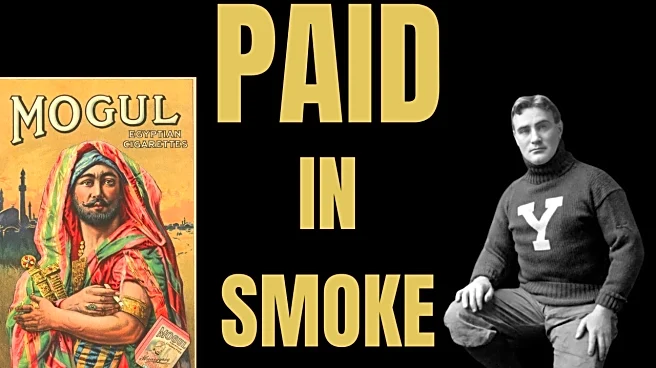
While Camp was building his football empire, James Buchanan “Buck” Duke was building a commercial one. Duke had merged his four largest tobacco competitors in 1890 to create the American Tobacco Company, which controlled 90% of American cigarette production. By 1900, it had absorbed more than 250 companies. Duke wanted market penetration into the Ivy League, and he found his vehicle in Yale’s most celebrated athlete.
The arrangement was direct and entirely public. Hogan held the exclusive cigarette franchise for the American Tobacco Company at Yale — a commission structure that paid him a cut of every box sold in New Haven. Students didn’t ask for a brand. They asked for “Hogan cigarettes.” He also held the scorecard concession at Yale baseball games, paid no tuition, lived in one of the finest suites on campus, and traveled to Havana, Cuba each spring on an all-expenses-paid trip that Walter Camp quietly logged in the athletic department’s financial records as “miscellaneous expenses.”
Camp, who had written publicly that “a gentleman never competes for money directly or indirectly,” was simultaneously managing the $100,000 slush fund that made Hogan’s lifestyle possible. The language of amateurism was always running alongside the machinery of commerce.
The mythology and the money coexisted from the very beginning.
A Legal Resurrection
Hogan left Yale in 1905, coached at Phillips Exeter, enrolled at Columbia Law School, wrote for the Columbia Law Review, and passed the bar. He was appointed Deputy Street Cleaning Commissioner for New York City in 1909. In March 1910, he died of Bright’s disease at just 33 years old.
He was buried in Torrington — back where it all began.
When the College Football Hall of Fame inducted him in 1954, the cigarettes had been scrubbed from the record. By then, the NCAA had fully committed to the amateur ideal, and Hogan was presented as a paragon of a cleaner era. He stayed in that sanitized footnote for 67 more years.
Then, in 2021, Justice Neil Gorsuch pulled him back into the light. In the opening argument of a unanimous Supreme Court opinion, the Yale tackle who sold cigarettes at Morey’s and vacationed in Havana became the historical proof that the NCAA’s amateurism model had never been what the institution claimed it was.
What Hogan’s Story Tells Us About Today
The transfer portal, the massive NIL contracts, the chaos of conference realignment — we are often told that modern college football has lost something sacred. But James Hogan’s story suggests that the sacred era was always a constructed narrative. The money was present from the very first decade of organized college football. The difference is that today, at least some of it flows to the players themselves.
Was the game ever truly amateur? Or was amateurism just a story powerful men told to protect a very profitable business? Hogan’s life — immigrant, mill worker’s son, All-American, tobacco franchise holder, Supreme Court citation — might be the most honest answer we have.
Hardcore College Football History tells the stories that shaped the sport you love. Subscribe on YouTube and explore our full documentary archive at our website, where you can trace the complete history of early American football and the evolution of the game’s greatest offenses.