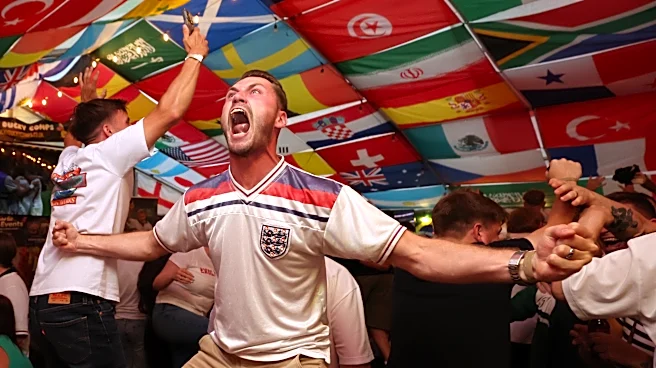


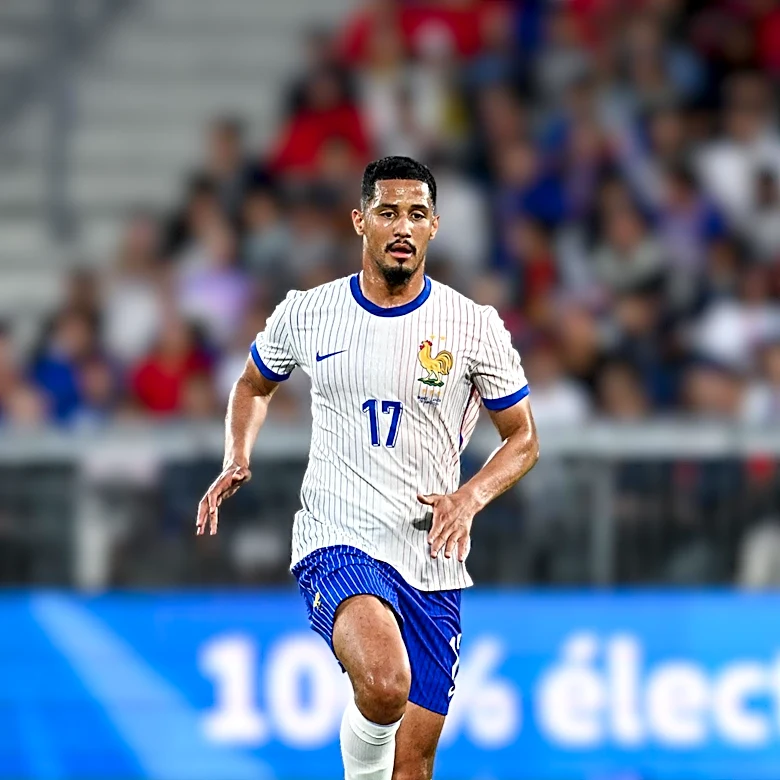
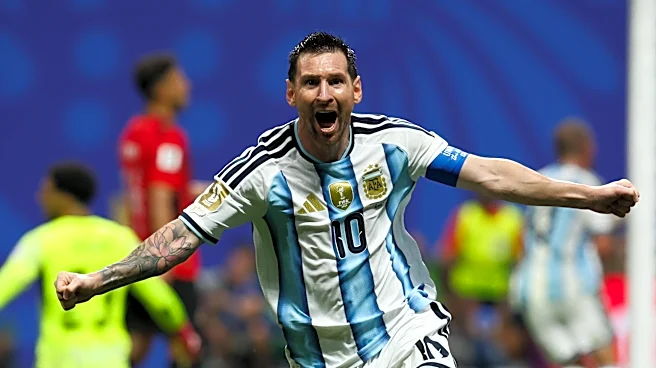
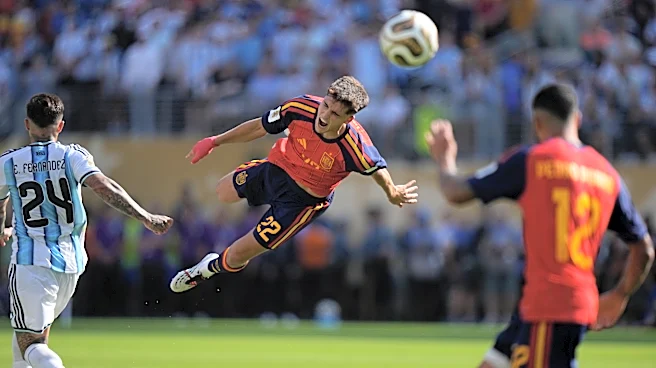
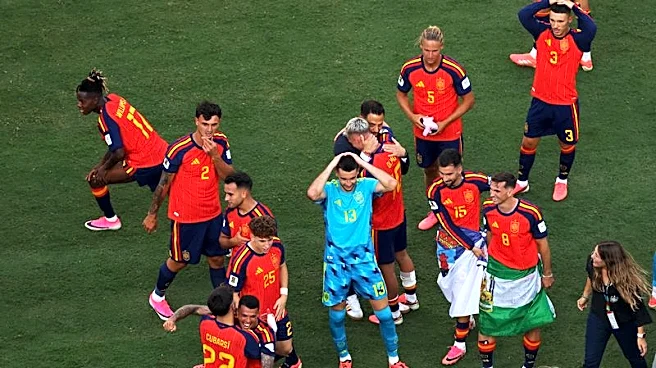
I’ve spent the past few days thinking about what we learned from the World Cup that’s applicable on a club level: tactical stuff, coaching ideas, all that. Some of the secrets to success—have a midfield that can grind opponents into dust a la Spain, have 6 world-class forwards a la France, have the best player in history a la Argentina—aren’t really options for Fiorentina. The Viola brain trust will instead have to look for somewhat more widely-applicable conclusions. Here are four that jumped out at me.
1. Know thyself
All four semifinalists were among the pre-tournament favorites but what stood out to me about them is how each had a defining characteristic: Spain’s masterful possession rendered it untouchable; Argentina had Messi and the power of friendship/bullying; France’s tornado of daggers in the front four was unstoppable’ and England combined effort and control. Going back, what almost all the other teams in the knockout stages was a clear identity. The teams that underwhelmed (Germany and Brazil in particular), on the other hand, never seemed certain what their own strengths were.
That’s an obvious conclusion to draw but one Fiorentina could learn from. Last year’s team under Pioli had no idea how it wanted to play (other than very badly). Paolo Vanoli’s accomplishment was instilling the outline of an identity in the group. Fabio Grosso’s job is to figure out what approach best suits his players and implement it. Looking at the roster right now, I think this team is built to play a stubborn mid-block that prevents opponents from playing through the middle and breaks very quickly the other way, eschewing possession in favor of verticality. Fabio Paratici’s next few moves in the transfer market could change that, of course, but Grosso needs to know how he wants this squad to play and he needs to have explained it enough detail that everyone understands.
Beyond the obvious tactical identity, though, there’s also the need for an emotional identity. Under Pioli, it was sullen frustration. Under Vanoli, it was slacker-doing-the-bare-minimum-to-pass-chemistry-with-a-C-minus. That attitude has ranged from a snarling, swaggering aggression (Vincenzo Italiano) to 80% stolidity-20% arrogance (Raffaele Palladino). I don’t know any of these individual players well enough to know how they’ll react to anything, much less what happens when they’re all together. But if Grosso can establish an esprit de corps based around some sort collective identity, he’ll be more than halfway there.
2. The system is king
I’ve seen a lot of people talking about how Spain beat France (the best collection of attackers in the world) and then Argentina (the best single player in history), proving the supremacy of the system over the individual. I think that’s an absolutely insane take. Spain’s roster is chock full of world-class players; this isn’t the Little Engine that Could so much as a roster that had no weaknesses from top to bottom.
Similarly, France and Argentina and every other team played a system and pretending otherwise is willful ignorance at best. The Spanish model was predicated on everyone being passing and moving until a gap opened up that any of the outfield players could exploit. Its French and Argentinian counterparts were designed to put specific players in advantageous positions, usually isolated against a single defender in space. Those both require all eleven players doing their jobs conscientiously. That principle applies to every team at the World Cup. Also to every team ever, I suppose, but bear with me.
What jumped out to me was how few teams had a Plan B. Some of this is the lack of practice time inherent to the international game but I was astonished at how few tactical adjustments I saw most of the managers make. Spain, in fact, had the most obvious fallback in Mikel Merino, who created a completely different threat as a substitute that opponents had trouble adjusting to. For the most part, though, every team’s Plan B was essentially Plan A but better and maybe with a couple different players.
I thought this was most obvious in France’s case. Despite having the colossal Jean-Philippe Mateta on the bench, Didier Deschamps didn’t turn to the target man when chasing the game against Spain. He ordered his back six to push the ball forward even more quickly, leading to more errors which Spain could exploit. Given how well the Spanish defense shackled Mbappé and company, I didn’t understand why Deschamps didn’t toss on Mateta, which would’ve offered Cubarsí and Laporte an entirely different challenge and possibly given France a path back into the game.
That’s just one example. It felt to me like most of the subs in this tournament were like-for-like. Some of the players did slightly different things but not in ways that changed how the team played; Norway’s approach didn’t change even after Erling Haaland subbed off. I think that’s an echo of the rise of the system manager at club level. Players are used to that approach. The mister has to stick by his principles or lose credibility as a tactician. The real trick is convincing the squad to follow along even if the results aren’t there. Again, I’m not sure what system Grosso’s going to install. But my guess is that it will be THE system and the only deviations will be weird one-offs.
3. The fullbacks are crucial
To paraphrase media tactics godfather Michael Cox, “The team with the best fullback pairing is usually the one that wins the World Cup.” I think that’s slightly less true from 2010 to 2022 but the importance of fullbacks in tournament play can’t be overstated over the past 3 decades. In fact, FIFA has picked at least one fullback from the winner in every Team of the Tournament since 1992. This time around, both Pedro Porro and Marc Cucurella made the XI.
Fullbacks are foundational because their impact is felt in every third of the pitch. At least one of the pair has to be elite going forward, as opponents will either leave the winger high on that side and deal with the danger in other ways that deform the shape even more or have the winger track that fullback, removing an attacking threat. Defensively, having a fullback who can hold up in the sort of 1-v-1 situations that usually decide knockout games is obviously critical. As Spain demonstrated, top fullbacks are more important than top wingers.
The position isn’t quite as important at the domestic level. The length of the season means teams have more training time and thus more tactical flexibility to sort out wrinkles; think of how Palladino mitigated the defensive weaknesses of Robin Gosens and Dodô while emphasizing their attacking strengths. Even in Serie A, though, good fullback play matters. Against a deep block, your fullbacks provide extra attacking impetus. Against a team that presses high, they’re often the simplest out ball.
I don’t think the World Cup has influenced Paratici’s transfer strategy but it’s hard not to see connections. Despite lacking a single senior winger besides Albert Guðmundsson, the DS has focused on rebuilding the defense. Alex Jimenez is in the team, João Mário might join him, and Victor Valdepeñas is one of a number of leftbacks linked to the Viola as well. With Gosens already out the door and Dodô following shortly, the revolution at fullback is well underway.
Paratici’s targeted a specific profile at rightback: rapid, technical, better going forward than defending, and primarily an overlapper rather than an inverter. Valdepeñas, nominally a centerback, is an entirely different profile; while quite athletic and happy to carry the ball forward, he’d probably be far more reserved in his positioning. Those differences could foreshadow what types of wingers Paratici wants. For now, though, it’s obvious that his primary criterion at fullback is athleticism.
4. Fast, fast, fast is back
It’s not just at fullback that Paratici’s looking for athleticism. Viery, Radu Drǎgușin, Arthur Atta, Jimenez, and Christ Inao Oulaï are all specimens, albeit in different ways. That matches what we’ve seen at the World Cup: no matter how you play, the most important thing these days is having athletes who can win their individual battles in both attack and defense. The most perfect tactical plan falls apart if the players lack the physical capacity to execute it.
This shift has been ongoing for the past decade or so as teams reacted against Pep Guardiola’s Barcelona by increasing their out-of-possession ability. That’s most visible in England, where size and speed are now the most valuable commodities, and due to the Premier League’s stature, everyone else is following suit in hopes of reaping the comically inflated transfer fees those clubs are willing to pay. It’s resulted in an arms race to find increasingly rapid refrigerators wearing boots and that approach has spilled into the international game as well.
What I find interesting is that it doesn’t matter what style a team plays; big lads who can run are in demand regardless. Teams that sit deep, pack the box, and try to break need the pace in forward positions to get in behind but also need midfielders quick enough to support those counters and defenders who aren’t so slow-footed that they’ll give up space on the edge of the box. Teams that prioritize possession also need that pace, because keeping the ball doesn’t mean anything without the ability to burst into the tiny spaces that clever passing creates; having rapid defenders who can recover when opponents go long is also critical.
Gone are the days of louche playmakers and maverick geniuses, replaced by hard-charging tanks, the type that Carlos Bilardo deemed “useful idiots.” This isn’t the permanent state of affairs, of course. It’s a pendulum that’s currently swung about as far to one side as it can get. Chasing trends isn’t always profitable, particularly for smaller teams with ambition. Bigger clubs swoop in and take the most desirable players, leaving the have-nots with a squad of misfit toys that can’t execute whatever tactical ideal currently holds sway. However, Paratici’s clearly understands what profiles are hot right now and is acting accordingly.