

WASHINGTON, D.C. — A year and a half on from Hurricane Helene, I-40 in some areas between North Carolina and Tennessee is still down to just one lane in each direction. The hurricane changed the communities and families in those Appalachian regions of the states, but passing through that section in either direction will take you back to the big cities. Whether east to the Research Triangle, or west to Nashville, you’ll find two families that won’t be split up. These families have only needed one lane,
one track to accomplish their one mission for the last 40-plus years.
And now, they’re intertwined.
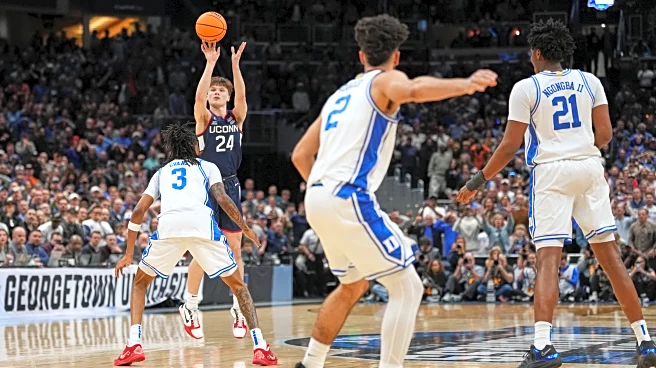
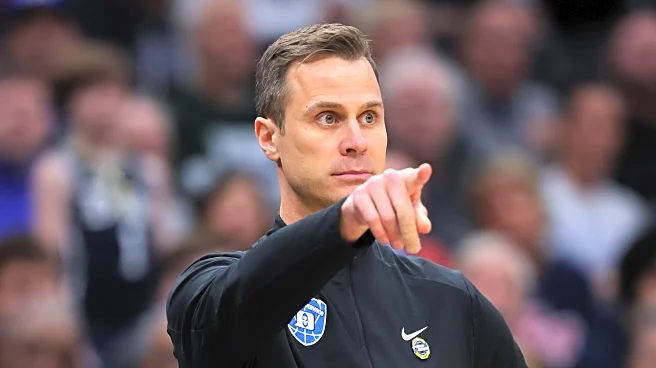
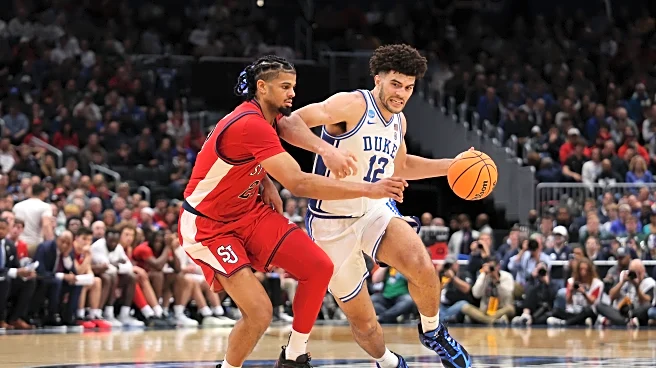
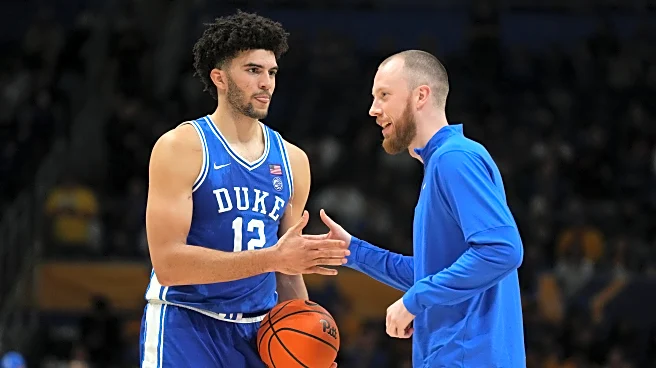
As the Duke Blue Devils, coached by former national champion point guard Jon Scheyer, who took over for Mike Krzyzewski in 2022 and has since won more games through a coach’s first four seasons than any other in history, prepare for their third straight regional final, assistant coach Evan Bradds is nearing the end of his Duke chapter. Once Duke’s season ends, Bradds will drive his stuff across that road, through the hurricane-ravaged sections, all the way to the Music City, to go back to the place where he made his name. On March 19, he was named the successor to Casey Alexander as head coach at his alma mater, Belmont, continuing the lineage of the legendary Rick Byrd.
Byrd’s 713 wins as the Bruins head coach changed the university, but the process by which he earned those wins created a foundation for even more after he retired in 2019. Bradds wasn’t the only former Bruin who could’ve gotten the job.
“I think it’s natural that Belmont wants to continue with what was built and how it was built,” Byrd told Mid-Major Madness. “The quality of the people that they always want to recruit, that we always want to recruit, some of the things outside of the game of basketball that were important to our program, was important to (former Belmont and new Kansas State head coach) Casey Alexander, and it will be to Evan, and it is to Mick Hedgepeth at UAH, and Steve Drabyn at Bethel (University) in Indiana, and tons of high school coaches as well.”
But Bradds is a little bit of a unicorn among those coaches. Alexander coached at Belmont from the moment that he graduated until he got his first head coaching job. Hedgepeth coached at a few lower-level programs, and so did Drabyn. But Bradds, the two-time Ohio Valley Player of the Year, took a different path to get back to Belmont.
It has been almost nine years since Bradds tore his ACL working out for the Indiana Pacers in the process of ramping up for the NBA Draft. He wanted to continue playing basketball. He wrote that on this very website shortly afterwards, but Brad Stevens had a different plan in place, wanting to get Bradds’ basketball mind in the Celtics organization. Stevens hired him as an assistant coach for the G League Maine Red Claws that year at just 23 years old, and his playing career ended there.
He was called up to the big leagues a year later and spent four seasons on the Boston bench before joining fellow Celtics’ assistant Will Hardy as one of his assistant coaches for the Utah Jazz.
Three years later, he went back to the college ranks, joining Scheyer, a close friend of both Hardy and former colleague Joe Mazzulla, as an assistant for Duke. It’s given him exposure to learn about basketball at levels higher than Belmont, for some of the sharpest minds of the generation.
“Does that mean you think somebody outside of me knows more about basketball or anything different?” Byrd joked. “Oh my goodness, it’s fantastic what (Bradds) has been able to do, and the people he has been able to serve under.”
Stevens and Byrd chat consistently, and whenever Byrd would ask about Bradds, he’d use one word.
Stud.
“Brad’s not going to tell me something that isn’t exactly how he feels,” Byrd said. “He’s very high on Evan. I went up and saw the Celtics play earlier this year, and Brad took me in to see the coaching staff before the game, and all they talked about was Evan Bradds, and he’s been gone (four) years. They love him.”
Bradds, who comes from the small town of Jamestown, Ohio, went the big city, flashy lights route in his coaching career, one that allowed him to expand his horizons. It’s not what he expected for himself, or what Byrd expected for him.
When Bradds wrote his first piece for our site in 2017, still recovering from that ACL tear, he wrote that he planned to go to “plenty” of games and cover both the OVC and mid-majors around him locally in Ohio.
He thought that he wanted to cover basketball at some point in his life, but was still focused on playing.
“I’d be interested to know exactly when he thought (coaching) was his path,” Byrd said. “He could’ve been thinking about it before (the Celtics hired him), or it might’ve been that moment. You know, ‘hey, I can stay in the game this way.’”
But it’s not surprising to Byrd that he’s become a great coach.
“He certainly was an intelligent basketball player,” he said. “Crafty as anybody’s ever been. An undersized post player scoring against guys bigger and more athletic than he was. You could see that some of this game is an art, and it’s not just learned or a science, and he’s got that.”
Bradds is still chasing a championship with the Blue Devils. He won’t be introduced until after that season is over, and a Duke official told Mid-Major Madness that he’s not discussing his future at Belmont with the media until then. And he’s not the only one pulling double duty.
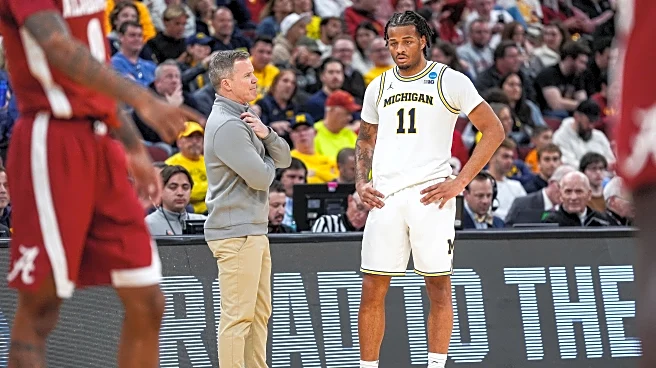
On the other sideline on Sunday, Luke Murray is simultaneously searching for a third national championship and a coaching staff to join him at Boston College. Michigan’s Justin Joyner is off to Oregon State when the Wolverines’ season ends. Last year, Kevin Hovde and John Andrzejek were named head coaches at Columbia and Campbell before helping Florida win the national championship.
He’s been integral in Duke’s success this season.
“Evan has been incredibly helpful for me,” Scheyer said on Thursday. “When we were talking, even before he was hired, I was very transparent with what I was trying to accomplish. So I’ve enjoyed some of the early mornings, late nights just bouncing stuff off of him, talking to the staff, figuring out how we can put our guys in the best position to execute late in games. He’s got a great mind. He’s been around a lot of great players (and coaches). I think that experience has been helpful. He’s creative. We’re able to throw some different stuff at the wall and see what sticks. I think it’s led to great confidence in our guys in understanding what we’re looking for, what adjustments we can make, then trusting and executing that plan.”
The Bruins’ tradition, winning 19 or more games in each of the last 21 seasons, including 10 25-win seasons, is as strong and consistent as any program in America. Perhaps only matched by that of the Blue Devils. And in the NBA, who has been more consistent than the Celtics?
For a coach to combine those trees, it’s hard to imagine Belmont won’t stay consistent and elite in the Missouri Valley.
And that’s before you even get into what Byrd thinks will be his biggest strength.
“He’s just so easy to like and get along with,” Byrd said. “He’ll recruit players well with his personality, and I also think that when (kids) see a guy with NBA and Duke experience, that’s going to resonate. He’ll be a guy that players like to play for.”
Bradds may have been destined to be the head coach at Belmont. But had they decided to hire somebody else, like Hedgepeth, who has been extremely successful at a top Division II program, or even somebody outside the family, Bradds would’ve found a head coaching job, at least according to one of his former bosses.
“When Brad (Stevens) said he was ready (to be a head coach),” Byrd said. “I don’t think there’s anybody in the game that understands coaching better than Brad does. He said ‘You better hire him because somebody else is going to.’”
And Belmont athletic director Scott Corley agreed. And the interstate awaits, on the path to rejoining his Bruin family.