

It’s time y’all got some deep education.
Welcome to the first Tale of the Tape, a new series in which I review one or two routines from each event of LSU’s most recent meet to explain this sport in a more detailed way than usual. After three years of ridiculously long recaps that were late, I figured I should get those out on time and give my thoughts room to breathe. This is a huge experiment, so please let me know if you have any feedback.
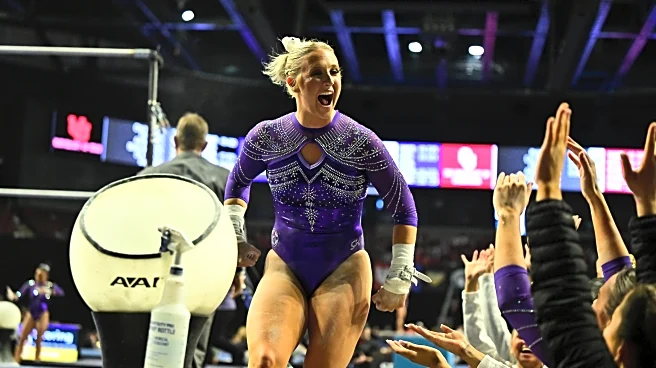
Nina Ballou FX
A lot of people were confused by the 9.825 on this routine.
After all, the leaps looked fine and the landings had no deductions. However, this routine had the same issues that I noted when evaluating the Open Mike Night routine: insufficient amplitude in the tumbling passes.
Let’s start with the double layout. The best double layouts look like they’re rising in the second layout. Kaliya Lincoln’s DLO is a perfect example of one that looks like it’s rising in the second layout. This makes sense from a physics perspective. Get a water bottle and drink enough so it’s still about 75% full. Now try and make it flip in the air twice and land upright two feet away from you. If you can land it, you’ll see the same thing. What you want is a nice parabola, and that’s the arc that Kaliya’s takes. Look at Nina’s landing, though.

See how her chest is facing the ground? That’s an obvious indication that she didn’t do a nice parabola, and if you look back at the arc she takes, that becomes clearer. Her apex comes as the first layout ends and she keeps falling during the second layout. She doesn’t get a landing deduction, but she should’ve been deducted for insufficient amplitude and for a low chest.
Now let’s head over to her front through to Rudi. Here’s the chest position on the Rudi.

Notice how it’s a bit low again? That means she didn’t have a good arc on her Rudi. Compare this landing position to any of Haleigh Bryant’s landings on this pass from her last two seasons and the difference is clear. Haleigh was great about using the front layout and punching harder into her Rudi. That’s a key thing to look for on any combination pass: the second pass needs to be higher than the first. You should have more downward momentum after finishing the first part than when you punched into the first part. Madison Ulrich did a great job of this on her front through to front full.
Victoria Roberts VT vs Madison Ulrich VT
Haleigh’s front pike half was an incomparable standard of excellence in the history of NCAA gymnastics. Her most perfect 10s had the greatest combination of block technique, height, distance, location in the center of the mat and control that anyone’s ever done on that vault and on most vaults ever. I will not be comparing Madison and Victoria’s front pike halves to that Haleigh’s. Instead, I want to go into where they excelled and how they compare to each other.
First, let’s start with the best part of both vaults: their distance from the table. Front pike half vaults are the most common vaults that fall victim to distance deductions. This vault was developed on the old vault table that looked like, and sometimes was, a pommel horse. That meant gymnasts had less distance to travel from the point of impact on the block to their landing, and it’s partially why front handspring entries were more popular 30 years ago than they are in today’s era of Yurchenko entries.
If you watch both of these vaults, you see that they get very good travel in the air. Compare that to Kentucky’s vault lineup at the 2024 SEC Championship, a lineup with at least three front pike half vaults that were each compared to Haleigh’s. Yes, podiums allow for more distance, but I want to refer back to that 2024 Kentucky vault rotation that was also on a podium.
Upon further review, both of these vaults had great height, too. I’ve seen good distance with poor height, but these vaults didn’t have that. Both gymnasts got a phenomenal block off the table and used that to drill their vaults.
Madison’s vault got a higher score, but that was all due to the landing. She only had a slight hop (-.05) on her landing while Vic had a normal hop (-0.1). When you look at the block, though, you’ll see that Vic has slightly better form in her pre-flight (before hitting the table) and block.
Side-by-side, it’s very obvious who has the better technique. Vic’s legs are glued together from the start, but Madi’s are way apart until she brings them together during the first flight. Vic’s legs are slightly bent, but her technique beyond that is fantastic.
Courtney Blackson’s UB
This was absolutely gorgeous. I can’t find what the deduction was for certain, but it definitely didn’t feel like a 10-worthy routine. I think it’s down to her perfecting her movements.
Think about a bars routine as if it’s a roller coaster you wanted to design in Roller Coaster Tycoon. Courtney’s routine is a roller coaster that pulls the cart up to the top of the first hill with a chain and uses momentum to carry it through the rest of the track. If you build a coaster that doesn’t generate enough momentum going into a hill or a loop, you get a broken ride.
Courtney’s ride is smooth. Every handstand is smooth. Every transition is smooth. Every release is smooth. Every catch is perfect because it lets her glide into the next movement. That’s especially true on her Markelov, a skill some still call a Khorkina. When you compare her Markelov to Kailin’s from this same meet, you see that Kailin can’t catch it cleanly and that her messy catch impacts the flow into her final handstand. Courtney has all of her momentum traveling in the correct direction, and that’s why she nails the handstand without needing to give more effort.
Courtney nailed her dismount, and the apex of her curve came as the first layout finished. She stuck her landing because she had a great release off the bar. She’s swinging with confidence, she’s flowing with ease, and she’s nailing her landing. There’s not much more she could do beyond fixing her piking.
Lexi Zeiss BB and how LSU got screwed
LSU would have won this meet if the judges had done their job properly. This is not going to be a commentary on Lexi’s ability as a beam worker, but I’ll address it by saying that she’s very good at what she does and can only get better. Instead, this is an explanation of why Jay Clark was so irate at the end of the meet. The broadcasters did a horrible job of explaining what was happening because they were fixated on Konnor’s routine, but Jay had every reason to be mad at the judges. Also, I can’t find a link to this routine and am having issues doing an upload of it myself.
According to Jay’s Monday press conference, the original score flashed in the arena was a 9.875. Judge 1 went 9.90 and judge 2 went 9.85. Then, the person flashing the score for judge 1 put up a correction. Judge 1 gave Lexi a 9.9 start value and a 9.80 score. None of this made its way to the broadcast or to the live scoring system.
A low start value usually happens on a balance break on a skill series like a combination that involves a split leap or an aerial. However, Jay was making an inquiry regarding Lexi’s double wolf turn. College gymnastics defers to the USAG Level 10 Code of Points for the majority of rules regarding deductions, requirements, skill values and anything else that could come up during a meet. However, there are some things that are modified for college, and those modifications are listed in this document. On certain events, skills have modified values for college, and one of those is the double wolf turn on beam.
In the Level 10 code, a double wolf turn on beam is a D skill. D skills earn 0.1 in bonus. However, a double wolf turn is an E skill on beam in college, and that means it’s worth 0.2 in bonus. It’s a simple mistake that can happen, especially in a loud arena that’s apparently pretty hot. When the start value was fixed, though, that judge changed her score to a 9.85 instead of the 9.90 originally flashed. Judges are allowed to change their score during an inquiry, but this shouldn’t have required an inquiry.