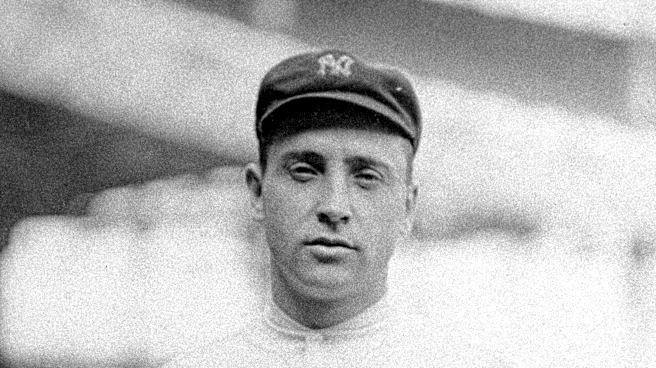







Before he was Birdie, William Cree was a little man with a big right arm and impressive speed. Born about an hour south of Pittsburgh, like many players of his day, the old-timer had a unique path to the majors, including playing under a fake name to preserve his eligibility.
William Franklin “Birdie” Cree
Born: October 23, 1882 (Khedive, PA)
Died: November 7, 1942 (Sunbury, PA)
Yankees Tenure: 1908-15
After finishing school in Pennsylvania, Cree attended Southwestern State Normal School, where he played
football and baseball while earning his teaching credentials. After graduating in 1903, Cree started teaching in the public school system while continuing to play baseball and football. His athletic prowess earned him a scholarship offer from Penn State.
In the fall of 1904, just three days into his Nittany Lion football career, Cree dislocated his collarbone and was out for the season. However, he was healthy and ready for baseball the following spring. After collecting several extra-base hits, the nickname Birdie was born.
Cree actually used a variation of that nickname for his secret identity, presenting himself as Bill Burde, to play amateur baseball for some spending money while still in school. Following the 1907 season, Burde was purchased by Connie Mack and the Philadelphia Athletics.
The team left him with his amateur club for the start of the 1908 season and they moved him to center field. Before the season was over, Detroit acquired Cree the outfielder, not Burde the shortstop, from the Athletics and then promptly traded him to the New York Highlanders.
In September of 1908, Cree made his major league debut. He appeared in 21 games the rest of the way, batting .269 with two triples. The Highlanders finished the year in eighth place with a 51-103-1 record.

At age 26, in 1909, Cree played his first full season of professional baseball. The Highlanders moved him all over the field as he saw time at all three outfield spots, both middle infield positions, and even made one appearance at third base. Cree hit his first home run, which also happened to be the first home run hit out of legendary Shibe Park in Philadelphia by a right-handed batter. The team improved overall but still finished below .500.
The 1910 season was Cree’s breakthrough campaign. The team finished second in the American League with an 88-63-5 record, in part due to Cree’s improvement. His average increased by more than 20 points to .287, while he hit 16 triples and tied for the team lead with four home runs.

For an encore, Cree followed up his breakthrough season with what ended up being his best campaign. In 1911, Cree ranked in the top five in the American League in several categories and had one of the best seasons in club history by a non-superstar player. His batting average was .348, while he slugged .513 on 181 hits. That included 22 triples, 30 doubles, and 48 stolen bases. His production was good for a 5.6 WAR and a 152 OPS+.
The amazing run peaked and he started to come back down to earth in 1912. That season, Cree still slashed a very respectable .332/.409/.453 but was limited to only 50 games after battling a severe cold to start the year and then getting his wrist broken on a hit by pitch at the end of June. Sadly, Cree was never the same after this injury.

With the wrist injury lingering, Cree battled through the 1913 season. His average dropped to .272, but he still managed to hit 32 extra-base hits in 145 games. This year was the first in which the club was officially known as the Yankees, giving Cree the distinction of having played under both names.
Rocky is the only way to describe Cree’s 1914 season. Arriving overweight and out of shape, Cree was released and briefly played for Baltimore in the International League before the Yankees bought him back. Finishing off the year, Cree hit .309 in 77 games with a 2.9 WAR.
Cree couldn’t lose the weight he had added and then suffered another injury during spring training in 1915. In what would be his final professional season, Cree slashed .214/.353/.276 in 74 games, opting for retirement after the season rather than going down a level into the minors. Cree ended his career having played parts of eight different seasons professionally all with New York. His final career slash line was .292/.368/.398 and a 125 OPS+.
In retirement, Cree worked in banking and took up several leisure activities, such as golf and tennis. He even appeared at a few Old-Timers’ Days as well. But in November 1942, Cree succumbed to an illness just a couple weeks after turning 60.
Happy birthday, Birdie!
See more of the “Yankees Birthday of the Day” series here.