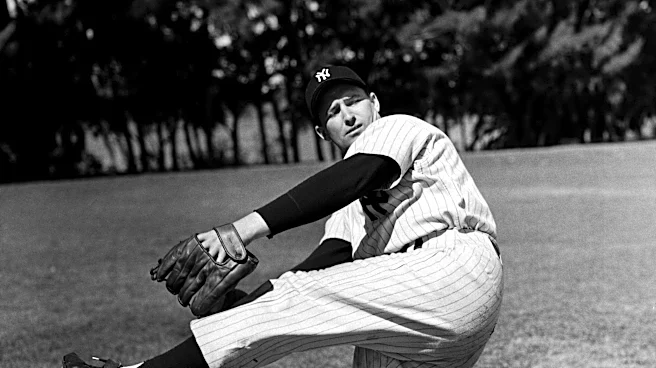

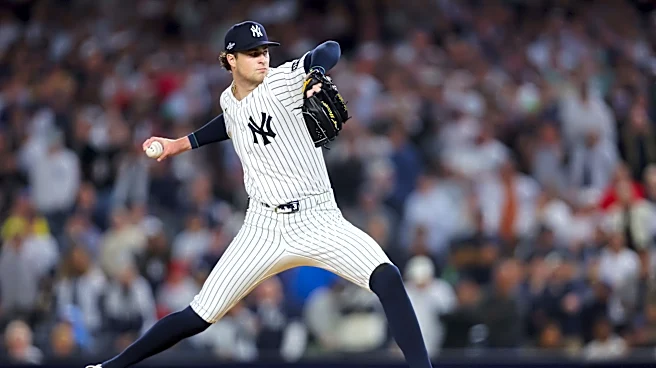
Gifted at birth with a father who was a semiprofessional pitcher, Francis Joseph O’Shea (the O’ was later dropped) spent his childhood hearing about how he would be a pitcher in the major leagues someday. A Yankees fan since childhood, Shea’s father would take his son to games in the Bronx each chance they got, years before Shea would take to the very same field as player.
Francis Joseph “Spce” Shea Born: October 2, 1920 (Naugatuck, CT) Died: July 19, 2002 (New Haven, CT) Yankees Tenure: 1947-1951
While attending Naugatuck High School, the right-hander blossomed into a prodigy, famously propelling the school’s baseball team to victory in Connecticut’s inaugural state championship game in 1938. Known as “Spec” due to his freckles, the beloved hometown hero signed a contract to join the New York Yankees during the winter of 1940.
Shea’s professional journey started with the Amsterdam Rugmakers, where he went 11-4 with a 3.94 ERA. That was good enough to get him promoted a level the following season to the Norfolk Tars. With the Tars in 1941, the 20-year-old went 16-10 with a 3.17 ERA, showing enough progression to get promoted prior to the 1942 season to the Kansas City Blues.
On the fast path to the big leagues, it seemed nothing could or would stop Shea. That was until World War II started. Shea joined the United States Armed Forces in 1943 and served for three years. As a sergeant in the Army Air Corps, he was sent to Europe. He was among the thousands of Allied soldiers who went ashore in Normandy just days after the historic D-Day landings. Friendly fire allegedly caused Shea to get injured with burns while serving.
After getting discharged, Shea ended up back in Connecticut and was playing semiprofessionally for the Waterbury Brasscos. In September 1945, the Brasscos hosted the New York Yankees for an in-season exhibition game. Seizing the moment, Shea pitched seven shutout innings. The performance earned Shea an invite to spring training the following year.
Shea would have another stroke of bad luck that would further delay his dream. While the Yankees were in Panama, he suffered a sudden bout of appendicitis and had to undergo an emergency appendectomy, which sidelined him for a couple of months. Shea spent the rest of the season pitching in Triple-A for the Oakland Oaks. Shea went 15-5 with a 1.56 ERA.

The 1947 season is when the stars finally aligned for Shea as he officially made the New York Yankees’ major league roster. Shea embarked on what could only have been a fun and electric rookie campaign. Shea’s home debut against the Boston Red Sox generated so much excitement that his hometown high school actually shut down for the day so students and staff could travel to Yankee Stadium to cheer him on. Shea finished the regular season with a stellar 14-5 record, a 3.07 ERA, and an American League-best .737 winning percentage. In the middle of that summer, he became the first rookie pitcher ever to earn a win in the All-Star Game. Shea finished third in Rookie of the Year voting, losing out to Jackie Robinson. Then he capped off his dream season by pitching against the Brooklyn Dodgers in the World Series. Shea won Game 1 and Game 5 to help propel the Bombers to the championship.
Shea’s sophomore season in 1948 was severely hindered by a nagging neck injury that was misdiagnosed as arm fatigue. Despite the physical limitations and persistent pain, he fought through, making 28 appearances and 22 starts. He finished the campaign with a 9-10 record and a 3.41 ERA.
The 1949 season was a deeply frustrating one as Shea’s physical struggles came to a head. He pitched just 52 major league innings across 20 appearances, finishing with a 1-1 record and a 5.33 ERA. Struggling, the Yankees sent Shea to the minors for the entire 1950 season. That winter, he visited a chiropractor who discovered that his multi-year physical struggle was actually caused by a misaligned neck vertebra and successfully adjusted it back into place.

A pain-free Shea returned to the Bronx in 1951. He split time between the bullpen and the rotation, making 25 appearances with 11 starts. He finished his final full season in New York with a 5-5 record and a 4.33 ERA, earning his second World Series championship ring as the Yankees took down the New York Giants.
On May 3, 1952, the Yankees traded Shea, alongside Jackie Jensen, Jerry Snyder, and Archie Wilson, to the Washington Senators in exchange for Irv Noren and Tom Upton. Shea spent four years pitching for the Senators, appearing mostly as a starter during the first two and then out of the pen during the last. After his final season in 1955, Shea retired with a final career line of 56-46 with a 3.80 ERA in 943.2 innings across eight seasons.

After hanging up his cleats, Shea returned to his beloved hometown of Naugatuck. He spent two decades serving as the town’s parks and recreation director. Life had another fun wrinkle later in life when Hollywood came calling in 1984. Actor Robert Redford hired Shea as a pitching consultant for the iconic film The Natural; they had been connected through future Yankees media director Rick Cerrone (not the catcher), who was consulting for the film as part of his role with the commissioner’s office. Shea spent weeks teaching Redford how to replicate the distinct, old-time pitching mechanics of the 1930s era.
Happy birthday, Spec!
See more of the “Yankees Birthday of the Day” series here.