
From David De Gea to Pablo Marí, from Borja Valero to Marcos Alonso, we’ve seen a total of 16 Spanish players represent Associazione Calcio Firenze Fiorentina over the club’s entire history. However, the very first Spaniard to represent La Viola was none other than Guillermo Amor Martínez.
Born in Benidorm, Spain, Amor became obsessed with football from the very start, and after impressing in a youth tournament against clubs like Barcelona, Valencia, and Hércules, Amor was invited to undergo a week-long
trial at Barcelona. This would materialize in a youth team contract, with Amor leaving Alicante at 12 years of age and becoming one of the very first players to reside in Barcelona’s newly established La Masia academy.
“I was happy being with my family and studying in Benidorm, but when I was 12 years of age, I impressed in a youth tournament featuring Barcelona, Valencia, and Hércules. I then spent a week trying out in Barcelona, and in the end, they decided to sign me,” stated Amor in an exclusive Viola Nation interview. “Everything I’ve experienced, the people I’ve met, the resources the club has provided, everything they’ve put in place for me, and all the guys who’ve had the opportunity to play, those were some very nice years until a certain age.”
Whilst he made his senior debut in 1982, replacing Diego Maradona in a friendly match to commemorate the inauguration of the Miniestadi (the home of Barcelona B, Juvenil A, and Barcelona’s women’s team until 2019), Amor would have to wait six more years before making his competitive debut vs. Espanyol. He didn’t look back, becoming an integral figure under new manager Johan Cruyff, scoring 13 goals in 36 appearances across the 1988/89 season, and helping the Blaugranas win the UEFA Cup Winners’ Cup. Similarly to Neto Borges, Amor combined a measured passing ability with a constant willingness to arrive in the final third and cold-blooded finishing, scoring 8 goals and 1 assist in 42 appearances in 1989/90, none more important than his opening goal in Barcelona’s 2-0 win against Real Madrid in the Copa del Rey Final. This victory would open the floodgates and turn the tide for the Blaugranas, who would finally put an end to Real Madrid’s run of five straight league titles and claim four championships in a row between 1991 and 1994. And in 1992, he spearheaded Barcelona to their first-ever European Cup (now UEFA Champions League title) title, with the Blaugranas beating Sampdoria in the final.
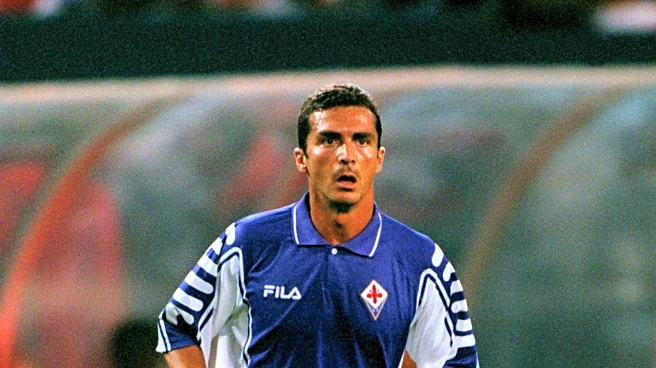
The Cruyff era came to an end in 1996, after which Amor was able to compete in his first-ever major tournament with Spain and score the winning goal against Romania in the Round of 16 – in total, Amor scored four goals in 37 Spain caps between 1990 and 1998. He proved indispensable as Barcelona won three trophies under Bobby Robson, in addition to narrowly missing out on the league title by two points, before spearheading Barcelona to a domestic double under Louis van Gaal in 1997/98. But after competing in the 1998 FIFA World Cup in France, Amor found himself deprived of opportunities at the club level. It’s why, after nearly two decades at the club, he opted to depart Barcelona as the winningest player in club history and start a new chapter at Fiorentina.
“I had a very good first impression of Fiorentina. Serie A was a very strong championship back then; today, the Premier League and LaLiga are the most important leagues, but back then, when matches started being televised, everyone was watching the Italian league. There was a very high level of teams with really good players, you had the ‘Sette Sorelle’ with so many great teams like Roma, Fiorentina, Milan and Inter. The experience was very good; the city of Florence is very beautiful, and I was lucky to have such a great time with so many great players, which was coached by Giovanni Trappatoni. I really enjoyed the day-to-day life of football, because it was all about the ball. The training sessions were rondos, positional games, short matches, and larger games, not full-space games. And it was all a lot of fun to spend time there at a more mature age of 30-32 years old.”
“It’s true that I had to do things a bit differently, with more physical work. I had to run more, I had to train harder, I had to work more in the gym. It was kind of the opposite of everything I had been through with Barcelona, but the experience was very good. The players and teams in Italy were very competitive and always very prepared to play. Serie A teams are always very difficult to beat, whether you’re playing on a Wednesday or a Sunday. They’re very well prepared, tactically astute, and very strong and solid, and very difficult to beat. Italian teams are always very difficult to beat, and when they play you head-to-head, they’re tough. But I can tell you that the experience was very good in many aspects.”
Alongside the likes of Gabriel Batistuta, Francesco Toldo and Rui Costa, Amor proved essential as Fiorentina made it all the way to the Coppa Italia Final, only to lose to Parma. They led the Serie A table for considerable swaths of the season, only to end up relinquishing the Scudetto in the final weeks and finish third; over in the UEFA Cup, Fiorentina were disqualified after a handmade bomb was thrown at an official during a match vs. Grasshoppers. Having made 26 appearances in his first season, Amor’s playing time took a nosedive in 1999/00, registering just 11 appearances for Fiorentina. It’s why he decided to head back to Spain and join Villarreal, where he helped the Yellow Submarine cement their status in the top-flight. Amor then made the move to Scottish side Livingston in January 2003, where he played just three times before calling it quits on his legendary career.
After hanging up his boots at 35 years of age, Amor returned to Barcelona and oversaw La Masia’s development as the Head of Youth Football, before eventually departing in 2007; he returned three years later and worked as the Technical Director of Football Training between 2010 and 2014. But just like others such as Glenn Crooks, Amor always had a burning desire to coach football; it’s why he decided to head across the world and start a new adventure in Australia. After one year as Adelaide United FC’s Technical Director, Amor replaced his compatriot Josep Gombau as the club’s manager, leading them to the A-League Premiership as well as their first and only A-League Championship, before eventually heading back to Barcelona in 2017. He initially administered Barça B and the U19A and B sides, before becoming the club’s new Head of Institutional and Sports Relations for the first team between October 2017 and July 2021.
At 58 years of age, Guillermo Amor has established himself as an icon for FC Barcelona, as well as a memorable figure for various other clubs in Italy, Spain, and Australia. Only time will tell whether he returns to Barcelona for yet another chapter, but one thing’s for sure: Amor will go down as one of the greatest Spanish players to ever put on a pair of boots. He’s cultivated this legacy not merely because of his many successes, but his ability to get back up after being knocked down to the ground.
“I believe that when you work hard to reach your goals, even if you don’t succeed, you’ve got to remain calm. It isn’t a failure if you’ve given your all. On the contrary, if you’ve done everything you can, then you’ve succeeded. Even if you don’t achieve your objectives, it still helps you grow in other areas. Life has its ups and downs; if you fall down, you get back up, and if you lose, then you’ll still win one day. I think that’s what’s beautiful about life.”