
With the 2025 Texas Rangers season having come to an end, we shall be, over the course of the offseason, taking a look at every player who appeared in a major league game for the Texas Rangers in 2025.
Today we are looking at pitcher Carl Edwards, Jr.
It is always kind of fun when a guy who was in your team’s farm system originally, who gets traded and ends up with a significant amount of major league service time, comes back to your team in the twilight of his career.
Edinson Volquez was part of the fabled DVD crew, got traded (along with the immortal Danny Ray Herrera) to the Cincinnati Reds in one of the best trades the Rangers ever made, and had a really good season for Cincy followed be a decade or so of journeyman performance. He returned to the Rangers prior to the 2018 season, signing a two year minor league deal as he recuperated from Tommy John surgery, and then pitching 21 innings over 18 games in 2019 and 2020 before calling it a career.
Jesse Chavez was a 42nd round pick of the Rangers in 2002, got dealt at the trade deadline in 2006 for Kip Wells, and after a decade of surprisingly useful work as a have arm, will travel major league pitcher, spent part of 2018 with the Rangers, as well as 2019 and 2020.
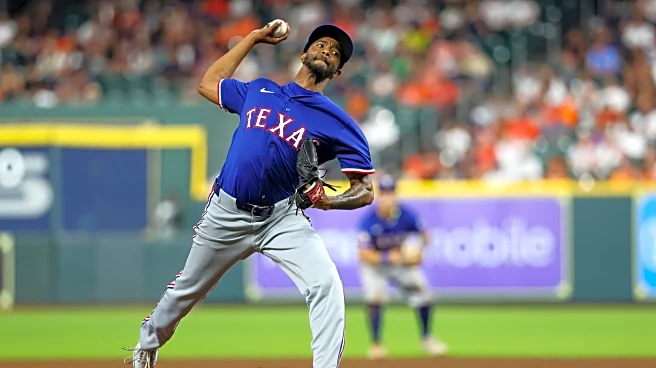
And in 2025, Carl Edwards Jr., the pitcher formerly known as C.J. Edwards, came full circle, pitching in the majors for the first time for the team that originally selected him in the 48th round of the 2011 draft.
The 2011 MLB draft is very interesting to me, as a Rangers fan. The previous two drafts, in 2009 and 2010, the team had been hamstrung in its drafting by the limitations imposed upon it due to Tom Hicks’ financial problems and the team’s subsequent bankruptcy proceedings. Texas ended up being unable to sign 2009 first rounder Matt Purke due to the commissioner’s office nixing their above-slot offer (which the commissioner’s office could do because the Rangers’ finances were being overseen by the commissioner’s office). In 2010, the Rangers had a number of early picks, but went low cost on their first two picks, Jake Skole and Kellin Deglan (who was picked one spot before the Marlins selected Christian Yelich), in no small part because of the ongoing bankruptcy proceedings.
In 2011, however, the Rangers were out of bankruptcy, had new, deep-pocketed ownership, and had just appeared in their first ever World Series. They had a pair of first round picks, and seemed well-positioned to make a big splash in what appeared to be a very strong draft class.
And make no mistake, the 2011 draft class ended up being very good. Six first rounders have surpassed 30 career bWAR — Francisco Lindor, Gerrit Cole, George Springer, Trevor Story, Anthony Rendon, and Sonny Gray. Other first rounders included Javy Baez, Jackie Bradley Jr., Blake Snell, Brandon Nimmo, and Kolten Wong. The late Jose Fernandez was a first round pick in that draft. Dylan Bundy. Michael Fulmer. C.J. Cron. Joe Musgrove. The second round included James McCann, Josh Bell, Brad Miller, Daniel Norris, Austin Hedges, and Nick Ahmed.
The Rangers selected, with their first two picks, Kevin Matthews and Zach Cone, two unheralded prospects who were signed for slot. They never reached the majors. Neither did Will Lamb, Kyle Castro or Desmond Henry, the team’s second, third and fourth round picks. Fifth rounder Brandon Woodruff and sixth rounder Derek Fisher went on to have major league careers, but after signing with other teams, as the Rangers couldn’t reach agreements with them. Ditto seventh rounder Max Pentecost, who was picked 11th overall in the first round by the Jays in 2014.
The top of the draft was a disaster for the Rangers. Not only did their picks not pan out — they didn’t ever even become prospects, didn’t get to where they had any value that could be utilized in a trade.
From the 8th round onwards, however, it was a remarkably productive draft for the Rangers.
Their 8th round pick was the newly retired Kyle Hendricks, who was traded to the Cubs in one of the more unfortunate trades in recent Rangers history. Seven other guys taken in the later rounds ended up making the majors — Connor Sadzeck, Andrew Faulkner, Jerad Eickhoff, Ryan Rua, Nick Martinez, Phil Klein, and a string bean pitcher from the backwoods of South Carolina who went by the name of C.J. Edwards.
Edwards was drafted out of Mid-Carolina High School in Prosperity, South Carolina. Prosperity had a population of 1,180 in the 2010 census, and a population of 1,178 in the 2020 census. According to Wikipedia, there are only three notable people from Prosperity — former federal judge Charles Cecil Wyche, who was born in 1885, former major league pitcher John Buzhardt, who pitched in the 50s and 60s, and Edwards.
Edwards was unusually old for a high school draftee, turning 20 less than three months after he was picked. He was unusually skinny — B-R lists him at 6’3”, 165 lbs., and he probably weighed less than that when he first joined the Rangers. There’s a reason why one of his nicknames, per B-R, is “The String Bean Slinger.”
(The other nickname listed for Edwards is Carl’s Jr. Once he switched from C.J. Edwards to Carl Edwards Jr., it set up the oft-used joke that, when he’s playing east of the Mississippi, he’s known as Hardee’s Edwards.)
And he was unusually successful for a 48th round pick. Making his pro debut in 2012, he dominated both the Arizona Complex League and the short-season A Northwest League. He was a consensus top 50 prospect prior to both the 2014 and 2015 seasons, ranking as high as #28 on BA’s preseason top 100 list heading into 2014.
Of course, by that time, he was a member of the Chicago Cubs organization, having been sent at the 2013 trade deadline, along with Justin Grimm, Mike Olt, and a player to be named later who became Neil Ramirez, to Chicago in exchange for Matt Garza.
This was a trade that wasn’t popular with Rangers fans at the time (I can’t tell you whether it was popular with the Chicago police department). The Rangers had acquired Ryan Dempster from the Cubs a year earlier, for Christian Villanueva and the aforementioned Kyle Hendricks, and Dempster did not work out.*
* Dempster was acquired to replace Colby Lewis in the rotation, when Lewis went down with a flexor strain, and was acquired instead of Zack Greinke, who would have required the Rangers to part with Olt or Jurickson Profar. I will not post yet another 1000 word screed on how the downfall of the early-10s Rangers teams can be traced to Lewis’s elbow injury in 2012.**
** But seriously, it can be.
So now the Rangers were making another trade with the Cubs for a rental starting pitcher. And Garza was perceived by us as having negative vibes, problematic on a team where we were already have to root for A.J. Pierzynski and Lance Berkman, and which had seen Nelson Cruz suspended for PEDs, and had an offense doing its level best to ruin one of the best pitching performances in team history.*
* The 2013 Rangers had a 114 ERA+ on the year, tied with the 2010 team for the 4th best ERA+ in team history, trailing only the 1983 team, the 2011 team, and the 1977 team. If you prefer Fangraphs and ERA-, the 2013 Rangers had an 86 ERA- on the season, tied with the 2025 team for the second best ever, and trailing only the 1983 team.**
** The 1983 team was 77-85-1, despite having the best performing pitching staff in team history. And yes, the offense was bad, but they were also unlucky — their Pythag W/L was 85-77.
Garza ended up making 13 starts for the Rangers, gave up 47 runs in 84 innings, and his most lasting contribution was this gif:
In 2014, while the Rangers were enduring their Terrible Horrible No Good Very Bad Season, the Cubs had Ramirez and Grimm as quality contributors in their bullpen, Olt playing in the majors (albeit not well), and Edwards in the minors as an elite prospect. It seemed destined to be one of the worst trades in Rangers history.
As it turned out, it wasn’t really as bad as we thought it would be. Grimm was an okay reliever for a few years, then wasn’t an okay reliever anymore, and got released by the Cubs in the spring of 2018. Ramirez, whose medicals were never great, had one terrific season for the Cubs in 2014, then was never really healthy or productive for the rest of his career, which saw him play for seven different teams over six seasons. Olt’s biggest contribution to the Cubs was being around to be named the starting third baseman for the Cubs to start the 2015 season, allowing them to send Kris Bryant to the minors to start the season, which gave them an extra year of team control over Bryant.
And Edwards? Edwards had a few good seasons in the pen for the Cubs, before being traded mid-2019 to the San Diego Padres. He bounced around after that, spending time in the majors and the minors, putting up a couple of nice seasons for a couple of bad Nationals teams but never really sticking in the bigs anywhere else. Edwards has appeared in the majors for 8 teams, including the Rangers, and has 300 career appearances. 192 of them are with the Cubs, and 89 are with the Nationals. He has no more than six appearances for any of the six other clubs he’s pitched in the bigs for.
Edwards started the 2025 season with the Angels, got released, and was toiling for Quintana Roo in the Mexican League when the Rangers came calling. He signed a minor league deal with the Rangers on July 22, 2025 — 12 years to the day after the Rangers traded him to the Cubs. When the Rangers needed a live arm in mid-September, they added him to the 40 man roster and called him up. He pitched three scoreless innings over two games in Houston during that three game series where the Rangers’ season was effectively ended. He was DFA’d a couple of days later, cleared waivers, and ultimately became a free agent, once again, at season’s end.
Previously: