

The Arizona Cardinals are the second-oldest continuous pro football team in North America, behind the Toronto Argonauts. However, no team in the NFL is older.
A lot of sports teams have included a color in their team’s name.
Look at today’s landscape to prove this point: Vegas Golden Knights, Toronto Blue Jays, Golden State Warriors, Chicago White Sox, Winnipeg Blue Bombers, Cincinnati Reds, Cleveland Browns, Chicago Blackhawks, Columbus Blue Jackets, Boston Red Sox, St. Louis Blues, Ottawa Redblacks,
and Detroit Red Wings.
RELATED: WHEN END ZONES WERE INVENTED
There have been several defunct teams/names that also used colors: Washington Redskins, St. Louis Browns, Pottsville Maroons, Louisville Grays, California Golden Seals, Cincinnati Red Stockings, Sacramento Gold Miners, Toledo Maroons, Denver Gold, Hartford Dark Blues, and the Chicago White Stockings.

And, the Cardinals. The Racine Cardinals.
Origins
The Arizona Cardinals franchise began at a gym.
Back in the day, gyms were available in cities for men to work out, lift weights, swim, and play games, such as basketball and baseball. Boxing was also a normal activity. These gyms were called “athletic clubs,” which encouraged amateur athletic activities.
A usual activity at these gyms was to form their own baseball team. During this time frame, the sport of baseball was king. Everyone loved baseball. Everyone played baseball while growing up. And everyone loved going to watch baseball, especially at the professional level.
These athletic club baseball teams would compete against adjacent cities and towns. Oftentimes, these were rival cities that had competed for years at the high school level and would get quite heated. So, an adult version of competition among neighboring entities was the next step. As time rolled along, these local athletic club teams represented their city or town, and gave the locals something to boast about to their neighbors.
Entire towns would come out to watch their local team against another town. The local newspaper would write articles about the event, its players, coaches/managers, and sponsors, and talk about “civic good.”

Leagues began to sprout up with teams from one city’s athletic club against another gym down the highway or across state lines. People became familiar with other areas of their region simply because their local baseball team played against them, and often, fans would travel to see them play on the road, which allowed these patrons to get to know local restaurants, hotels, and other amenities and landmarks.
As the sport of American Football began to take hold at the college level, some of these athletic clubs wanted to field a football team in addition to their baseball counterpart. The sports were completely different, and so the game of football required a less refined individual to compete. These men were more rugged, less concerned with getting hurt or getting dirty, for that matter. They liked it rough, and American Football gave them that satisfaction.
Not every man who played for the local athletic club’s baseball team was the type needed to become a member of the athletic club’s American Football squad. But fans seemed to like watching the new sport. They liked how uncultivated it was, and to see grown men hit each other and then fall to the ground, often bleeding.
During this time frame, uniforms were sewn from wool, which was durable but became heavier when they got wet or soaked with body sweat. Padding was achieved by stuffing pieces of leather into pants and sweaters used for jerseys. Pants and sweaters were often mismatched pieces of clothing or multiple fragments piecemealed together, which meant they weren’t exactly the same color.
Chicago’s Southside
On the south side of Chicago, there was a gym called the “Morgan Athletic Club.” One of its members was a local painting and decorating contractor by the name of Chris O’Brien.
O’Brien and his brother Pat set up the football team at the Morgan gym.

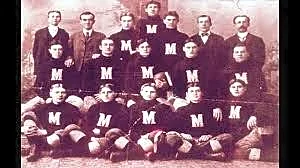
He began scheduling football games against other towns beginning in 1898. Their roster was comprised of gym members, and a few guys that they knew who had played a bit on area college teams such as the University of Chicago and the University of Illinois.
At this time, the NFL was 22 years away from being formed.
Since the Morgan Athletic Club baseball team had been playing other cities and towns for years, it was a natural occurrence to set up games with these same other gyms that had also begun a football team. This often meant traveling by train to other states since American Football was in its infancy and there were few teams.
Early teams were the Pittsburgh Athletic Club, Chicago Athletic Club, Latrobe Athletic Association, Duquesne Country and Athletic Club, Greensburg Athletic Association, Carlisle Indian Industrial School, Detroit Athletic Club, Cleveland Athletic Club, Franklin Athletic Club, Jeannette Athletic Club, Warslow Athletic Club, and Oil City Athletic Club.
The Latrobe (PA) Athletic Association became the first football team to play a full season using only professional players in 1897.

But these athletic clubs didn’t just schedule games against other gyms, but against just about any city or town they could find, especially if the travel time weren’t too long. Harvey, Illinois, had a football team. So did Muncie, Indiana, and Toledo, Ohio. But the closer to their city, the better. This cut down on travel costs, which were predominantly by train. If a team could travel to the game site, play the contest, and then return the same day, all the better.
Every team made its own schedule each year and played as many, or as few, games as they wanted. There were few actual “stadiums” and most games were played in open fields with a rope surrounding them. Patrons were charged a small fee, and the referees and property usage were the only costs. Often, the playing facility was a baseball park or a polo arena. Fixed bleachers were always a huge plus; otherwise, fans stood along the sidelines and at both ends of the gridiron just inches from the playing field.
In Part 2, more name changes, how the team was named after the color, and the first appearance of the cardinal bird is invented. Why was this decided?
Barry Shuck is a pro football historian and a member of the Professional Football Researchers Association