
Prior entries:
Forecasting most players has, well… constrained error bounds. A pretty good player with a point estimate of about 3 WAR might give you a couple more in a great year or lose you three wins in a worse-than-forgettable campaign.
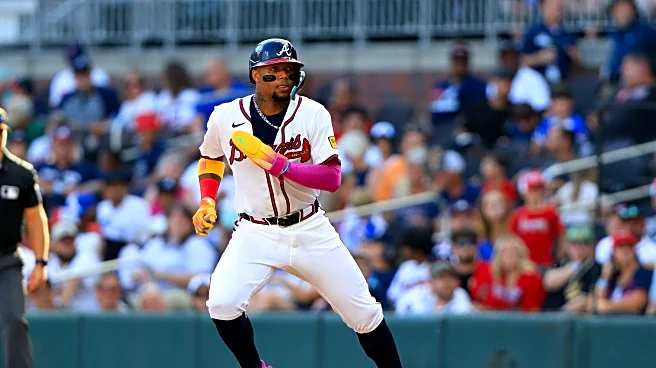
Ronald Acuña Jr., though? He can make your season by himself, if things go his (and your) way. The difference between his MVP-winning 2023 and his unfortunate 2024 was over eight wins in fWAR terms. Eight wins turns a .500 team into a likely playoff entrant. Forecasting
Acuña is probably less scary than facing him as a pitcher, but neither should strike you with confidence or zeal.
Career-to-date, status
Oh boy, how to summarize this? Acuña hit the ground running with over 9 fWAR in his first 1,200 career PAs, and then found another gear offensively in 2022-2021, approaching 7 fWAR in under 600 PAs. Unfortunately, there was that whole ACL injury thing suffered in 2021, and 2022 was an uncomfortably pedestrian season. He rebounded with an MVP campaign (9.2 fWAR) in 2023, socking 41 homers, stealing 73 bags, and putting up an absurd .460 xwOBA — he and Aaron Judge were the only two players that year to eclipse even .450 in xwOBA, and Judge only managed 458 PAs that year. 2024 ended up being a weirdly uncomfortable season for him (a career-worst .350 xwOBA) and he never got a change to dig out of that hole, as he tore his other ACL.
His defense also never really returned to anything useful after his first ACL injury — whether due to his own tentativeness, a direction for him to take it easy in the field, or some combination of the two.
Acuña is in the final guaranteed year of an eight-year, $100 million extension he signed early in the 2019 season, which was the largest contract at that time for a player with less than a year of service time. The Braves hold a couple of $17 million options for him in 2027 and 2028, which they’ll certainly exercise — unless they can somehow find a way to layer on an extension in the process. That seems to be in their favor for the obvious reason that Acuña can change an entire season around for a team given how good he can be, but, of course, the cost effectiveness of any deal that would get him to forgo a shot at free agency looms large. As we’ll see below, forecasting him is kind of a nightmare, so it requires a lot of risk tolerance to work out a solution that will result in fresh ink on contract pages (are MLB contracts e-signed now? I have no idea).
Recent performance
Acuña’s 2025 was weird. He approached a .400 xwOBA, and actually outhit it, the first time he’s outhit his xwOBA since his rookie year. (He has a sizable career xwOBA underperformance.) Still, his “new gear” offensively was notably higher than “just” .400. On top of that, it’s hard to make heads or tails of what exactly he changed (or didn’t) in 2025. He walked a ton, and he explicitly credited Tim Hyers and the team’s changed offensive approach to his ability to garner those walks… but the reality is that his chase rate didn’t really budge, and he had a bunch of contact issues, especially on changeups for whatever reason. When Acuña is going berserk, he’s crushing changeups and sliders as well as fastballs, but the changes he made in 2025 made him much more of a fastball-eviscerator. As noted, he really struggled to connect with changeups, while his contact quality on sliders straight-up died as he was fighting them off and flicking them rather than destroying them like he did earlier in his career. What does any of this mean for the future? I have no idea. Acuña’s ability to make on-the-fly adjustments is one of the many things that makes him a phenom, so there’s no reason he’s locked in to any system or mode of performance.
On the flip side, we can probably figure he’s going to continue to be tentative in the field, and might see a bunch of DH time, especially with Sean Murphy apparently not making it back for Opening Day. Acuña hasn’t been a positively defensively in an outfield corner relative to his peers since before the first ACL tear, and last season was as big of a mess defensively as you’ll see from a guy that isn’t miscast as an outfielder in the first place. Suffice to say: his ability to generate value is entirely on his bat, and moreover, on how well his hitting outpaces whatever he gives away WAR-wise from hanging out in right field or appearing as a DH.
All in all, Acuña managed 3.5 fWAR in 412 PAs last year. Nothing to sneeze at, and really, laudable numbers for nearly any MLBer. His 161 wRC+ was the second-highest of his career, but again, (slight) xwOBA overperformance helped there.

Forecasting
Yeah, I don’t know. To do this well, you not only have to somehow figure whether there’s going to be another catastrophic injury, how many small nagging injuries he’ll get breaks for, how much rest is baked in to his schedule, and even aside from all that, which offensive version of the guy you’re going to get. We’ve had two struggle-y seasons, one coming off injury (2022) and one before an injury struck (2024). Those sandwiched an MVP campaign. As noted above, his 2025 was weird but still good despite the weirdness.

If you’re struck by those numbers being “low” — they aren’t — except the PA tally, which resembles 2025 in point estimate terms. The wRC+ is basically in line with his career, and yeah, the defense is a drag, but it is what it is. My interpretation here is that the big question for Acuña is health — there’s basically a 1.5 WAR swing between figuring he misses up to seven weeks with issues, and he plays pretty regularly, and that matters.

And nowhere is that more evident than in the above chart, where, like Austin Riley before him, there’s this giant gap between the rate of production (which looks normal-ish, if skewed towards lower rates a bit) and how that actually translates into production given that he might once again miss a bunch of time. This bimodal distribution is the stuff of nightmares because of how far apart the two peaks are — that’s basically an entire meaty part of the win curve right there, as a result of one ultra-talented 28-year-old. Oof.
With regard to other systems:
- Steamer has Acuña at a 148 wRC+ and basically the same WAR/600 as IWAG. The issue is, again, whether you discount his playing time at all given his track record.
- ZiPS has him hitting notably better than IWAG/Steamer, and basically a half-win better on a per-600 basis — but also has a PA point estimate of well below 550 PAs. I don’t really know what to do with this, I’m just throwing it out there.
Your turn
Alright, I’ve given you the info. Well, some info. You may have your own info. With that, I ask you:
- Rounded to the nearest fWAR, how much will Ronald Acuña Jr. produce in 2026?
- How confident are you in your choice? Go with a scale from 1-5, where 3 is “I dunno, reasonably confident,” 5 is certain, and 1 is “I am participating but have no confidence in my choice and don’t want the fact that it will likely be incorrect to affect my place in any theoretical standings all that much.”