




During the 4th inning of Wednesday’s second game against the Braves, the Giants’ broadcasters used the occasion of Mike Yastrzemski, current Brave and former right-fielder for Giants, stepping into the box to discuss the defensive skills of his “protegé,” Jung Hoo Lee.
Dave Flemming deemed Lee “a worthy successor.” Javy Lopez described Lee’s play in right field as “fantastic,” with his glove “never a question” when making the transition from KBO to MLB, and a player who’s “acclimated extremely well”
to Oracle’s tricky right corner dimensions.
Here highlights the disconnect between advanced defensive metrics and the good ol’ fashioned “eye-test,” because according to the stats, Jung Hoo Lee’s outfield defense has been far from “fantastic.” In fact, it’s rather sub-par, below-average, even bad.

Baseball Savant rates Lee’s Outs Above Average, a cumulative range measurement, at -2 and arm value at -1 — both around the 20th percentile compared to the rest of the league. Overall that puts his combined Fielding Run Value at -3, in the 15th percentile. His Defensive Runs Saved (DRS) according to the people at Fielding Bible and Fangraphs sits at -3, while he has a -4.5 DEF rating, which accounts for positional differences.
Some would caution using defensive metrics for such a small sample size, and yes, nearly half-a-season can be considered a small sample size, but the robot army of calculators have never fawned over Lee’s work with the glove. In 2025, a year he spent patrolling centerfield, Lee accrued a -18 DRS with a -5 OAA, the meat of one of the league’s worst outfield sandwiches. The shift to right was believed to be more sustainable (he’s definitely hitting like it is) and fitting his natural skillset (strong arm, not incredible range) — but months into the season, the numbers are far from convinced.
Then how did two professional baseball minds like Flemming and Lopez, who get paid to watch and analyze Lee play outfield every day, so emphatically grab the wrong end of the stick? I’m fairly certain they aren’t the only ones either. I wouldn’t use such effusive language to describe his work in the field, but I am certainly surprised by how low Lee’s ratings are, and I’m sure many of you feel the same.
So are we just dumb? Are we paradoxically blinded by our sight? Not to make this debate over Lee’s defensive abilities another theater of war in the heightening conflict between the soul versus A.I., but… do crunched numbers, or our perceived sensory experience, have sole claim on reality?
I guess some perspective would be helpful. First, the classic caveat: Defensive metrics are weird. They all have convoluted ways of measuring information, and they all have their blind spots. Defensive Runs Saved uses human scorers and “zones” to evaluate defensive success rates. Outs Above Average is more of an exact measurement, measuring the specific distance a player needs to travel and how much time they have to catch a ball to calculate “catch expectancy.”
This is how Savant explains it:
“Outs Above Average (OAA) is the cumulative effect of all individual plays a fielder has been credited or debited with, making it a range-based metric of fielding skill that accounts for the number of plays made and the difficulty of them. For example, a fielder who catches a 25% Out Probability play gets +.75; one who fails to make the play gets -.25.”
A low line-drive pulled towards the corner when a fielder is positioned to protect the gap would have an incredibly low catch expectancy, therefore that fielder wouldn’t be charged for not catching it. Similarly, that fielder would be credited handsomely for recording an out on that same play. OAA heaps rewards on exceeding expectations and punishes cruelly those for not meeting it.
Pete Crow Armstong’s league-leading 14 OAA is thanks in part to his 6% success rate added to what was expected (91% estimated success rate to 97% actual success rate). It’s not the routine flyouts, but the catches that defy the odds that have grown his OAA. A’s right fielder Carlos Cortes has achieved a 75% success rate on balls in play he’s responsible for, which is a solid majority of outs — the problem is it’s 10% lower than what is expected. His -6 OAA is tied with Owen Cassie for lowest in the league among right fielders, but he got to that point in nearly half as many attempts as Cassie, meaning he’s made some really big misses that have hurt his rating.
Most outfielders aren’t PCA or Cortes. They aren’t “fantastic,” or “bad.” They do their jobs with few mistakes and few stand-out plays. Lee has not missed a catch with an out-probability higher than 90% this year. He’s also only made two catches on balls with an out-probability lower than 80% (considered three-star plays or higher based on Savant’s scale). PCA has made 16 so far; Right fielder Corbin Carroll has 12.
16 of 34 qualified right fielders are within 2 outs (plus or minus) of 0 Outs Above Average. If you look at this year’s OAA leaderboard for right fielders it’s clear how slim some of these margins are between defenders. Mike Yastrzemski’s nominally better -1 OAA compared to Lee’s -2 OAA ranks in the 41st percentile, nearly twice as high as Lee’s current standing. Brewers right fielder Sal Frelick’s 0 OAA ranks in the 57th percentile. The reality is Frelick, Yaz and Lee are in the crush of average defenders, and there isn’t really much that separates them in terms of performance.
For Lee, his “deficiencies” can be traced back to a pair of fly balls that fell in front of him in the same inning about a month ago.
In the 5th inning on May 15th in Sacramento, Shea Langeliers flipped a Tyler Mahle fastball towards right field. The contact wasn’t solid at all. He was late and got under it. Lee was positioned deep and pinched towards center, about 100 feet from where the ball eventually landed, near the right field foul line. But the ball hung up in the air for more than 5 seconds, plenty of time to race over and get under it. Lee didn’t. He first broke back, got a late break, and the ball fell oddly close to his feet for a single. Two batters later, Brent Rooker lobbed another into right that stayed airborne for 3.4 seconds and landed only 37 feet from where Lee was positioned — and yet again, the right fielder played it on a bounce.
My friend, Stu from Auburn, was at that game and texted me that from his vantage point behind home that both singles seemed catchable. He was right. Langeliers’ single boasted a .080 xBA with a catch probability of 85%. Rooker’s an even lower .070 xBA, with a catch probability of 90%.
Those two “drops” by Lee took a 1.75 chunk out of his OAA total. It would take roughly 18 straight outs on similar fly balls, or just two incredible 5-star catches, for him to make up the loss. The OAA numbers for Lee aren’t wrong, they’re just unflinchingly cold.

Cold, unfeeling — this is why we have numbers! They’re proof of Lee’s faults when it comes to initial jumps, routes, and closing speed. Both the eye test and numbers test didn’t look too kindly on Lee in Sacramento, and yet there were still variables to consider. Neither forms of assessment took into account the time of day, the low light stands of the Triple-A stadium, the park’s lack of an upper-deck, the tricky wind patterns that progressively got worse throughout the series, or most importantly, the game situation. Down 2-runs in the 5th, the defense’s main prerogative was to keep the deficit manageable. Nick Kurtz had just hit a lead-changing 3-run homer. Laying out for Langeliers’s bloop and missing it could’ve turned a single into a triple, or worse. Selling out on a dive rather than keeping Rooker’s ball in front of him could’ve allowed Langeliers to score from first.
Discernment — that’s Lee’s default defensive approach, which, ironically, can be hard to discern. Some might describe his style as “conservative” and “risk averse” to a fault. He’s very much a successor to Mike Yastrzemski in this regard. Play smarter, not harder. Be fundamentally sound, not overly flashy or emotive. Study the field, understand its quirks. Know your limits. Field within your means.
The primary goal for Lee in right field is to do his job and stay healthy, something he didn’t do in 2024 when he slammed into the centerfield wall, dislocated his shoulder and missed four months of the season. No out, or run saved, or highlight clip is worth that injury. That’s a reasonable perspective to have overall, if not a little soulless. Playing in the outfield should be about exuberance. It’s a vast and open field — fans want to see some frolicking! Lee doesn’t frolic. He tiptoes, airing on the side of caution too frequently, especially at balls in front of him, and while our eyes often forgive him, the fielding metrics have punished him for it.
This doesn’t mean Lee eliminates all risk. We’ve seen recently how willing he is to take chances when the game calls for it, or when he knows a teammate will benefit.
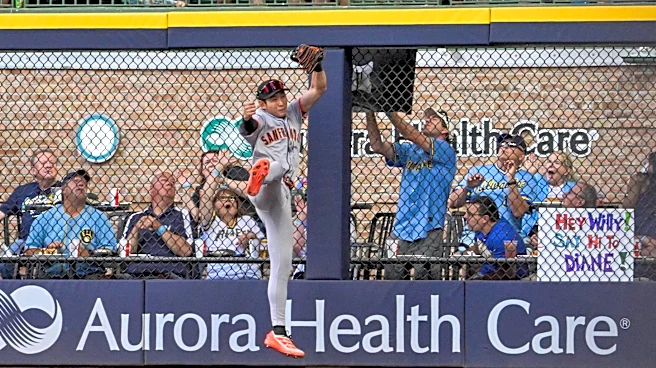
On May 29th, Lee tracked down a liner off the bat of Kyle Karros that led him into Denver’s right field wall. It had an xBA of .310, a catch-probability of 75%. Most importantly, reeling it in would end the inning and keep a run off the board, helping keep the Giants’ lead (which didn’t last) while pushing Logan Webb through another frame in his return from the injured list.
On June 14th, he felt emboldened once again as Webb tried to finish off the 8th in a dominant performance against the Cubs. Michael Busch’s liner into the corner would’ve gone for extra bases, knocked in a run, and chased Webb off the mound if Lee hadn’t tracked it down.
A great play. Lee’s best in 2026, according to the numbers and to the eye. The out’s 55% catch-probability is the lowest of the year, and how he chased after the baseball with abandon, throwing his glove out at the last second, rolling into the brick wall, consequences be damned. Now that’s defense with some soul!