
Some time in the not too distant future, an NBA superstar will emerge from China. It’s a mathematical certainty considering the country has 300 million people who play basketball and has already produced one Hall of Famer in Yao Ming.
Nearly as certain is that this future superstar whoever he — or she — will have been touched by Joe Tsai’s growing presence in Chinese basketball. The Nets and Liberty owner has taken on the responsibility of finding that player and developing him — or again her — whether
providing opportunities for middle school students to attend U.S. high schools, playing for a team in the Asian University Basketball League he’s financing … or maybe getting high level experience with his teams in the G League, NBA or WNBA.
Three male Chinese players — Team China’s Jackie Cui and Fanbo Zeng as well as Hong Kong’s David Muoka — have already gotten court time on the men’s side of the Tsais’ basketball apparatus. So has one woman — Han Xu — who played 58 WNBA games for the Liberty and may again. New York still holds her WNBA rights.
Hiantian “Jay” Li, who Tsai describes as “running the program for me,” is open about the plan. China was once dominant in Asian basketball, winning the FIBA Asia Cup nine years out of 10 not that long ago and developing a number of NBA players including Yao and the Nets’ Yi Jianlian. But the rise of basketball in unlikely places like Lebanon and Iran plus a reorganization of FIBA so that Australian and New Zealand teams are now part of FIBA Asia have hurt. But the larger issue, Chinese basketball experts concede, is long-term development of all that potential.
Now, though, Tsai is involved and has put a new slant on development. No longer will Chinese basketball be developed solely through state-run sports schools, but through his auspices as well and that means the American model writ large.

Li, 36, is indeed an ideal manager for Tsai’s ambition. He’s been in what he calls the “basketball industry” for the last 16 years. His career began after college in Rochester, N.Y. at the NBA league office in Secaucus as an intern, working in global media distribution and international business development.
After four years with the league, the Beijing native moved back to China where he became Yao Ming’s chief of staff at the Chinese Basketball Association. Ultimately, he, Tsai and Yao worked together on the Tsai scholarship program.
By 2020, Li was managing director of Tsai’s scholarship program and five years after that, with financing from Tsai, he had become the CEO of the Asian University Basketball League, Tsai’s six-country, 12 team league with the goal of creating an “NCAA system for Asia.” Like Tsai, he has an entrepreneurial streak.
The scholarship program was initiated in 2019 just before the NBA and China had their big falling out over then Rockets GM Daryl Morey’s famous tweet.
“Yao Ming and Joe are aligned on the idea that in order to develop more basketball talent from China it’d be great to have a program where kids could be sponsored and go study in the U.S. That was kind of the original idea which is still the idea today.” Li told NetsDaily in an exclusive interview.
It’s become the first rung on the ladder of Tsai’s strategy.
FIRST RUNG: BASKETBALL SCHOLARS
At the beginning, it wasn’t called the Joe Tsai basketball scholarship. It was called the CBA Elite Overseas program, but the idea was the same. By 2021, following the Morey incident and the rise of COVID, the CBA and Tsai decided to formally rename it and also change the management structure so that it was less dependent on the CBA and more under Tsai and Li’s control.
“It has always been boys and girls. The program has always been open for anyone from China that is between the age of 13 and 15 – like middle school students in basically seventh grade or eighth grade,” said Li.
“What we do is similar to a high school or college application. You submit an application online, then we do an initial screening and we pick a number of kids, like 60 kids in November, December where we do a tryout at a three-day training camp. We run drills, we do scrimmages and we have experts committee to review the kids and then we decide. We do English tests.”
The program is centered in Hangzhou, home of Alibaba, the giant Chinese e-commerce, AI and cloud company Tsai heads. It gives him an opportunity to add a personal touch to the process.
“Joe’s been very very involved. First of all he cares about it. It’s part of the Joe Tsai Foundation whose theme is promote the integration and importance of sports in education,” said Li. “For the past three years, he’s been attending the training camp. That shows a big commitment.”

However, as Li and others point out, China has a history of separating the athletic from the academic at an early age. It’s not just a basketball challenge, Li admits. There are cultural issues. Academics and athletics don’t always mix in the minds of Chinese parents.
“In Chinese culture, historically in the last decade if you want to become an athlete, a professional athlete you have to quit school early on in your life to go into a professional athlete training program. That’s not the case in the U.S. where for example you stay in school and you play basketball at school. Joe really cares about sports can play a big part in education and you should not separate them.”
Both Cui and Zeng, the one-time Nets, developed their basketball skills using that route as did Yao a generation earlier.
Indeed, Tsai’s personal journey has driven the scholarship fund’s priorities. At age 13, his father, one of Taiwan’s top lawyers, sent him to Lawrenceville School outside Princeton where he played football and began a lifelong love affair with lacrosse, which he continued at Yale. He credits sports with his business and personal growth and recently built a $40 million lacrosse training center.
As Li said, “that was a key element of his life, of sports helping to shape who he is” and he uses his experience as Yale-educated business leader to persuade parents that their children can succeed at both. Harvard-educated NBA champion Jeremy Lin is another example Tsai cites and one who works with him.
“I’m just thrilled that I get to help talented kids from China to play top-tier basketball at high schools in the U.S. while they get a sound education and build strong character,” said Tsai who is not at all shy about his intentions, both from a basketball and cultural perspective.
“I’ll do anything to help develop young basketball talent from China,” he told ND. “I believe the best way is to immerse young people in a well-rounded educational environment while playing high level team basketball.”
And Tsai being Tsai, his involvement is very hands-on and multi-faceted. For example only does he provide scholarships to U.S. schools but he also set up a program in China to reward those who agree with his athletics+ academics strategy He’s even set up the Sports Principals Program through his Joe Tsai Foundation.
“Basically, he selects ten very distinguished middle school and upper school principals a year,” said Li. “He honors them for emphasizing the sports in their daily management and leadership in their schools He rewards 10 of them every year.”
So far, so good. Of the 28 players selected by the program over the past five years, none have dropped out. Some from the first group are now in college, while others are playing professionally. Several recipients have also represented China on national and international stages, according to the CBA. At the moment, 24 recipients are playing in the U.S. schools.
The support isn’t just financial. Li runs a team of professionals who work not just with the players but with some 4o U.S. schools, coaches, principals and the parents back home.
The fund’s biggest name so far is Sinan Huan, a 7’1” defensive-oriented center from Beijing who committed to Purdue this year after spending four years at Georgetown Prep in Washington on a Tsai scholarship. Sinan was a 4-star high school recruit this year and has been a member of China’s national teams, setting FIBA records for blocks.
He was attracted to the Indiana school because of its record of developing bigs. (Ironically, Purdue’s most prominent big man of recent vintage is Zach Edey, who like Tsai is of Chinese heritage and carries a Canadian passport.)
The NBA, said Li, has been a big supporter.
“They’re very supportive of the scholarship,” Li noted of the NBA. “Every year they send staff to our training camp and every year, of our judges one judge is from the league on our scholarship panel. Every year at the training camp we have American coaches — high school level coaches — helping out.” But not Nets or Liberty coaches, so far.
FROM MIDDLE SCHOOL TO COLLEGE BALL
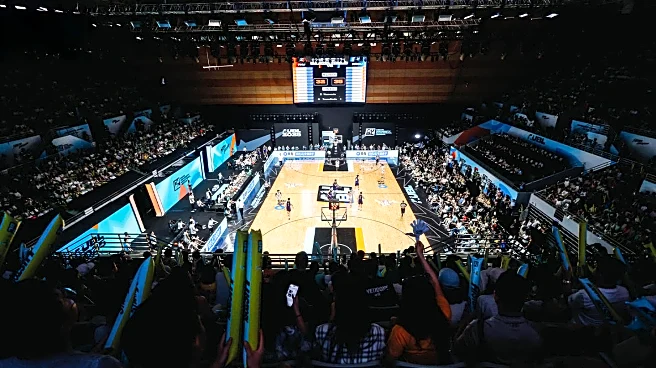
For those stars and others who don’t make it to U.S. universities, Tsai has the Asian University Basketball League. Last year, he pumped at least seven figures into the first year of AUBL operations which brings together 12 teams from six Asian countries: China, Hong Kong, Japan, South Korea, Taiwan and Mongolia.
Li would not directly address the question of whether Tsai’s plans will ultimately lead to more Asian players on Tsai’s NBA and WNBA clubs, but instead spoke of things in a larger crucible, the worldwide basketball “ecosystem.”
“Having more talent from Asia is definitely a priority for the NBA and the WNBA overall, not just the Nets and Liberty,“ said Li. ”If we can cultivate talent, good talent so that one day they can be eligible for the NBA Draft, any team can draft them. So what we are doing here, what Joe is supporting is investing into the infrastructure of Asian basketball and among NBA owners, nobody else knows Asia better than him. He feels responsible to the NBA to invest in the infrastructure in Asia. He’s doing this for the NBA.“
It’s also part of the general internationalization of the NBA, particularly in Asia. Mark Tatum recently noted that preseason ratings for Portland Trailblazers rookie Hansen Yang’s games outdrew the NBA Finals last June!
The AUBL is a different animal than the scholarship fund. It is intended to be money-making venture with Tsai as the lead investor. It mirrors what he’s done with the two professional lacrosse teams in the U.S. that he supports. It was something Li dreamed up with Tsai as his advisor and mentor.
“For past four years, I’ve been thinking about creating more regional competition for Asia. Asia is a very important market for the NBA and for the global basketball business or ecosystem. but there’s a need for Asia to have better competition.
“So I had a conversation with Joe. He is also super excited about this. He thinks college basketball in Asia is a great example of education and sports, where education meets sports. We want to promote the culture of college basketball.”
Tsai had previous experience with American college basketball. Alibaba had promoted a partnership with the PAC-12 a few years back where teams played regular games in China. (When LiAngelo Ball, then of UCLA got busted for shoplifting, it was Tsai who got him out.)
Tsai and Li moved quickly, setting up a Final Four-like tournament, again in Huangzhou, last August as a preliminary to a full schedule.
“We had a tournament this year we six countries from mainland China, Chinese Taipel (Taiwan), Hong Kong, Japan, South Korea and Mongolia but we will expand into more countries and regions in Asia next year,” said Li of the AUBL Showcase who noted rivalries, essential to any college sports, are being encourated. “We’ll have home and away games across many major cities in Asia, in Tokyo, Seoul, Shanghai, Beijing, Taipei, we’re going to have games in all those cities.”
Again, Tsai made sure there was an academic connection, Li told ND.
“Tsinghua and Peking universities are regarded as the Harvard and Yale of China and they’re not only the Chinges Ivy League schools, but they do have the best basketball programs in China. It’s interesting because so many of our parents are concerned about education,” said Li.
“The goal is to truly create a robust ecosystem of college basketball in Asia where we will have many more countries and regions participate from those countries and regions. You will have multiple conferences so we elevate the level of college basketball and becoming kind of a central platform where kids can look up to as somewhere where they want to play basketball.”
There’s already an AUBL high school program , with the first AUBL Hoops Scholars debuting in Hong Kong a few months back. The purpose: “build pathways — connecting elite coaching, high-level training environments, and the next generation of aspiring players,” per the website. And Li says, they hope to set up a women’s AUBL within three years.
Beyond the court, Li told ND the plan is to produce “entertainment for general audiences” … at a profit.
Li said that the AUBL’s mini-series last August had been seen by streamed by more than 15 million viewers across Asia. It drew two billion Internet impressions. The NCAA Final Four was seen by 16 million. There’s a bit of apples and oranges to that comparison, but as Li noted, there’s a combined media reach of over 500 million people.
Bottom line, said Li, is that Tsai’s plan is about “trying to develop that American style system where there’s a high school – college – pro pathway. The European soccer system where kids go into youth clubs at a very young age and drop out of school isn’t around in China. We think it’s important not to drop education. We’re trying to build everything that could help with the school pathway.”
What about criticism that Tsai is helping Team China, a competitor to Team USA? Li dismissed it and let’s face it: Tsai may be a native of Taiwan who holds Chinese citizenship, married a native of Kansas and holds degrees in economics and law from Yale. But he is, by heritage, a Chinese patriot.
“I don’t see there’s a competition when it comes to basketball between the U.S. and China. U.S. and China are competitors in many different fields but are also partners in other fields,” said Li. “But there’s no competition for the NBA or the WNBA. Rather it’s centered around that ecosystem and the pinnacle of that ecosystem is the NBA and the WNBA. They are creating a global ecosystem where talent is developed not only in the United States anymore but everywhere.”
He said as well that Tsai sees basketball and sports as a way to deal with and possibly quell geopolitical tensions.
“There are geopolitical tensions at times of course, but sports, culture and entertainment are always great forums of how people interact with each other.”
(Tsai and his wife, Clara Wu Tsai, have also pushed youth development in New York, opening the Brooklyn Basketball Center for Brooklyn youth across from Barclays and financing a citywide basketball training program with the Board of Education that works with 40,000 school children a year.)
NETS, LIBERTY TO BENEFIT?

Whatever benefit Tsai’s two pro teams in the U.S. gets will ultimately have to be filtered through the NBA’s gatekeeper function, the draft and free agency. Don’t expect the Nets and Liberty to benefit — at least directly, Li told ND.
“As someone who has worked both sides, for the NBA and the CBA, I understand wholeheartedly that basketball is a global ecosystem. You cannot take the NBA or WNBA out of the vacuum and say they’re on their own. The NBA now is almost 50% of the players come from overseas.” (The number this season is actually about a third.)
“You know if some of those talents can help Chinese basketball to grow, eventually, whether its players or coaches or referees or lead office staff or journalists, they all contribute which will benefit the NBA and the Nets and Liberty. Everything is interconnected.”
Going back to when he bought control of the Nets as well as Liberty, Tsai has said he’d like Chinese players on his teams.
“I have said, I’ve been on record saying if there’s good Chinese players, I would do anything to help them come — if they want to come play in the NBA,” Tsai told NetsDaily back in May 2019. “I would do anything to help them do that.”
CHINA’S TEAM
The Nets and Liberty’s relationship to China is both broad and deep. The Nets are the only team that’s traveled to the People’s Republic four times, twice before Tsai bought in, twice after. Its offerings on Weibo, the big Chinese social media site, attract a following or around 7.3 million fans. That’s behind only the Lakers and Warriors. They have finally surpassed the Rockets, Yao’s team, rejecting the notion that Chinese basketball loyalties were forever tied to Houston.
As the Macao News reported at the time of the NBA China Games in the city, Tsai wants to make Brooklyn “China’s Team.” It could also be argued that he’s making China the Nets nation. Fans have active fan blogs … and arguments that mimic those in the U.S.
There’s money to be made by everyone.
Alibaba and the NBA agreed this fall to an AI partnership with Tsai’s company, the goal “driving personalization and archive storytelling.“ Said Tsai at the time of the deal, “Use China as a lab for content creation and social distribution. Then bring the innovations back to the US, since China is far ahead in this space.”
At the other end of the spectrum, Brooklyn Sports & Entertainment have helped set up “Cheer Nets,” a Chinese version of the Brooklynettes complete with choreographer that will perform at events throughout China, expanding the brand in a different way. The team members were selected in a mini-series on TenCent, one of China’s big streaming service.
Most important for fans, there are benefits to players that could make Brooklyn more attractive. Virtually every NBA superstar benefits from Chinese revenue streams: deals from sneakers and other gear to more intricate business investments. BSE has its own Chinese Business Strategy Group. This past summer in the build-up to the NBA’s return to China, more than a dozen All-Stars, from LeBron James to Victor Wembanyama to D’Angelo Russell made highly successful marketing trips to China. It should also be noted that not long after he was drafted, Egor Demin set up a presence on Chinese social media. Having a Chinese presence in the ownership suite can’t hurt the Nets in free agency going forward.
There are risks as the Morey incident showed but a lot more possibilities as the NBA China Games showed. Their NBA/WNBA positions also give the Tsais more prominence in China basketball and sports in general. There’s little subtle about it. The revival is just the latest iteration.