

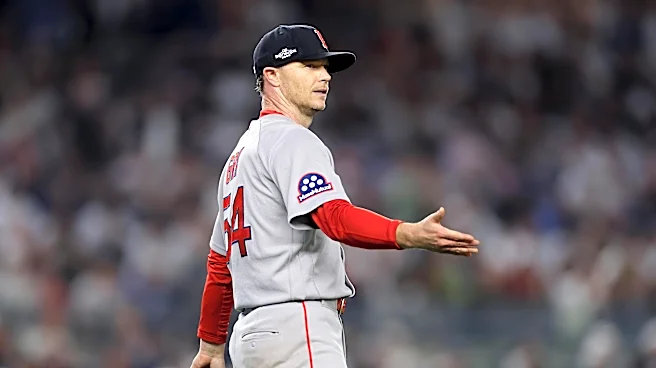
Yankees outfielder Trent Grisham has been nursing right hamstring issues since the summer. Two injured list stints and many missed games later, the problem appears to be mostly behind him, as he was activated on time for the AL Wild Card Series against the Boston Red Sox. We say ‘mostly’ because, even though the Yankees have deemed him healthy enough to play, we have no idea if he’s actually close to 100 percent, and the one thing we know for sure is he didn’t seem fully himself in the first series
of the postseason.
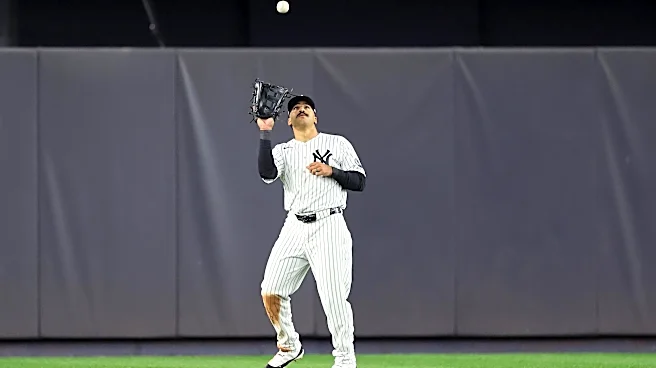
He was fine at the plate, notching two hits and a walk in Wednesday’s Game 2, but he didn’t look the part in center field. He has been far from his 2020 and 2022 Gold Glove-winning versions in the last two seasons, but the image he projected in the Wild Card round was much, much worse.
Consider this play in particular:
The Athletic’s Chris Kirschner noted that Grisham’s sprint speed when attacking and fielding that ball was 23.5 ft/s. He was so slow that Nate Eaton took advantage and turned it into a double when it should have been a single. For reference, Kirschner reportedthat just three players had a slower average sprint speed than that this season, and all of them are what you would consider slow catchers: Christian Vázquez, José Trevino, and Sandy León.
Of course, the fact that he was so slow to the ball doesn’t necessarily mean that he can’t run faster. Maybe he was too confident and didn’t think Eaton would go for it. Or, perhaps, he was still tentative when running because he didn’t want to risk aggravating an injury that was already deemed a Grade 2 hamstring strain just over a month ago.
In any case, it’s definitely cause for concern. The Yankees would be better off handing regular center field duties to rookie Spencer Jones, who is younger and more athletic, and only using Grisham sparingly at the position if needed. This is not to say he should or shouldn’t be on the AL Division Series roster, but he is just not a starting center fielder at the highest level anymore. Not with two straight years of subpar performance there, not with a bum hamstring, and certainly not against the Rays.
When you face a team like the Rays, used to maximizing its strengths and attacking the opposing squad’s weaknesses, every little detail counts. Having a well below-average defender cover the most important outfield position regularly is, at this point, in this series, and against this particular rival, malpractice.
Grisham used to be a very, very solid defensive center fielder. The two aforementioned awards prove it. However, his decline started in 2025, when he finished with -11 Defensive Runs Saved (DRS) and -2 Outs Above Average (OAA) in center field. The 2026 campaign wasn’t much better. He posted -8 DRS and -6 OAA this year, in 961.1 innings. Evidently, he doesn’t have the range he used to have, and the hamstring(s) could be behind his regression with the glove. This season, Grisham ranked in the 18th percentile in Fielding Run Value, even worse than last year’s 30th percentile. His lousy range (OAA) had him in the 10th percentile.
The fact that he’s about to turn 30 — center fielders tend to decline relatively quickly with the glove — plus his injuries, have led to Grisham not being the defensive player he used to be. He suffered a left hamstring issue last year and experienced countless setbacks with the right hamstring in 2026.
Grisham’s bat and, especially, his power can still make an impact against top competition. The same can’t be said about his glove, and the Yankees should act accordingly.