



Analytics nerds have long had access to a statistic known as WPA or “Win Percentage Added.” This statistic uses a model based on historical data which tells you approximately how likely you are to win a game based on the current game state. If you’re up by 3 points with 1:48 remaining in the game and about to kick off to the other team, your odds of winning are almost exactly 50%. If you are up by 4 in the exact same situation your odds of winning rise to 70%.
WPA has become famous (and somewhat infamous)
lately when teams stage large comebacks, and we hear reporters say things like “the Bears won despite Green Bay’s odds eclipsing 98% at some point.”

WPA is useful for identifying the big moments in a given game, or when things really turned for one side or the other. WPA is not particularly useful for identifying “clutch” players or finding predictive value for how people will execute going forward. However, when discussing field goal kickers, WPA should be top of mind, because unlike every other position in football, field goal kickers are extremely high leverage players, and while WPA is probably the best way to quantify how important kickers are, it actually understates how important they are fairly drastically.
We’ll get to why that is, but first, let’s deal with all of the smack talk.
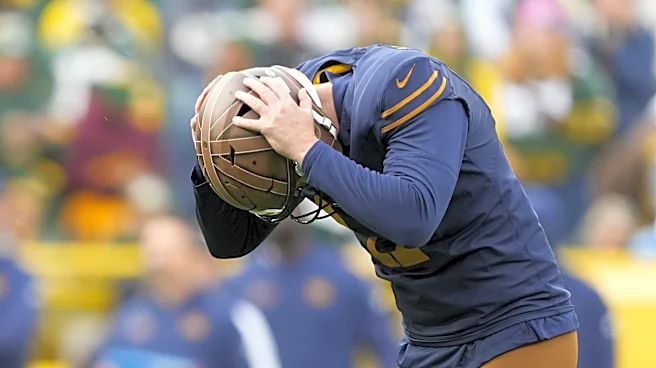
I’ve seen much criticism targeted at Green Bay for both drafting a kicker in the first place, and sin of sins, trading up for him, and I just wanted to say that the people making that argument are nuts. Don’t get me wrong, the Packers have been absolutely terrible at selecting and signing and scouting kickers in the post-Crosby era and they absolutely do not deserve the benefit of the doubt.
They drafted Anders Carlson, the Casey Urlacher to Daniel Carlson’s Brian, probably because Rich Bisaccia knew Daniel. The random guys they do find, like Lucas Havrisik, have stunk (depsite Havrisik’s franchise-record hit last year). And they held on to Brandon McManus mostly because of his stupid outlier 2024 season where he hit 95.2% of his field goals after never once hitting more than 85.7% in any other season despite spending most of his career in Denver. They are VERY bad at this. They are in fact worse at this than those of us here at Acme Packing Company, who tried desperately to help, but to no avail.
But the first step in recovery is admitting you’re you have a problem, and that’s what this pick was. As I have a ton of experience kicking field goals, I am expertly qualified to comment here, and so let’s hear your whiny, faux-nerd complaints, and deal with them one at a time.
1. Drafting a kicker is bad because on average drafted kickers don’t provide value over free agent or UDFA kickers.
You CAN find kickers anywhere, that’s true, but it’s getting more difficult because the rest of the league figured this out before Green Bay did. There is an old economist joke (which isn’t funny because economists are not funny): Two economists are walking down the street. One sees a twenty-dollar bill on the sidewalk. Neither picks it up, because if it were really there, someone would have already picked it up. See, not funny.
Anyway, Brandon Aubrey is the 20, and all the Brandon Aubreys have been picked up. Harrison Mevis is a Ram. The streets are littered with Lucas Havrisiks, sure, but those are not 20s, they are pennies that have been stomped into discarded chewing gum. Can you pick it up, clean it off, and use it? Yes. Is it worth it? No it is not. Will you feel bad about it and have to spend 15 minutes washing your hands? Yes you will.
And there’s another issue for the Packers. If you’re a free agent kicker choosing between teams, do you want to head to the climate-controlled confines of Jerry World or sunny LA, or kick in the windy 15-degree outdoor stadium in the far North?
Finally, the value proposition is all true for the average kicker, but the Packers don’t employ an average kicker, they employ Brandon McManus, a terrible kicker entering his age 35 season. They should be exploring every avenue possible for a new kicker. Sure, you can find a kicker “anywhere” — but “anywhere” includes the late rounds of the draft!
2. But trading up?
My dude, seventh round picks are worth less than nothing. They are the Doughy’s Pizza of draft picks. They could have literally traded five of them and it still would have been a good idea, because having five seventh round players on your team is a bad sign, because seventh round draft picks are usually not very good at football.
3. But the high variance of kickers means that year to year, you can’t even count on a “good” kicker! Brandon Aubrey finished 19th in FG% this year and now makes like $8 million! Why not just sign some guy and hope?
I should do the hard statistical work, and maybe I will, but I’m pretty sure in the current NFL that kicker value actually matters WAY more than our traditional valuations capture. For starters, kickoffs are important again, and being able to land the ball deep in the landing zone consistently is worth a lot, especially if you can do that funky knuckle side spin kick thing. Aside from that, kickers like Aubrey have expanded what is possible on distance kicks, and having a kicker who CAN sometimes knock through a 58+ yarder versus one who cannot is a real advantage, especially in end-game situations.
But even though Aubrey fell to 19th in FG%, you also know Aubrey is still good, and that his FG% requires a ton of context, including the fact that he was perfect from inside of 50 yards! And over 50, because he’s Brandon Aubrey, they ask him to try some insane kicks, which artificially pushes down his percentage.
4. But the average WPA split from best to worst kicker is tiny, like a third of a win! We drastically overrate how often it comes down to the kicker. Again, just find a guy.
And here is where I think WPA is worth using and understates kicker value. Take the book Bringing Down the House by Ben Mezrich, about the MIT blackjack team (Note: Please do not watch the comically whitewashed movie, which is terrible). Their betting system involved one expert card counter reading the deck, but never changing their bet, and then when the deck became extremely favorable to players, signaling to a team member who was pretending to be a drunken rich idiot out partying. That person would swoop in and make a huge bet or two, and then resume partying. This helped them to avoid detection, but it also highlights the importance and the value of a small number of EXTREMELY high-leverage plays.
Leverage is important, and the MIT team of math geniuses obviously understood that very well, but in football, we sometimes misunderstand a few key issues around leverage. It’s probably true that over the course of the regular season, even a bad kicker will only cost you a win or two in a worst-case scenario versus an average kicker. But of course, not all wins are equal, and treating them as such is dumb because of how likely kickers are to be key players in extremely high leverage situations. Kickers are the pretend-drunks circling the table, waiting to be called in when it matters most.
Now, it also doesn’t really matter if the Jets kicker misses all of his field goals. The Jets are terrible, and their wins don’t matter. (Note: Jets kicker Nick Folk was actually incredible, leading the league in FG% at 96.6, with his only miss coming from outside of 50, where he went 7/8. He was also perfect on PATs. He was probably worth 2-3 wins of WPA. 2-3 extremely pointless wins.)
But the Packers play in an extremely competitive division and just barely eked into the playoffs at 9-7-1. When your playoff margin is within a game (or a half game, stupid tie), a win is not simply a win. A win is HUGE. I’m not even sure how to quantify it. “Marginal win” doesn’t cut it for me, and I wish there was a better term for a win that is the difference between making and not making the playoffs. Like a MegaWin. Or a RizWin, for the young folks out there?
And playoff games? They’re even MORE of a “win.” They’re like 10 wins. When it comes to the NFL season, playoff wins are, I would argue, the entire point.
The Packers lost to the Bears in the playoffs by a score of 31-27. I do not blame Brandon McManus for missing his 55-yard attempt at the end of the first half, as kicks like that are dicey even for great kickers. However, having a great kicker would have at least allowed for the possibility of a make. And leaving that kick aside, I do blame McManus for honking a PAT in the fourth quarter, creating a 27-16 lead instead of a 28-16 lead, and then missing a 44-yard field goal with three minutes left in the game. If McManus makes that PAT, it’s possible that when the Bears scored a few minutes later they just kick the PAT (though I still think they go for two). It drastically alters the dynamics of the game.
But even if the Bears did go for and convert the two-point try, if McManus makes his next field goal it’s a seven point game, and Chicago’s next touchdown gives them a tie instead of a four-point lead. Then, instead of needing a touchdown to win on their next drive, the Packers would have just needed a field goal. The game ended with the Packers on the Chicago 28-yard line. And this isn’t the first time a missed kick has cost them recently! Against the 49ers in the 2023 playoffs, the Packers lost by three in a game where Anders Carlson missed a 41-yard field goal. There are a LOT of people who believe that Jordan Love has come up short in the playoffs multiple times, but if the Packers had better kickers, the narrative would be completely different.
It’s hard to quantify exactly how much McManus’ misses cost the Packers in that playoff game even with the WPA model, as every play impacts what would have happened in the future. But returning to my original example, the difference between the Bears being up 30-27 versus 31-27 with just under two minutes to go was about 20 points of WPA. The 44-yard miss cost them 9 points of WPA per the model. I think it’s fair to say that between the two kicks/four points that they left on the table they probably lost something like 20-30 WPA points. And how does one value a kicker costing his team a fifth to a third of a playoff game with stats alone?
Maybe Brandon Aubrey misses those kicks as well. Maybe. No kicker is perfect, but I know that in a high leverage situation, I would rather have the MIT blackjack team of Brandon Aubrey versus the drunk idiot on his bachelor party that is McManus. Even if the per-hand edge conveyed by card counting it relatively small, sometimes the hand is worth an insane amount.
The Rams would put an end to the Bears the following week in a 20-17 overtime thriller. The Rams were somewhat similar to the Packers as they started the season with Josh Karty (whom they selected in the 6th round of the 2024 draft) kicking for them. He was terrible, making just 10/15 field goals while also honking three PATs. He was relieved of his duties after November 2nd and replaced with Thiccer Kicker, and APC favorite Harrison Mevis, who went on to hit 12 of his 13 regular season FG attempts and all 39 of his PATs. In the playoffs he was perfect, hitting all 6 FGs, all 9 PATS, and knocking through a 42-yarder in overtime to put the Bears away.
The lesson shouldn’t be to not draft kickers. The lesson isn’t about Karty or new Packer kicker Trey Smack. Harrison Mevis was just as available to the Packers as he was to the Rams, and if Green Bay had picked him up, it’s very possible the Bears’ season would have ended a week earlier than it did. The lesson is that kicker is actually super important, and you should not stop looking for a good one via all player acquisition methods until you have one (and once you do, never let him go).
I have no idea if Trey Smack will be any good (though I am hopeful based on this analysis), but at least the Packers are likely moving off one of the worst kickers in football and trying to improve one of the highest leverage positions on what should be a contending team. Paying a couple of sevenths for the opportunity is fine.