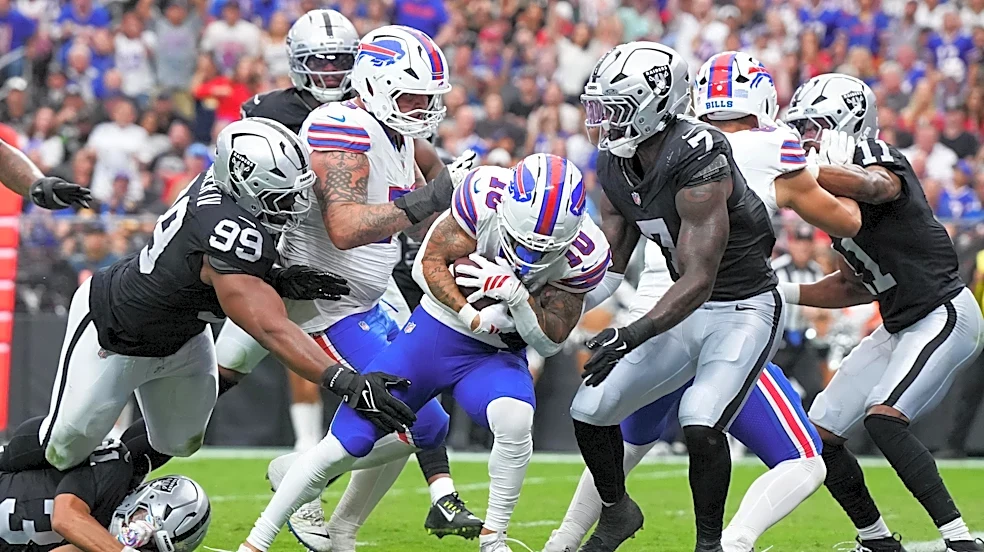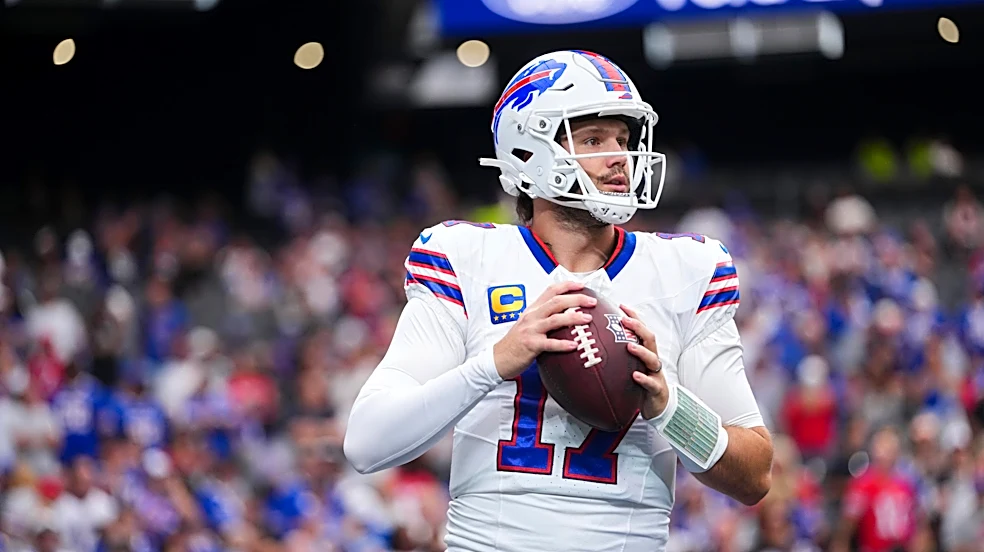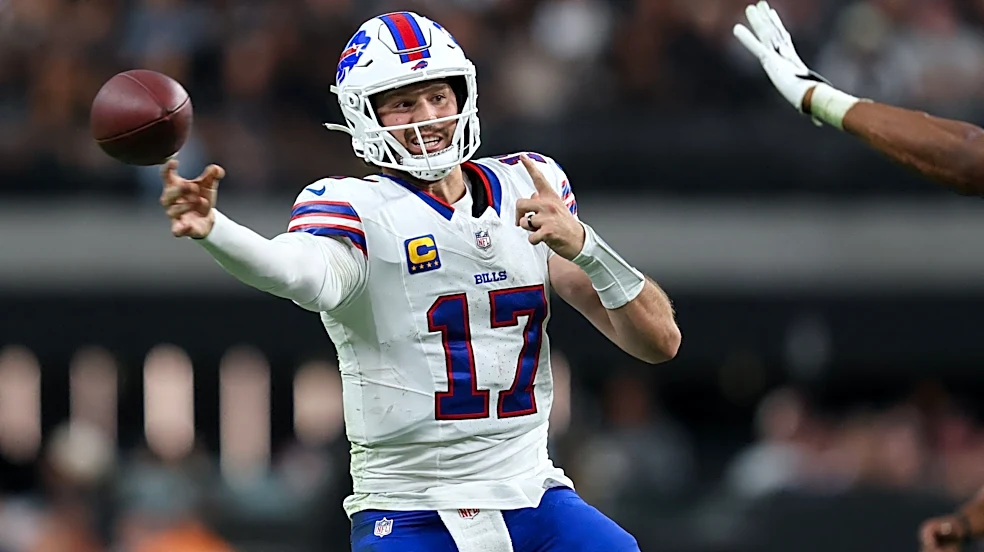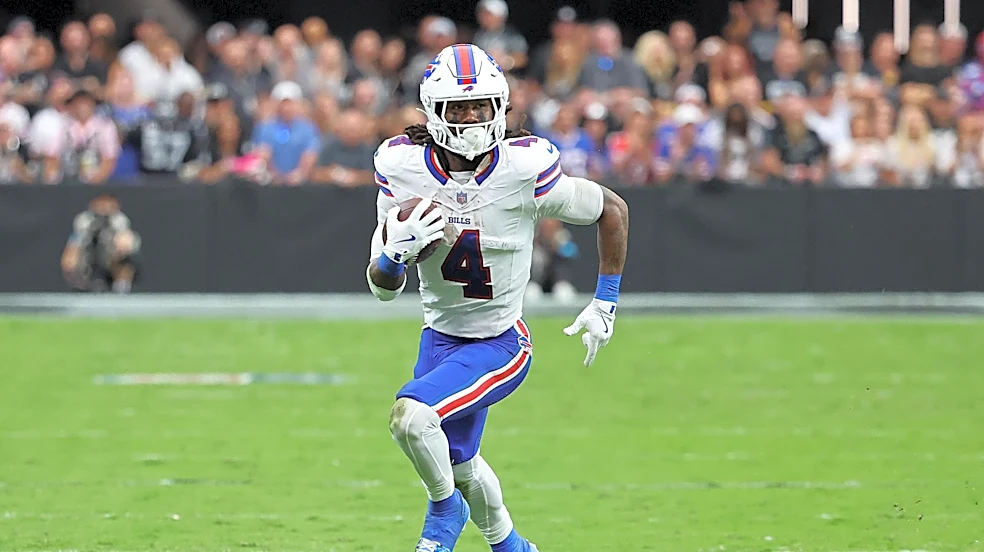




To be fair, the Las Vegas Raiders’ run defense against Buffalo Bills running back James Cook was a mismatch heading into the Week 6 contest. Cook came into the matchup averaging more than 11 yards per game than he did while winning the 2025 rushing title
, and the Raiders’ run defense ranks 18th with a negative 0.07 EPA per rush this year, according to Sumer Sports.So, it shouldn’t come as much of a surprise that Cook had 22 carries for 95 yards and a touchdown in Las Vegas. However, the breakdown
of his production via Sumer Sports is mind-boggling.
- Vs. light box (6 or fewer defenders): 2 carries, 5 yards (2.5 YPC)
- Vs. standard box (7 defenders): 5 carries, 16 yards (3.2 YPC)
- Vs. heavy box (8 or more defenders): 15 carries, 74 yards (4.9 YPC) and 1 TD
In other words, the Silver and Black had more success stopping the running back when they had fewer defenders dedicated to him. How does that happen?
For good measure, Cook’s yards per carry against a heavy box is in line with his average for the entire season (4.9), but the two other figures above were well below his production in the first five games: 6.8 ypc versus a light box and 5.5 versus standard. Also, his avoided tackle rate was about 10 percent lower on Sunday: 14.6 percent to 4.5 percent.
These numbers simply don’t make sense, so let’s flip on the tape to answer the question above.
We’ll start with a couple of positive reps to help add some context into why the Raiders were successful using a light box against Cook.
Buffalo comes out in 11 personnel and in the shotgun with back offset on the weak side, while Las Vegas is in nickel and has just six defenders in the box. Defensive coordinator Rob Leonard gets creative with his play call by having the linebackers cross paths, where Dean crashes downhill and attacks the strong side A-gap while Quay Walker wraps around and replaces Dean on the weak side B-gap.
That action throws off left tackle Dion Dawkins’ angle climbing to the second level, and Dean does a great job of sinking his hips to redirect and make the tackle for a short gain. A well-timed play call by the coordinator and well-executed by the linebacker.
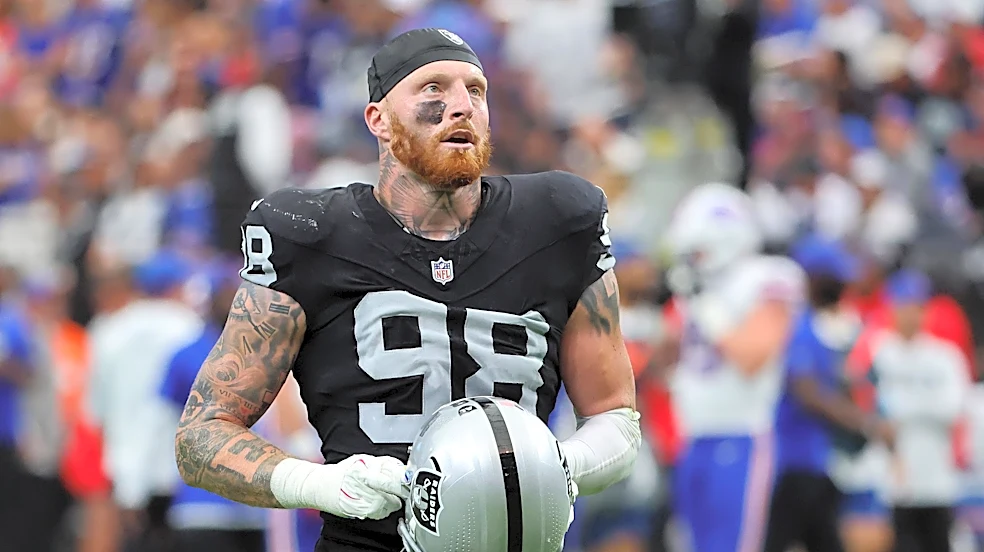
Another big factor in the Raiders’ run defense on Sunday was that Maxx Crosby was fairly hot and cold throughout the game. For example, Pro Football Focus had him accounting for four ‘defensive stops’ against the run but a season-low 55.6 grade as a run defender. He doesn’t make the tackle/stop here, but he does have a really good rep that helps set up Dean and defensive tackle Foley Fatuaski to make the play.
The Bills are in 12 personnel and run toss outside zone to the two-tight end side of the formation, while the Raiders are in nickel personnel with safety Jeremy Chinn in the box as the weakside linebacker and Walker on the line of scrimmage as the outside linebacker on the strong side edge.
Walker manages to set the edge, and Crosby (who is playing as a 6-technique defensive end) manages to split and defeat the combo block between the right tackle and tight end to take away the C- and D-gaps. Also, Adam Butler has a nice rep as the 3-technique defensive tackle, where he gets some push against the right guard and runs his feet to eliminate the B-gap. All of that forces Cook to cut back side.
Meanwhile, Dean does an excellent job of mirroring Cook, and Foley Fatukasi (as the back side one-technique) has a similar rep as Butler, resetting the line of scrimmage and running his feet to beat the left guard’s block. As a result, Dean and Fatukasi meet the running back in the hole for a short gain.
On the opposite end of the spectrum, this is an example of a negative rep from Crosby’s afternoon. Buffalo tries to run inside zone to the weak side of the formation. However, the back side cutback lane is open for Cook, partially because Crosby gets pancaked by a combo block from two tight ends. But the defensive end is far from the only problem the Raiders have on this rep.
For some reason, Leonard wasn’t matching personnel on Sunday. To his credit, that didn’t come back to bite Las Vegas in the running game too much throughout the game, but it did on this play.
With Las Vegas in nickel against this three-tight-end formation, Chinn is the weak-side edge defender and defensive back Taron Johnson is in the box as the MIKE linebacker. That’s two defensive backs playing out of position and in spots where they’ll have to take on or defeat blocks in the running game.
Post-snap, Johnson crashes too far downhill and abandons the back side A-gap that he’s responsible for. That’s likely a result of lacking linebacker instincts since he’s out of position, and could also be symptomatic of Chinn trying to set the edge against an offensive tackle. Granted, with Malcolm Koonce and Thomas Booker IV plugging up their gaps, Chinn doesn’t become much of a factor on this play despite struggling to anchor.
The problem is, no one is in the back side A-gap until 3-technique defensive tackle Jonah Laulu gets his shoulders turned and washed inside by the combo block from the right guard and right tackle. In other words, Laulu is in a bad position, too. Combine that with Crosby getting taken out of the equation, and Cook gets an easy five yards on the ground.
This is a similar play call from Buffalo, only they come out in 11 personnel and a condensed formation with two wide receivers next to the tight end on the strong side instead of two more tight ends. But the Bills still call a weak-side inside- or mid-zone run that Cook hits on the back side. That being said, one tweak really throws the Raiders for a loop: one of the wide receivers motioning across the formation.
Initially, Las Vegas is in a great front to stop Cook. Focusing on the second level and Johnson: Chinn has the weak-side B-gap, Walker is in the strong-side A-gap, Dean can account for strong C, and Johnson can either fit inside the outside receiver’s block or close the gap with the receiver and stay on the edge.
However, instead of having cornerback Hezekiah Masses follow the outside receiver across the formation, the second level of the defense shifts to the weak side so that Chinn can cover the receiver if it’s a pass play. As a result, the Raiders have four defenders on the weak side, including two (Chinn and Walker) who are covering the B-gap, allowing the Bills to get a hat on a hat with their backside blocks.
Additionally, JJ Pegues (the one-technique nose tackle) gets widened by the center, Booker gets pushed into the second level as the strong-side 3-technique, and Dean fits to the wrong side of his block. That gives Cook a cutback lane right up the gut for a nine-yard gain.
We’ll wrap up with another toss outside zone out of 12 personnel from the Bills.
The Raiders stay in nickel personnel again, which puts Walker on the edge and pushes Crosby inside as a 6-technique defensive end. This time, Walker doesn’t set the edge against the outside tight end, and Crosby gets pinned inside by the combo block from the right tackle and inside tight end. Additionally, the inside tight end picks up Dean and gets vertical movement on the linebacker, while Butler (the strong-side 3-technique defensive tackle) gets reached by the right guard.
That makes Cook’s read about as easy as possible, hitting the play exactly where it’s designed for a chunk gain and first down on the ground.
In summary, Buffalo’s success on the ground was a combination of the Vegas’ defense not putting itself in good positions to stop the run despite loading the box and an overall lack of execution from several defenders, even ones the unit has been able to rely on this season.