

With the losses of Robert Garcia, Kyle Finnegan, and, most recently, Jose A. Ferrer, in the past year, the Nationals’ bullpen is in much worse shape than it started the year, though the farm is better off for it. Pending any free agent additions or other trade subtractions, the Nats will enter 2026 with an incredibly young bullpen unit, with just one arm projected to be in the bullpen over the age of 29, being the 30-year-old Julian Fernandez. This leaves a lot on the shoulders of the returning arms
to carry a unit that was the worst in all of baseball last season, and at the forefront of the cast of returning arms is righty Clayton Beeter.
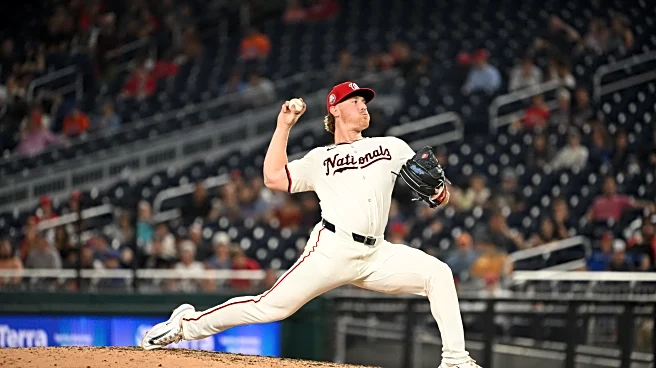
Acquired for Amed Rosario at the trade deadline this season, Beeter made 24 appearances for the Nats in August and September, and was perhaps the Nationals’ best reliever during that time. Across 21.2 innings, he had a 2.49 ERA, 2.72 FIP, struck out over 13 batters per 9 innings, and posted 0.5 fWAR. The strikeout stuff was the key for Beeter, as he posted one of the best whiff rates among all relievers in baseball at 32.9%. Beeter also excelled at limiting hard contact, as he allowed an expected batting average of just .200, and an average exit velocity of 88.3 MPH.
One of the most impressive parts of Beeter’s success was the fact that he was getting it done with just 2 pitches: his fastball, which averages 96.5 MPH, and his slider, which gets an impressive 41 inches of vertical drop. The fastball is a sturdy pitch, often setting him up well for his breaking ball later, but the slider is his best offering, as it had devastating results in 2025, such as a .098 opponents’ batting average, 49.1% whiff rate, and .216 opponents’ slugging percentage. Similar to Kyle Finnegan and his splitter, Beeter can throw hard and will do so, but he’s looking to get hitters out with his slider.
The main issue for Beeter in 2025, and practically his whole career, has been allowing free passes at a high rate. Part of the reason the Yankees were willing to let an arm like Beeter with impressive stuff and solid results go was the fact they couldn’t count on him to throw strikes consistently, and while his strike-throwing improved in his short first stint in DC, it still is the major flaw in his game. While you could live with his 16.7% walk rate if it meant continued results in the future, the reality is an inability to consistently find the zone lowers Beeter’s floor compared to other relievers and makes him hard to count on in high-leverage situations.
So what can the new Nationals coaching staff do to turn Beeter from a high upside arm currently to a future setup man or closer? For starters, they should do as much tinkering as possible in the offseason and winter to find tweaks in Beeter’s game to throw more strikes. Whether it’s an arm angle change, changing up his timing, or a mindset change on the mound, they should explore all avenues they can to get Beeter to fill up the zone as much as possible, as when he does, he’s proven he is very difficult to hit.
The next step I would take is exploring a third pitch that Beeter can add to his arsenal. Having 2 pitches works when both are working for you on a given day, but when you’re having a bad day and one of them is off for you, you become very predictable as hitters sit and wait for that other pitch, a tale we saw told with Kyle Finnegan many times. Ideally, he adds a pitch to give him a boost against lefties, such as a changeup or splitter, as that was the side that gave him the most trouble in 2025, posting a .345 wOBA against him versus righties who posted a .195 wOBA.
Lastly, an easy step the new Nationals coaching staff can take towards improving Beeter’s performance is just tweaking his pitch usage so that he is throwing his best pitch most often. Like practically all Nationals pitchers under Jim Hickey, Beeter was throwing his fastball more than any other pitch, despite his slider being the substantially better offering.
Beeter’s slider has the ability to terrorize right-handed hitters, and yet for some reason, he was throwing it 49% of the time against them, with the other 51% being his heater. Nationals fans saw this story play out when Kyle Finnegan left the Nats for the Tigers and immediately saw improvement due to increased splitter usage and less fastball usage, and Beeter could see the same kind of jump in results if he is simply allowed to use his best pitch the most.
I am excited to see all the little changes and improvements the new Nationals coaching staff is able to make with all the current players on the roster, and Beeter is near the forefront of that when it comes to arms I want to see changes made to. I believe with the right tweaks and additions to his repertoire, Beeter will be ready to take over the closer’s role one day for the Nationals.