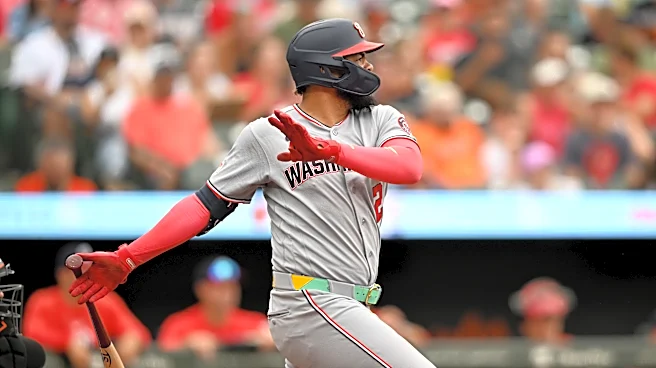






After Luis Garcia Jr. had what seemed like a breakout season in 2024, where he posted a 110 wRC+ and played above average defense at second base for the first time in his career, resulting in a 3.0 fWAR year, his numbers came crashing back down to Earth in 2025, posting a 91 wRC+ and playing subpar defense at second base, resulting in 0.7 fWAR over the full season. Entering 2026, his 7th season in the big leagues, many fans hoped he could at least come close to recreating the magic he had in 2024, or else
his future with the Nats was in question with a new front office in town.
Things didn’t click for Garcia Jr. right away this season, as he posted a 76 wRC+ through March and April while struggling at his new home defensively, first base. Some frustrated fans, including myself, called for him to either be benched or DFA’ed, believing there were options in Triple-A for the Nats who could provide more value than Garcia Jr. was. Things started to click, however, in May for him, posting a strong 123 wRC+ and hitting 4 home runs, and he has gone ballistic in June, with a staggering 207 wRC+ and 11 home runs for the month.
So here we are in late June, and Luis Garcia Jr. has a 131 wRC+, the 33rd highest in all of baseball, 10th highest amongst first basemen, and 3rd highest on the Nats, behind only James Wood (143) and CJ Abrams (138), whom he has become within range of passing soon. How has Luis Garcia Jr. found another gear offensively in his 7th season in the major leagues? By not centering his game around hiding his weaknesses, but around exemplifying his strengths.
Luis Garcia Jr. has, and likely will always be, a chase hitter, running a below-average chase rate his entire career, often in the bottom 10th percentile among all big league hitters. Counter to what you may expect, however, some of the best seasons of Garcia Jr’s career have come when his chase rate is at its highest, with a 9th percentile chase rate during his breakout 2024 campaign and a 6th percentile chase rate this season.
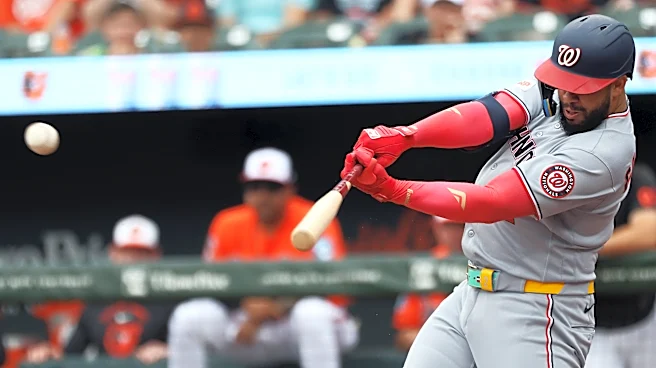
Garcia Jr’s chase rate has risen 3% from 2025 to 2026, and his walk rate is a 4th percentile 4.1%, but what he is doing is swinging the bat harder, with his average bat speed rising 1 MPH, hitting the ball harder, with a 91st percentile average exit velocity of 92.4 MPH, and lifting the ball more than ever, with his average launch angle rising from 9.2 to 11.6. Rather than trying to plug one of the holes in his game, and hurting his skillset as a result, Garcia Jr. has made swinging hard and doing damage to the pull side his focus in 2026, and it is paying off in the form of a career year.
So what is the next step for Luis Garcia Jr.? Offensively, if there is a way for him to draw more walks while still providing the same power output he is currently, that would be ideal, but I wouldn’t dare mess with what he has going on right now. Defensively, Garcia Jr. has work to do at first base, as his -4 OAA ranks in the 13th percentile among all first basemen, and getting to even league average would help out both the Nats and Garcia Jr. himself tremendously.
With just a year and a half of service time remaining, Garcia Jr. may be a trade piece for Paul Toboni and the front office if they decide selling is best for the future this trade deadline. If we’re nearing the end of his tenure as a Nat, it has been a pleasure to see him develop and grow, from when he was a fresh-faced 20-year-old debuting in front of zero fans in 2020, to a slugging first baseman on the best Nationals club of his big league career. Whether he’s a Nat or not moving forward, he will be a player I look back on fondly when I look back on the 2020s as a decade for the Washington Nationals.